P&ID Symbol Diagram Basics - Part 2

International P&ID Standards


1. P&ID International Standards Summary

As you have read, there is more than one standard that defines the different symbols that allow you to design a P&ID diagram. As always, if we want to define our internal standard of plant, it is better to read the content of all the standards and select the best of each one of them.

It is also important to take as a reference standards that ensure an update of their content based on the evolution of technology, this ensures that our reference p&id standard always provide a solution to the different representation problems that will arise over the years.

Whatever the choice of a reference standard is a decision that will condition the plant documentation for a long period of time, this implies that the change of standard or reference will be complex or practically impossible.

As reference, over 8 years after the release of ANSI/ISA-5.1 in 2009 most companies are still using only PIP PIC001 or ISA-5.1 1984 for their P&ID diagrams.

Claro, aquí tienes el texto convertido a formato Markdown, respetando los enlaces y la estructura original:


Other related articles:

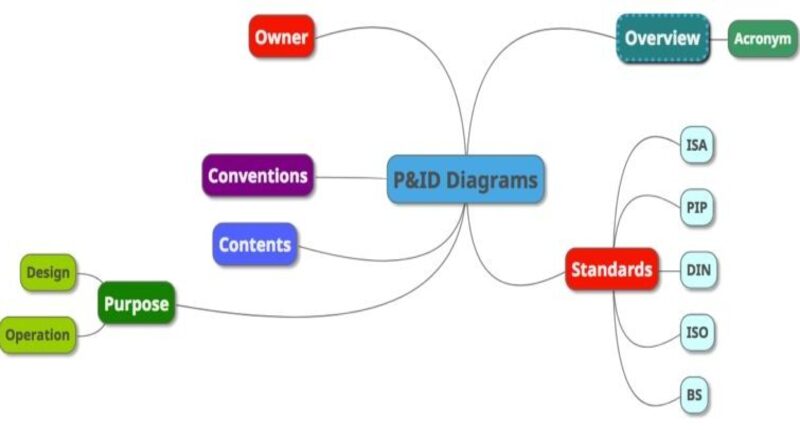
P&ID Diagram Basics PART2 P&ID Diagram - Mindmap showing the contents of the article

P&ID Diagram Basics PART2 P&ID Diagram - Mindmap showing the contents of the article

This article is a summary of the different existing standards on the symbology and methodology to create a P&ID. Some of these standards, such as the ISA, are more than 20 years old and have been considered, in the absence of other documents, as de facto standards in the international industry.

As a general rule, the standards mentioned in this article are used as reference documentation in the process of creating process plant standards. Each plant/organization adapts the content of these standards to its own internal standard by selecting the most significant material that best suits its purposes, thus generating its own internal rules.

If, on the other hand, we do not have these internal rules and there is no established standard in the plant/organization, normally the symbology is usually based on the ISA-5.1-2009 (R1992) standard, which is an excellent, flexible document that defines, primarily, instrument symbolism.

P&ID diagrams must be designed systematically and uniformly within a company. Firstly, the development and implementation of a P&ID project always involve professional engineers from various departments.

The revisions on the P&ID diagram allow to reflect the changes of the process and it is essential that they follow some rules whenever a revision is necessary. A P&ID diagram with incoherent formats leads to confusion and misunderstandings on the part of process technicians.

Based on the above reasons, a complete set of standards must be determined before the development of P&ID diagrams, either to create a P&ID diagram by hand or on a computer.

These standards define the format of symbol and identification label for each component of the P&ID diagram. P&ID diagram symbols are graphical representations for process components, e.g., equipment, piping, and instruments.

Identification labels are a combination of letters and numbers used to uniquely recognize a process item. Currently, there are many standards for instrument symbols and lettering abbreviations of the P&IDs. The most common ones comprise the PIP, ISA, ISO, BS, and DIN standards.

Below are the different organizations that have developed guides or standards on the P&ID symbology:

  • ISA – Instrument Society of America
  • DIN – Deutsches Institut für Normung
  • PIP – Process Industry Practices
  • ISO – International Standards Organization
  • BS – British Standard

2. Which are the P&ID standards?

2.1. ISA Instrument Society of America

Instrument Society of America

Instrument Society of America

2.1.1 ANSI/ISA-5.1-2009, Instrumentation Symbols and Identification, is generally used in the instrumentation and control field to document projects/assets

This standard lets a person with a basic knowledge about process control to understand what measurements are available in the installation and understand how control over the process works by interpreting the documents and drawings of the process.

One important function this standard performs is to provide a standard list of line symbols to be used in the documentation process.

ANSI/ISA-5.1-2009 Instrumentation Symbols and Identification latest version has significant changes over the previous version ISA-5.1-1984 (R1992). This release includes new and evolving Instrument Technology, Control Systems and Computer Networks.

The latest version of American standard ANSI/ISA-5.1, Instrumentation Symbols and Identification, is approved by Standards and Practices Board of International Society of Automation (ISA) in 2009. This standard describes the instrumentation symbols and their identification systems. This drawing standard introduces a consistent mechanism that comprises identification schemes and graphic symbols in order to describe and identify instruments and process items and their functions. The ISA standard is widely applied in commercial process software, which is used for measuring, monitoring and controlling actual process production (ISA, 2009).

2.1.2 ANSI/ISA-S5.5-1985 Graphic Symbols for Process Displays

The purpose of this drawing standard is to establish a system of graphic symbols for displays that are used by plant operators process measurement and control. The system is intended to promote:

a. the fullest and quickest comprehension by the operators of the information that is to be conveyed through the display, and b. uniformity of practice throughout the process industries.

Resulting benefits are intended to be:

a. a decrease of operator errors, b. a shortening of operator training, and c. generally better and easier matching of the information transmission intent of control system designers with the reception and interpretation of results by plant operators.

The drawing standard is suitable for use in the chemical, petroleum, power generation, air conditioning, metal refining, and numerous other industries.

2.1.3 ISA (1983) S5.3 Graphic Symbols for Distributed Control and Shared Display Instrumentation Logic and Computer Systems

The purpose of this standard is to establish documentation for that class of instrumentation consisting of computers, programmable controllers, minicomputers and microprocessor-based systems that have shared control, shared display or other interface features. Symbols are provided for interfacing field instrumentation, control room instrumentation and other hardware to the above. Terminology is defined in the broadest generic form to describe the various categories of these devices.

It is not the intent of this standard to mandate the use of each type symbol for each occurrence of a generic device within the overall control system. Such usage could result in undue complexity in the case of a Piping and Instrument Drawing (P&ID). If, for example, a computer component is an integral part of a distributed control system, the use of the computer symbol would normally be an undesirable redundancy. If, however, a separate general purpose computer is interfaced with the system, the inclusion of the computer symbol may provide the degree of clarity needed for control system understanding.

This p&id standard attempts to provide the users with defined symbolism and rules for usage, which may be applied as needed to provide sufficient clarity of intent. The extent to which these symbols are applied to various types of drawings remains with the users. The symbols may be as simple or complex as needed to define the process.

2.2. DIN Deutsches Institut für Normung

DIN LOGO

DIN LOGO

2.2.1 DIN 19227 Part 1 Control Technology Graphical Symbols and Identifying Letters for Process Control Engineering Symbolic Representation for Functions

This document defines graphical symbols for the basic representation of process instrumentation and controls including conventional measurement and control equipment. This standard applied to the preparation of design documentation for process control engineering incorporates existing measurement, operation, and control instrumentation (DIN, 1993).

This drawing standard is issued by German Institute for Standardization.

2.2.2 DIN 19227 Part 2 Control Technology Graphical Symbols and Identifying Letters for Process Control Engineering Representation of Details

This p&id standard deals with the detailed representation of the functions as specified in DIN 19227-1. This standard is issued by German Institute for Standardization.

2.2.3 DIN 40700-40717

Set of standards designed to deal with the representation of several standard graphical symbols. This set of standard are issued by German Institute for Standardization.

2.3. PIP -Process Industry Practices

PIP LOGO

PIP LOGO

2.3.1 PIP PIC001 (2008) Piping and Instrumentation Diagram Documentation Criteria

Process Industry Practice PIC001 (2008) Piping and Instrumentation Diagram Documentation Criteria has symbols for Process Piping and Equipment as well as Basic Instrumentation Symbology.

This standard contains symbols for pipes and process equipment, as well as basic instrumentation symbology, and we can use this document to create a complete P&ID.

The PIP standard ( PIC001) is related to the ISA standard ( S5.1), since it uses the same instrument symbols defined by ISA, although it is advisable to use both standards to allow a more up-to-date representation of the different control systems. These standards are complementary and the use of both allows us to define a more complete and easier to understand P&ID diagram.

The industry group Process Industry Practices (PIP) is an association of a series of member companies, with the aim to harmonize the internal standards of member companies for design, construction, and maintenance. It establishes a set of harmonized documents as Practices in various process disciplines such as power, pulp & paper, and pharmaceuticals.

The P&ID standard issued by PIP is enclosed in PIP PIC001, Piping and Instrumentation Diagram Documentation Criteria, which defines the P&ID format (drawing size, item layout, tag format, text arrangement, etc.), symbols, drafting rules, and tagging and numbering scheme for the equipment (tanks, exchangers, pumps, reactors, etc.), piping (piping lines, valves, and fittings), and instrumentation and controls (controllers, control valves, transmitters, Interlocks, relief devices).

2.4. ISO International Standards Organization

International Standards Organization

International Standards Organization

2.4.1 ISO 14617 Graphical symbols for use on mechanical engineering and construction drawings, diagrams, plans, maps and in relevant technical product documentation

The P&ID standard published by the International Organization for Standardization (ISO) technical committees belongs to the standard series ISO 14617, graphical symbols for diagrams. The purpose of ISO 14617 is to develop a library of the harmonized graphical symbols for diagrams used in technical applications.

The sections associated to the P&IDs involve:

  • 14617-3 specifies graphical symbols for functional connections, pipelines, and connection joints
  • 14617-4 specifies graphical symbols for basic elements in the actuator, complete actuators, and actuating devices in diagrams
  • 14617-5 and 14617-6 specify graphical symbols for measurement, and control devices and functions. Specifies symbols for measurement and control loops in diagrams using symbols and naming conventions.
  • 14617-8 specifies graphical symbols for valves.
2.4.2 ISO 10628-1- 2014 Diagrams for the chemical and petrochemical industry

This standard does not contain instrument and control symbols but defines the physical sequence of process equipment and systems.

2.5. BS British Standard

BS British Standard

BS British Standard

2.5.1 BS 1646 (1979-1984) Symbolic representation for process measurement control functions and instrumentation

The main purpose of this standard is define a set of basic symbols for process computer, interface and shared display/control functions. It is divided in four different parts.

British standard BS 1646 (1-4) has been developed by the Industrial process measurement and control standards committee of the British Standards Institution (BSI) from 1979 to 1984.

This drawing standard provides a set of symbolic representations for process measurement control functions, and instrumentation.

The standard is presented in four parts:

  • The part 1 and part 2 create a symbol system which involves a series of the graphical representations describing the functions of measurement and control equipment in a process. This system only clarifies the identification of the instrument functions without affording approaches of depicting specific instruments.
  • The part 3 specifies instrument symbols, such as signal lines, measurement devices, for use on interconnection diagrams.
  • The part 4 specifies symbols for the representation of the process computer and/or shared display/control functions in process measurement and control. The symbols can be used in conjunction with the symbols given in the part 1 and part 2 of BS 1646.

2.6. Related Standards

  • BS 3939 British standard
  • ANSI Y32.2 American Nacional Standards Institute
  • NEMA ICS Nacional Electrical Manufactures Association
  • CSA Z99 Canadian Standars Association
  • IEC Pub. 117 International Electrotechnical Commission

Download our free PDF file about this article!

  • Instrumentation and Control.net
  • Rating: 4.4701 - 1421 reviews
We have prepared this complete PDF so that you have all the information we give in this article and you can share it, discuss it with your colleagues, and use it professionally. Having the content in PDF format allows you to access it offline, print it easily, and keep it well-organized for future reference.
We consider that it is better to have a well-formatted text that includes all the key concepts explained in this publication, ready to share or save for later use. A PDF ensures that the layout remains intact across different devices and makes it easier to annotate or highlight important points.

Information and Definitions


ANSI/ISA-5.1

ANSI/ISA-5.1 is a widely used American standard that defines the symbols and identification methods for instrumentation and control systems in process industries. It provides consistent graphical representations of instruments, control functions, and interconnections used in P&ID diagrams. This standard plays a critical role in ensuring clear communication among engineers, technicians, and maintenance teams, especially in complex industrial projects. Its standardized approach minimizes confusion and errors in system design and interpretation, making it essential for safe and efficient plant operations.

Control Valve Symbols

Control valve symbols are standardized graphical representations used in P&ID diagrams to indicate the type, function, and actuation method of control valves within a process system. These symbols, as defined by standards like ISA-5.1 and ISO 10628, help engineers understand how fluids are regulated through pipelines. The symbols may include details such as valve type (e.g., globe, butterfly), fail position, and control signal. Their consistent use ensures that process diagrams are interpreted accurately across design, construction, and operation phases, supporting safety and efficiency.

DIN 19227

DIN 19227 is a German standard developed by the Deutsches Institut für Normung that specifies graphical symbols and identifying letters for instrumentation and control systems in P&ID diagrams. It is commonly used across Europe and offers a function-oriented approach to representing control components. This standard enhances clarity in documentation and design, making it easier for international teams to collaborate. Its emphasis on symbol standardization ensures that diagrams remain precise and easily interpretable, regardless of language barriers or regional engineering practices.

Functional Identification

Functional identification refers to the standardized method of assigning alphanumeric codes to instruments and devices in P&ID diagrams to indicate their function and role within a system. Following conventions such as those in ISA-5.1, these codes consist of functional letters (e.g., T for temperature, F for flow) and numerical sequences. Functional identification supports system clarity, helps trace equipment easily, and facilitates communication between engineers, operators, and maintenance personnel, especially during troubleshooting or system upgrades.

Graphical Symbols

Graphical symbols are simplified visual representations used in P&ID diagrams to depict process instruments, control devices, equipment, and interconnections. Standards such as ISA-5.1, ISO 14617, and DIN 19227 define specific shapes and lines for each component to maintain consistency and clarity. These symbols enable engineers and technicians to understand a system’s layout and functionality at a glance, regardless of their language or geographic location. The consistent use of standardized symbols ensures efficient design, documentation, and operation of industrial processes.

IEC 62424

IEC 62424 is an international standard that provides rules for representing process control systems through graphical symbols and data models, especially in electronic CAD environments. It aims to integrate P&ID diagrams into digital workflows and ensure consistency between system documentation and control engineering tools. IEC 62424 supports improved data exchange and reduces manual errors during design, commissioning, and maintenance. Its application is particularly important in modern, software-driven engineering environments where interdisciplinary coordination is required.

Identification Tags

Identification tags are unique alphanumeric labels assigned to equipment, instruments, and lines in a P&ID to indicate their type, function, and location. These tags follow standardized formats such as those in ISA-5.1 or ISO 10628 and may include prefixes for process variables (like P for pressure) and numbers for uniqueness. Tagging supports traceability, simplifies maintenance, and enhances communication between engineering and operations teams. Accurate tagging is essential for asset management, control system integration, and plant safety.

Instrumentation Legend

An instrumentation legend is a reference chart included in P&ID drawings that explains all the symbols, abbreviations, and tag formats used in the document. This legend follows the conventions of standards like ISA-5.1 or ISO 10628 and ensures that anyone reading the diagram can interpret it correctly. It typically includes graphical symbols for instruments, valves, lines, and control elements along with their descriptions. The legend is crucial for maintaining clarity and standardization across project documentation and helps prevent miscommunication.

ISO 10628

ISO 10628 is an international standard that defines the rules and symbols for creating process flow diagrams and P&ID diagrams in the chemical and petrochemical industries. It establishes how equipment, pipelines, and instrumentation should be represented and labeled to ensure global consistency in technical documentation. ISO 10628 promotes interoperability and clarity among multinational project teams and suppliers. Its guidelines are essential for aligning engineering practices across countries and simplifying the interpretation of diagrams during design, operation, and maintenance.

Loop Diagrams

Loop diagrams are detailed representations of control loops that show the connections between field instruments, control systems, and power sources. Although distinct from P&IDs, they are often created using the same standards, such as ISA-5.4, and complement P&IDs by providing more in-depth wiring and configuration details. Loop diagrams help technicians understand the logic and connectivity of each control loop, which is vital for commissioning, troubleshooting, and maintaining instrumentation systems in industrial plants.

Measurement Devices

Measurement devices are instruments shown in P&IDs that monitor process variables such as temperature, pressure, flow, and level. These devices are represented using standard symbols defined in ISA, ISO, or DIN standards and are often tagged with codes that reflect their function. Accurate representation of measurement devices ensures that system monitoring is reliable and understandable across teams. These instruments are critical for control and safety operations and are fundamental to the overall functionality of a process plant.

P&ID (Piping and Instrumentation Diagram)

A P&ID is a detailed schematic drawing that shows the piping, instrumentation, and control elements of a process system. It serves as a critical reference throughout the lifecycle of a plant, from design and construction to operation and maintenance. P&IDs are created using standardized symbols and identification methods defined by international standards such as ISA-5.1, ISO 10628, and DIN 19227. These diagrams help engineers visualize process flow, plan control strategies, and ensure system integrity.

Piping Symbols

Piping symbols in P&IDs represent various types of pipelines, junctions, and connections used in process systems. Defined in standards like ISO 10628 and ISA-5.1, these symbols distinguish between process, utility, and instrument lines. Accurate depiction of piping helps ensure safe fluid transport and proper integration of components. The use of standard piping symbols makes it easier for multidisciplinary teams to understand system layout and to coordinate tasks like installation, testing, and maintenance.

Process Flow Diagrams (PFDs)

Process flow diagrams are simplified schematics that show the general flow of process streams and major equipment in a system. While not as detailed as P&IDs, PFDs provide an overview of the process and are often used in early stages of design. P&ID standards sometimes reference PFD elements for context. These diagrams help teams understand overall process logic before diving into specific instrumentation and control details, serving as a foundation for more detailed documentation.

Process Safety Symbols

Process safety symbols are standardized icons in P&IDs that indicate safety-related components such as pressure relief valves, emergency shutdown systems, and alarm indicators. These symbols are crucial for identifying areas of risk and ensuring compliance with safety regulations. Standards like ISA-5.1 define how to represent these devices clearly and consistently. Including them in diagrams ensures that safety functions are visible and properly integrated into the control strategy, supporting plant reliability and operator protection.

SAMA Diagrams

SAMA (Scientific Apparatus Makers Association) diagrams are a specific type of functional diagram used to illustrate control logic and control system relationships, often for boilers and combustion systems. While not a direct part of P&ID standards, SAMA symbols can be referenced to complement ISA-based diagrams. These diagrams offer greater detail on control logic than traditional P&IDs and are used primarily in process industries where precise control is essential. They enhance understanding of system behavior and control loops.

Signal Lines

Signal lines in P&IDs represent the type of communication or connection between instruments, controllers, and actuators. These lines are drawn using various patterns (solid, dashed, dotted) to indicate pneumatic, electric, or digital signals. Standards like ISA-5.1 define the line styles and labeling conventions used. Accurate representation of signal lines is essential for understanding how control logic is implemented and for planning system integration and troubleshooting.

Tag Numbering System

The tag numbering system is a standardized way of labeling equipment and instruments in P&ID diagrams to reflect their type, function, and sequence. Following ISA or ISO conventions, tags use combinations of letters and numbers to describe what the device measures or controls and where it is located. This system ensures traceability, simplifies maintenance, and enables clear communication among all parties involved in the process lifecycle.

Valve Types and Symbols

Valve types and their corresponding symbols are standardized in P&ID diagrams to indicate function, actuation method, and control strategy. Different symbols represent manual valves, control valves, check valves, and safety valves. These symbols are defined in standards like ISA-5.1 and ISO 10628. Correct representation of valves helps ensure proper process control and system reliability, especially during the design and commissioning stages of industrial facilities.

Wiring Diagrams

Wiring diagrams are electrical schematics that detail the physical connections between instruments, control panels, and power supplies. Although separate from P&IDs, they often reference the same tags and symbols to maintain consistency. Standards like IEC 61082 and ISA-5.4 help align wiring diagrams with instrumentation standards. These diagrams are essential for technicians during installation, calibration, and maintenance, ensuring that all electrical components are connected as designed.

P&ID Diagram International Standards References


1 ANSI/ISA S5.3-1983 Graphic Symbols for Distributed Control and Shared Display Instrumentation Logic and Computer Systems

2 PIP - P&ID Example

3 ISA-5.1-1984-(R1992), Instrument Symbols and Identification

4 ISA-5.4-1991, Instrument Loop Diagrams

5 ANSI ISA-S5.5-1985, Graphic Symbols for Process Displays

6 DIN 19227 Graphical Symbols and Identifying Letters for Process Control Engineering Symbolic Representation for Functions

7 ISO 10628-1:2014 Diagrams for the Chemical and Petrochemical Industry

8 Qiang Sun (2013) A METHOD FOR GENERATING PROCESS TOPOLOGY-BASED CAUSAL MODELS

9 Medida, S. (2007) Pocket Guide on Industrial Automation

10 MEIER, F.A. (2004) Instrumentation and Control Systems Documentation

11 SAMSON (2013) Terminology and Symbols in Control Engineering

12 ANDREW, W.G. (1974) Applied Instrumentation in the Process Industry – Resource Material William G. Andrew & H. B. Williams

13 BATTIKHA, N.E. (2006) Condensed Handbook of Measurement and Control

14 DOUGLAS, O.J. (2005) Applied Technology and Instrumentation for Process Control

15 DUNN, W.C. (2006) Introduction to Instrumentation Sensors and Process Control

16 GOETTSCHE, L.D. (2005) Maintenance of Instruments and Systems

17 ANSI/ISA-5.1-1984, Instrument Symbols and Identification, ISA, Research Triangle Park, NC, 1984

18 HUGHES, T. (2002) Measurement and Control Basics

19 ISA (2012) Successful Instrumentation and Control Systems Design

20 LOVE, J. (2007) Process Automation Handbook – A Guide to Theory and Practice

21 SIEMENS (2012) Procidia Control Solutions – SAMA Diagrams for Boiler Controls

Another calculators or articles that may interest you ...


1 P&ID Diagram Basics - Symbols - Get started with understanding P&ID basic symbols.

2 P&ID Diagram Basics 3 - Functional Identification - Understand functional numbering systems in piping diagrams.

3 Introduction to Hazop Analysis - Comprehensive guide to hazard and operability studies.

4 Instrument Selection Principles - Key criteria for selecting the right measurement instruments.

5 Absolute Viscosity of Common Gases - Reference data for gas properties used in instrumentation.

6 Orifice Plate Calculator - Pressure Drop - Calculate differential pressure across orifice plates.

7 Flow Rate Calculator - Comprehensive flow rate calculation tool for pipes.

8 Restriction Orifice Calculator - Size - Design and size restriction orifices accurately.

Frequently Asked Questions


Q1 What are graphical symbols in P&ID diagrams?

A1 Graphical symbols in P&ID diagrams are standardized icons used to represent physical devices, control elements, and connections within a process system. These symbols are defined by international standards such as ISA-5.1, ISO 10628, and DIN 19227 to ensure consistent communication across engineering disciplines. Symbols may represent valves, instruments, controllers, lines, or equipment. Using these symbols allows engineers and technicians to quickly understand the design, function, and control relationships of a system without relying on extensive written explanations, improving safety and efficiency during operation and maintenance.

Q2 What does a tag number represent in a P&ID?

A2 A tag number in a P&ID is an alphanumeric identifier that provides specific information about an instrument, equipment, or pipeline. It follows a standardized format set by ISA or ISO standards, typically including functional letters (like T for temperature or F for flow) and a sequence number. This coding helps engineers and technicians quickly identify components, their purpose, and their role within a system. Tag numbers support efficient maintenance, troubleshooting, and documentation by ensuring that every element in a process is uniquely and clearly labeled, which is vital in large and complex installations.

Q3 What is the difference between a PFD and a P&ID?

A3 A Process Flow Diagram (PFD) shows the general flow of materials and major equipment in a system, focusing on high-level process understanding. A Piping and Instrumentation Diagram (P&ID), on the other hand, includes detailed information about instruments, valves, sensors, control loops, and interconnections. P&IDs are used for design, operation, and maintenance, offering a deeper level of detail and control structure. While PFDs are essential for conceptual design, P&IDs are critical for ensuring safe and efficient process operation, complying with international standards that unify how these diagrams are created and interpreted.

Q4 What is functional identification in P&ID standards?

A4 Functional identification is the process of assigning a unique code to each instrument or control device in a P&ID to describe its function. According to ISA-5.1 and similar standards, this code uses letters to indicate the measured variable and control function, followed by a number for uniqueness. For example, FT-101 might be a flow transmitter. This system ensures that each device can be clearly recognized and referenced throughout the project lifecycle. It enhances communication, reduces confusion, and supports efficient maintenance and troubleshooting across multidisciplinary teams.

Q5 What is IEC 62424 and how is it applied?

A5 IEC 62424 is an international standard that defines how to represent process control systems using diagrams, focusing on computer-aided engineering (CAE) applications. It helps bridge the gap between P&ID diagrams and control system design by offering a structured approach to symbol and data representation in digital environments. The standard supports better integration between engineering software tools, making system design more consistent and efficient. It is particularly useful in projects involving large teams or automated systems, where consistent documentation and digital workflow alignment are essential for success.

Q6 What is ISO 10628 used for in process industries?

A6 ISO 10628 is an international standard that specifies the symbols and rules for creating flow diagrams such as PFDs and P&IDs in the chemical and petrochemical industries. It standardizes how equipment, piping, and instrumentation are represented to ensure that diagrams are universally understandable, regardless of language or region. By following ISO 10628, organizations can ensure that their technical drawings meet global expectations, improving communication across multidisciplinary teams, facilitating inspections, and supporting compliance with regulatory requirements in international engineering projects.

Q7 What is the purpose of control valve symbols in a P&ID?

A7 Control valve symbols in a P&ID are used to indicate the presence, type, and function of valves that regulate process flow. These symbols follow standards such as ISA-5.1 and include visual clues about actuation method, fail-safe position, and control loop involvement. Accurately representing control valves is critical to ensuring proper system behavior and safety. These symbols help engineers design, operate, and troubleshoot systems effectively, allowing for clear communication of process control strategies within project teams and across documentation systems.

Q8 What role does the instrumentation legend play in a P&ID?

A8 The instrumentation legend in a P&ID serves as a reference key that explains all symbols, abbreviations, and notations used within the diagram. It ensures that everyone reading the P&ID interprets the symbols consistently, regardless of their background or location. The legend includes details about instruments, valves, lines, and control loops, which are defined based on standards like ISA-5.1 or ISO 10628. This consistency is vital in multidisciplinary projects, where clear communication reduces errors during design, construction, commissioning, and maintenance phases.

Q9 Why are international standards important in P&ID design?

A9 International standards in P&ID design ensure that symbols, tags, and layouts are consistent, clear, and universally interpretable across different industries and countries. Standards such as ISA-5.1, ISO 10628, and IEC 62424 provide guidelines that unify the way process systems are represented, facilitating better communication, reducing errors, and streamlining collaboration among teams. These standards support compliance with regulatory requirements, promote safety, and ensure efficient maintenance and training processes. Without such standards, diagrams could vary widely, leading to confusion and potential operational risks.

Q10 Why is signal line differentiation important in P&IDs?

A10 Signal line differentiation in P&IDs is essential for identifying the type of connection between components, such as electrical, pneumatic, or digital signals. Standards like ISA-5.1 use different line styles (dotted, dashed, solid) to visually distinguish these signals. This helps engineers and technicians quickly understand how instruments communicate and interact within a control system. Proper signal line representation is crucial for installation, commissioning, and maintenance, as it ensures that the control architecture is correctly implemented and that all components function as intended in the process environment.