Restriction Orifice Calculator - Find Orifice Size
Size Restriction Orifice Calculation
Common Results | |||||
| Pressure Drop | Pressure Drop Ratio (DP/P1) | N/A | |||
| Pressure Ratio (P2/P1) | N/A | Critical Pressure Ratio | N/A | ||
| Reynolds (ReD) | N/A | Reynolds Flow Regime | N/A | ||
| Contraction coefficient | N/A | Expansibility Factor | N/A | ||
| Beta Ratio | N/A | Velocity in Pipe | |||
| Mass Flow | Volumetric Flow | ||||
Specific Results | |||||
| Orifice Diameter | Noise Level | dB | |||
Limits of Use | |||||
| Choked Flow - The result has not yet been evaluated. | |||||
| Velocity in Pipe - The result has not yet been evaluated. | |||||
| Noise Level - The result has not yet been evaluated. | |||||
Overview
This tutorial walks you through the Restriction Orifice — Find Size calculator. Given a target mass flow rate and a defined pressure drop, the calculator solves for the required orifice bore diameter (d). This is the direct sizing problem: you know what flow you must pass and what pressure drop you can impose — you need the hole size.
You will complete two worked examples:
- Example 1 — Liquid: Water at 2 bar differential. Low beta ratio, incompressible flow.
- Example 2 — Gas: Nitrogen at 2 bar differential on a 10 bar header. Sub-critical flow, compressibility corrections applied.
By the end you will have sized both orifices and will understand why the gas bore is substantially larger despite a similar differential pressure.
Before You Begin
You should be comfortable with the following before proceeding:
- The restriction orifice sizing equation: $\dot{m} = C_d\,A\,\sqrt{2\Delta P\rho}$ (liquid), where $A = (\pi/4)d^2$
- Beta ratio: $\beta = d/D$, where $D$ is the pipe internal diameter
- For gas: density from the ideal gas law: $\rho = PMW/(RT)$
- Critical pressure ratio for choked flow: $r_c = \left(\frac{2}{\gamma + 1}\right)^{\gamma/(\gamma - 1)}$
- Expansibility factor
Y(orε): a correction < 1 applied to gas flows to account for density change across the orifice
You will also need the following data ready before opening the calculator for each scenario. Both sets are provided in full within each example below.
What You Will Do
- Enter identification data (optional, for ISA S20 report generation).
- Select the fluid state and enter fluid properties.
- Enter pipe diameter and target mass flow.
- Read the orifice bore diameter (
d) and beta ratio from the results panel. - Interpret the Reynolds number, flow regime, and (for gas) the choked flow indicator.
Calculator Layout
The calculator is divided into three input sections and two results sections.
Input Sections
| Section | Key Fields |
|---|---|
| Identification Data | Tagname, Plant, Area, Notes |
| Fluid Data | Fluid name, State of matter, Density (liquid) or Molecular Weight + Temperature (gas), P1, P2, Dynamic Viscosity |
| Pipe Data | Pipe Diameter (D), Mass Flow (target) |
State of Matter controls which fluid property fields are active. Select Liquid and the Density field becomes editable; Molecular Weight and Temperature are disabled. Select Gas and the reverse applies — density is computed internally from the ideal gas law using MW, $T$, and $P_1$.
Results Sections
Common Results — shown for both fluid states:
| Result | Description |
|---|---|
| Pressure Drop | Echoes $\Delta P = P_1 - P_2$, displayed in your chosen unit |
| Reynolds Number (ReD) | Based on pipe diameter and upstream conditions |
| Reynolds Flow Regime | Laminar / Transitional / Turbulent classification |
| Mass Flow | Echoes the target mass flow, converted to kg/h |
Specific Results — the primary sizing outputs:
| Result | Liquid | Gas |
|---|---|---|
Orifice Diameter (d) |
✓ | ✓ |
| Beta Ratio (β) | ✓ | ✓ |
| Contraction Coefficient | ✓ | ✓ |
| Expansibility Factor | — | ✓ |
| Critical Pressure Ratio | — | ✓ |
| Pressure Drop Ratio | — | ✓ |
| Choked Flow Indicator | — | ✓ |
Example 1 — Liquid: Sizing a Water Restriction Orifice
Scenario
A process line carries demineralised water at 14 bar (g). A restriction orifice must drop the pressure to 12 bar while passing no more than 360 kg/h. Find the required bore diameter.
Step 1 — Enter Identification Data
This section is optional but populates the ISA S20 datasheet header if you intend to download a report.
| Field | Value |
|---|---|
| Tagname | RO-101 |
| Plant | Utilities |
| Area | CW Circuit |
| Notes | Commissioning flow restriction |
Step 2 — Enter Fluid Data
Set State of Matter to Liquid. This enables the Density field and disables Molecular Weight and Temperature.
| Field | Value | Unit |
|---|---|---|
| Fluid Name | Water | — |
| State of Matter | Liquid | — |
| Density | 998 | kg/m³ |
| Operating Pressure ($P_1$) | 14 | bar |
| Pressure Downstream ($P_2$) | 12 | bar |
| Dynamic Viscosity | 1 | cP |
$P_1$ and $P_2$ must be on the same pressure basis (both gauge or both absolute). The calculator derives $\Delta P = P_1 - P_2 = 2\,\text{bar}$ internally. Do not enter $\Delta P$ directly.
Step 3 — Enter Pipe Data
| Field | Value | Unit |
|---|---|---|
| Pipe Diameter (D) | 4 | in (101.6 mm) |
| Mass Flow | 360 | kg/h |
Mass flow is the target value — the maximum flow rate the restriction orifice must pass at the defined $\Delta P$. This is the primary sizing input.
Step 4 — Read the Results
Click Calculate. The results panels populate immediately.
Common Results:
| Result | Value |
|---|---|
| Pressure Drop | 2 bar |
| Reynolds Number (ReD) | Turbulent |
| Mass Flow | 360 kg/h |
Specific Results:
| Result | Value |
|---|---|
| Orifice Diameter (d) | ~10.9 mm |
| Beta Ratio (β = d / D) | ~0.107 |
| Contraction Coefficient | ~0.61 |
Step 5 — Interpret the Results
A bore of 10.9 mm in a 101.6 mm pipe gives a beta ratio of 0.107. This is an aggressive restriction — the orifice area is roughly 1% of the pipe bore area. This is typical for restriction orifice applications where a large pressure drop must be imposed in a small space.
Low beta ratios (β < 0.2) are common and acceptable for restriction orifices. Unlike metering orifice plates — where beta is constrained to 0.2–0.75 for accuracy — ROs are sized purely for hydraulic restriction. A low beta is not a concern provided the bore is physically manufacturable (minimum ~1–2 mm for drillability).
The turbulent flow regime confirms that the discharge coefficient assumption is valid. At very low Reynolds numbers (laminar regime), the effective Cd decreases and the bore calculation would require iteration — the calculator handles this automatically.
Example 2 — Gas: Sizing a Nitrogen Restriction Orifice
Scenario
A nitrogen header runs at 10 bar absolute. Downstream equipment is rated to 8 bar absolute. A restriction orifice must limit nitrogen flow to 500 kg/h while absorbing the 2 bar pressure drop. Check whether flow is choked and find the required bore.
Step 1 — Enter Identification Data
| Field | Value |
|---|---|
| Tagname | RO-202 |
| Plant | Nitrogen Distribution |
| Area | Instrument Air / N₂ Header |
| Notes | Non-choked, sub-critical design |
Step 2 — Enter Fluid Data
Set State of Matter to Gas. The Density field disables. Molecular Weight and Temperature fields become active.
| Field | Value | Unit |
|---|---|---|
| Fluid Name | Nitrogen | — |
| State of Matter | Gas | — |
| Molecular Weight | 28.01 | g/mol |
| Operating Temperature | 20 | °C |
| Operating Pressure ($P_1$) | 10 | bar abs |
| Pressure Downstream ($P_2$) | 8 | bar abs |
| Dynamic Viscosity | 0.018 | cP |
The calculator computes gas density from the ideal gas law: $\rho = (P_1 MW)/(RT)$. At 10 bar abs and 20 °C, nitrogen density is approximately 11.5 kg/m³ — roughly 87 times less dense than water at the same conditions.
Confirm that $P_1$ and $P_2$ are both absolute pressures when working with gases. Mixing absolute and gauge values will produce an incorrect $\Delta P$ and a mis-sized bore. The critical pressure ratio check also depends on the absolute pressure ratio $P_2/P_1$.
Step 3 — Enter Pipe Data
| Field | Value | Unit |
|---|---|---|
| Pipe Diameter (D) | 4 | in (101.6 mm) |
| Mass Flow | 500 | kg/h |
Step 4 — Read the Results
Common Results:
| Result | Value |
|---|---|
| Pressure Drop | 2 bar |
| Reynolds Number (ReD) | Turbulent |
| Mass Flow | 500 kg/h |
Specific Results:
| Result | Value | Notes |
|---|---|---|
| Orifice Diameter (d) | > 10.9 mm | Larger than the liquid example |
| Beta Ratio (β) | Higher than liquid example | Reflects lower fluid density |
| Expansibility Factor ($Y$) | < 1, close to 1 | Small $\Delta P/P_1$ ratio → minor compressibility effect |
| Critical Pressure Ratio ($r_c$) | ~0.528 | For $\gamma = 1.4$ (diatomic gas) |
| Pressure Drop Ratio ($P_2/P_1$) | 0.80 | Above $r_c$ — flow is NOT choked |
| Choked Flow | No | $P_2/P_1 = 0.80 > r_c = 0.528$ |
Step 5 — Interpret the Results
Why the Bore is Larger Than the Liquid Example
Nitrogen at 10 bar abs and 20 °C has a density of ~11.5 kg/m³. Water at the same ΔP has a density of 998 kg/m³. The orifice sizing equation is approximately:
With $\rho_{gas} \approx \rho_{liquid}/87$ and a higher target mass flow (500 vs 360 kg/h), the required orifice area — and therefore bore — is substantially larger for the gas case.
Expansibility Factor
The expansibility factor $Y$ (or $\varepsilon$) corrects for the density change as gas accelerates and expands through the orifice. At a pressure drop ratio of $\Delta P/P_1 = 0.2$, $Y$ is slightly below 1 (typically 0.96–0.99 depending on $\gamma$ and $\beta$). The calculator applies this correction automatically. For low pressure-drop ratio cases, the effect is minor. At higher ratios — approaching choked conditions — $Y$ decreases significantly and the correction becomes critical.
Choked Flow Check
Critical pressure ratio for a diatomic gas ($\gamma = 1.4$):
The actual pressure ratio is $P_2/P_1 = 8/10 = 0.80$, which is above $r_c = 0.528$. Flow is not choked. Increasing mass flow or reducing $P_2$ further until $P_2/P_1$ falls to 0.528 would reach the choked condition — at that point, mass flow through a fixed bore cannot increase regardless of further downstream pressure reduction.
If the Choked Flow indicator returns Yes, the sizing is still valid as a maximum-flow design point, but the bore sized at choked conditions will pass less flow at sub-critical pressure ratios. Verify your design intent: are you sizing for the maximum possible restriction (choked design) or for a specific sub-critical operating point?
Key Differences: Liquid vs Gas Sizing
| Aspect | Liquid | Gas |
|---|---|---|
| Density input | Direct entry (kg/m³) | Computed from ideal gas law (MW, T, P1) |
| Compressibility | Not applied | Expansibility factor Y applied |
| Choked flow | Not applicable | Checked against critical pressure ratio |
| Bore size for same ΔP | Smaller (high density) | Larger (low density) |
| Viscosity effect on Cd | Via Reynolds number | Via Reynolds number |
| Additional results | — | Y, r_c, P2/P1 ratio, choked indicator |
Saving and Exporting Results
Once the calculation is complete:
- Download ISA S20 Spreadsheet: Click the download button to export a pre-populated datasheet using the identification data and results from this calculation. Useful for documentation packages and databook submissions.
- Save Calculation: Registered users can save the calculation to their account for later retrieval via My Calculations.
If you intend to include the datasheet in an official instrument index or project databook, populate the Identification Data section (Tagname, Plant, Area) before calculating. These fields populate the spreadsheet header directly.
Worked Example 3 — Steam Service (Pressure Let-Down Station)
Scenario. Size a restriction orifice for a steam let-down station that must reduce a 3-inch (77.9 mm ID) saturated steam line from 10 bar abs to 8 bar abs while passing 500 kg/h.
| Parameter | Value |
|---|---|
| Fluid | Steam (Water Vapor), x = 1.0 (dry saturated) |
| Operating temperature T | 180 °C |
| Upstream pressure $P_1$ | 10 bar abs |
| Downstream pressure $P_2$ | 8 bar abs |
| Steam density $\rho$ (auto-filled) | ~5.16 kg/m³ |
| Dynamic viscosity $\mu$ | 0.0145 cP |
| Ratio of specific heats $\kappa$ | 1.13 |
| Pipe internal diameter D | 77.9 mm (3" Sch 40) |
| Target mass flow | 500 kg/h = 0.139 kg/s |
Choked Flow Check Before Sizing
Before running the calculator, verify whether the intended operating point is sub-critical or choked.
For steam with $\kappa = 1.13$, the critical pressure ratio is:
The actual pressure ratio is $P_2/P_1 = 8/10 = 0.80$, which is above $r_c = 0.578$. Flow is not choked. The restriction orifice will operate in the sub-critical regime.
Significance. A sub-critical design means the flow rate depends on both $P_1$ and $P_2$. Any downstream pressure increase (fouling, back-pressure) will reduce the flow through the RO. A choked design ($P_2/P_1 < r_c$) would make the flow independent of $P_2$, acting as a firm flow ceiling. For this let-down station the 2 bar drop is intentional but the system is not choked.
Configuration Steps
- Set State of matter to Steam (Water Vapor) and enter x = 1.0 (dry saturated).
- Enter $T = 180\,^\circ\text{C}$ and $P_1 = 10\,\text{bar}$. The density auto-populates (~5.16 kg/m³).
- Enter $P_2 = 8\,\text{bar}$.
- Enter $\mu = 0.0145\,\text{cP}$ and $\kappa = 1.13$.
- Enter D = 77.9 mm and mass flow = 0.139 kg/s (500 kg/h ÷ 3 600).
- Click Calculate!
Expected Results
| Output | Expected value | What it means |
|---|---|---|
| Beta Ratio β | ~0.189 | d/D; typical for pressure-drop restriction orifices |
| Reynolds Number Re_D | ~150 000 | Fully turbulent |
| Discharge Coefficient Cd | ~0.62 | Standard sharp-edged orifice |
| Expansibility Factor $Y$ | ~0.927 | Significant correction at $\Delta P/P_1 = 0.20$ |
| Orifice Bore d | ~14.7 mm | Bore to specify for fabrication |
| $P_2/P_1$ | 0.80 | Above $r_c = 0.578$ — sub-critical |
Large expansibility correction. At $\Delta P/P_1 = 0.20$, the expansibility factor $Y \approx 0.927$ represents a 7.3% reduction in effective flow capacity compared to the incompressible assumption. This is larger than in typical gas metering applications (where $\Delta P/P_1 \leq 0.05$) and must not be ignored. The calculator applies $Y$ automatically.
Bore tolerance. Restriction orifices are typically drilled to ±0.05 mm. A bore 0.1 mm larger than specified (14.8 mm) increases the flow area by ~1.4% and therefore passes ~1.4% more steam. For critical let-down applications, confirm that this tolerance is acceptable at the maximum anticipated $P_1$. If not, a control valve downstream provides adjustable pressure control that a fixed RO cannot offer.
Steam quality sensitivity. If the steam quality falls to x = 0.95 (5% moisture) at 180 °C, the HEM density rises to approximately 15 kg/m³. The same bore (14.7 mm) at the same ΔP would then pass considerably less mass flow (~280 kg/h). Monitor steam quality upstream of the RO if wet steam conditions are possible.
Related Tools
- Restriction Orifice — Find Flow Rate — Given a bore and ΔP, calculate the resulting mass flow.
- Restriction Orifice — Find Pressure Drop — Given a bore and flow rate, calculate the resulting ΔP.
- Orifice Plate Calculator — Find Orifice Size — Metering orifice plate sizing per ISO 5167; beta ratio constrained to 0.2–0.75.
- Flow Rate Calculator — General-purpose flow rate calculator for pipes and channels.
- Heat Capacity Ratio of Common Fluids — Reference table for γ values used in critical pressure ratio calculations.
- Absolute Viscosity of Common Gases — Dynamic viscosity reference for gas inputs.
- Density of Common Liquids — Density reference for liquid inputs.
Information and Definitions
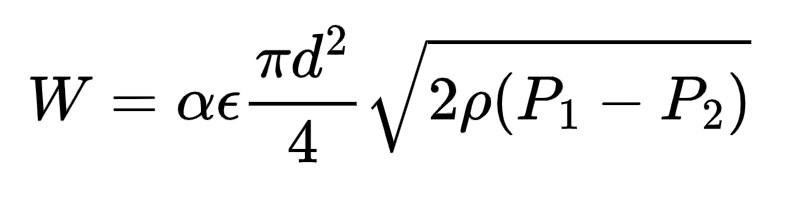
Used Equation
Dimensional Analysis

Beta Ratio The ratio of the orifice diameter to the pipe diameter, affecting flow restriction and pressure drop. It is essential in flow measurement, with specific ratios optimizing accuracy for different flow ranges.
Choked Flow Choked flow occurs when a gas flow reaches maximum velocity due to critical pressure conditions, limiting further flow increase. It is vital in gas transport systems to avoid system inefficiencies and ensure safe operation.
Common Results Refers to standard calculations and outputs in fluid mechanics, such as flow rate, pressure drop, and velocity, essential for analyzing system performance and determining if the design meets operational requirements.
Contraction Coefficient A factor representing the reduction in cross-sectional area in a flow contraction, influencing flow speed and pressure. It is used in flow calculations involving orifices and sudden changes in pipe diameter.
Critical Pressure Ratio The critical pressure ratio is the ratio of downstream to upstream pressure at which gas flow becomes choked, meaning maximum flow rate is reached. It is essential in designing nozzles and controlling flow in compressible fluid systems.
Density Density is the mass per unit volume of a fluid, typically measured in kg/m3. It impacts fluid behavior, such as buoyancy and pressure. High-density fluids exert greater pressure in systems, influencing design parameters in piping and fluid transport applications.
Dynamic Viscosity Dynamic viscosity is a measure of a fluid's resistance to shear or flow, measured in Pascal-seconds (Pa·s) or centipoise (cP). It affects how easily a fluid flows through pipes and around objects, influencing energy requirements in pumping systems.
Expansibility Factor A correction factor for compressible fluids, accounting for gas expansion in flow through orifices or nozzles. It affects accurate flow measurements and is particularly important in high-pressure gas systems.
Fluid Data Refers to essential information about a fluid, including properties like density, viscosity, and specific heat. This data is crucial for calculating flow rates, pressure drops, and heat transfer in systems.
Limits of Use Defines the operational boundaries, like maximum pressure or temperature, for a system. Staying within these limits ensures safe, efficient operation and protects equipment from damage or failure.
Mass Flow (kg/h) The amount of fluid mass passing through a point per hour. It is critical for measuring fluid transport, affecting system sizing, energy requirements, and overall efficiency in industrial processes.
Mass Flow (kg/s) Mass flow in kg/s indicates fluid mass per second, important for real-time flow control and energy calculations in fast-moving fluid systems, especially in high-demand applications like power generation.
Molecular Weight Molecular weight is the mass of a molecule of a substance, measured in atomic mass units (amu). In fluid mechanics, it helps calculate the density of gases and affects the fluid's compressibility and flow characteristics.
Operating Pressure The pressure at which a system operates, influencing fluid density and flow rate. Higher pressures increase fluid density in gases, affecting flow calculations and system integrity. Operating pressure is crucial for safety, efficiency, and equipment durability in fluid systems.
Operating Temperature The temperature at which a fluid operates within a system, influencing its viscosity, density, and flow behavior. Higher temperatures generally decrease fluid viscosity, affecting the resistance to flow.
Orifice Diameter The diameter of an orifice or opening in a pipe, used for flow restriction. It restricts flow, creating a pressure difference used to calculate flow rate, with smaller diameters increasing pressure drop and reducing flow. This is the primary output of the size calculator.
Pipe Data Refers to the dimensions, materials, and specifications of piping systems, affecting fluid dynamics, resistance, and capacity. Pipe data is essential for designing efficient fluid transport systems and calculating parameters like flow rate and pressure drop.
Pipe Diameter Inside diameter of the pipe. All process calculations are based on the volume of the pipe which is a function of its internal diameter. Larger diameters reduce friction and resistance, improving flow efficiency.
Pressure Downstream Fluid pressure after passing through the restriction orifice. It impacts flow rate and is essential for calculating pressure drops, energy losses, and flow efficiency within the piping system.
Pressure Drop Pressure drop is the reduction in fluid pressure as it flows through a system, caused by friction, restrictions, or changes in elevation. Across a restriction orifice it is a key input used together with the target flow to calculate the required orifice bore.
Pressure Drop Ratio The ratio of pressure drop across an element to the inlet pressure. It helps assess energy losses and efficiency in a system, with high ratios indicating significant pressure loss and potential flow restrictions.
Pressure Ratio The ratio of outlet pressure to inlet pressure. It is crucial in analyzing compressible flows, particularly in gas systems, to determine flow characteristics and efficiency. For gases, it determines whether flow is choked.
Ratio of Specific Heats The ratio of specific heats ($\gamma$ or $\kappa$) is the ratio of a fluid's specific heat at constant pressure to its specific heat at constant volume ($C_p/C_v$). It affects compressible flow and is critical in calculations involving gases and thermodynamics.
Reynolds Flow Regime The classification of flow as laminar, transitional, or turbulent based on the Reynolds number. It affects flow behavior, pressure drop, and efficiency, guiding the design and operation of fluid systems.
Reynolds Number A dimensionless number indicating whether a fluid flow is laminar or turbulent, calculated from fluid velocity, density, viscosity, and characteristic length. It helps predict flow patterns and friction losses in pipes and channels.
Specific Results Refers to calculated values unique to a system's conditions, such as the orifice diameter sized for the target flow and allowable pressure drop.
State of Matter Defines the physical state of a substance: solid, liquid, or gas, determined by temperature and pressure. In fluid mechanics, the state of matter affects fluid flow, density, and viscosity. Gases are compressible; liquids are nearly incompressible.
Steam Quality (x) Steam quality (also called dryness fraction) defines the proportion of vapor in a liquid-vapor mixture, on a mass basis. A value of $0$ represents fully saturated liquid; a value of $1$ represents dry saturated steam. For wet steam ($0 < x < 1$), the calculator uses the Homogeneous Equilibrium Model (HEM) to determine the effective mixture density:
where $\rho_g$ and $\rho_f$ are the saturated vapor and liquid densities at the operating temperature, derived from IAPWS-IF97 steam tables. Example: at 150 °C, $\rho_g \approx 2.55\,\text{kg/m}^3$ and $\rho_f \approx 917\,\text{kg/m}^3$ — for $x = 0.9$ (10 % moisture content), $\rho_{mix} \approx 2.83\,\text{kg/m}^3$, noticeably denser than dry steam, which directly affects the calculated orifice size. Steam leaving a boiler or passing through a throttling valve is rarely perfectly dry; typical quality values in industrial practice range from 0.90 to 0.98.
Velocity in Pipe The speed of fluid movement through the pipe, influenced by pipe diameter and flow rate. It affects pressure drop, energy losses, and is crucial for sizing pipes to avoid excessive turbulence or friction.
Volumetric Flow The volume of fluid passing through a point per unit time, often in m3/h. It is used in pump sizing, system efficiency calculations, and to ensure fluid supply meets demand in various processes.
Noise Level (Acoustic Power Level) The calculator estimates the acoustic power level ($L_W$) generated by the restriction orifice, expressed in decibels (dB). This output helps engineers identify potentially noisy installations at the sizing stage.
The calculation follows a simplified engineering model based on the mechanical power dissipated across the orifice:
Step 1 — Mechanical power dissipated:
where $q_m$ is mass flow rate [kg/s], $\Delta P$ is pressure drop [bar], and $\rho$ is fluid density [kg/m3].
Step 2 — Acoustic efficiency factor ($\eta_a$):
- For gas — subsonic flow: $\eta_a = 0.0001\,(\Delta P/P_1)^2$
- For gas — choked flow: $\eta_a = 0.01$
- For liquid: $\eta_a = 0.00001$
Step 3 — Acoustic power radiated:
Step 4 — Acoustic power level:
A warning is displayed when $L_W \geq 85$ dB, indicating a high acoustic power level that may require engineering review (noise insulation, silencer, or multi-stage pressure reduction).
Note: This is a simplified estimate intended for early-stage evaluation. For detailed acoustic assessment, refer to IEC 60534-8-3 (control valve noise) or project-specific acoustic studies.
Restriction Orifice — Find Size Calculator References
1 International Organization of Standards (ISO 5167-1). 2003. Measurement of fluid flow by means of pressure differential devices inserted in circular cross-section conduits running full - Part 1: General principles and requirements.
2 International Organization of Standards (ISO 5167-2). 2003. Measurement of fluid flow by means of pressure differential devices inserted in circular cross-section conduits running full -- Part 2: Orifice plates.
3 American Society of Mechanical Engineers (ASME). 2001. Measurement of fluid flow using small bore precision orifice meters. ASME MFC-14M-2001.
4 U.S. Dept. of the Interior, Bureau of Reclamation, 2001 revised, 1997 third edition, Water Measurement Manual.
5 Michael Reader-Harris (2015) Orifice Plates and Venturi Tubes.
6 Miller, R. W., Flow Measurement Handbook, 3rd ed., McGraw-Hill, New York, 1996.
7 American Gas Association, AGA Gas Measurement Manual, American Gas Association, New York.
8 Wikipedia
9 Corrosionpedia
10 Orifice Plates and Venturi Tubes (2015) - Michael Reader-Harris
11 EMERSON Fundamentals of Orifice Meter Measurement
12 Search Data Center
Another calculators or articles that may interest you
-
Absolute Viscosity of Common Gases — reference table for dynamic viscosity values needed as calculator input for gas flows.
-
Density of Common Liquids — a useful table that represents the density of some common liquids and their temperature.
-
Molecular Weight of Common Fluids — reference table for molecular weight values to use as input when calculating gas density.
-
Orifice Plate Calculator — Find Orifice Size — a useful tool to calculate the size of a metering orifice plate for flow measurement.
-
Orifice Plate Installation Guidelines — best practices for installing orifice plates in process piping.
-
Pressure Measurement — learn about pressure measurement principles, units, and instrumentation.
-
Thermal Expansion Coefficient Table — reference table for thermal expansion coefficients of common materials.
-
Difference between Actual, Standard and Normal Flows — explanation of volumetric flow reference conditions and conversion.
-
Flow Rate Calculator — calculate the volumetric flow rate of any liquid or gas through a specific pipe diameter.
-
What's the difference between Absolute, Gauge and Differential Pressure? — explanation of pressure reference types used in calculator inputs.
-
Heat Capacity Ratio of Common Fluids — reference table for the ratio of specific heats (γ) required for gas restriction orifice calculations.
-
Pressure-Temperature Compensation Formula — explanation of how pressure and temperature corrections affect gas flow calculations.
Frequently Asked Questions
Q1 How to size a restriction orifice plate?
A1 Sizing a restriction orifice plate involves determining the required pressure drop and flow rate for the application. Based on these parameters, the orifice diameter can be calculated to achieve the desired performance. Accurate sizing is crucial, as it directly impacts flow control efficiency and the protection of downstream equipment.
Q2 How does a restriction orifice work?
A2 A restriction orifice works by reducing the cross-sectional area available for fluid or gas flow, which creates a pressure drop. The velocity of the flow increases as it passes through the orifice, reducing downstream pressure. This controlled pressure loss is used to manage flow characteristics and achieve desired operational conditions.
Q3 How to design a restriction orifice?
A3 Designing a restriction orifice requires understanding the process requirements, including pressure, temperature, flow rate, and the characteristics of the fluid. Engineers select the appropriate orifice size, material, and configuration based on these factors, ensuring compatibility with the system's needs and compliance with safety standards.
Q4 How to calculate restriction orifice plate thickness?
A4 To calculate restriction orifice plate thickness, engineers consider factors like operating pressure, temperature, material strength, and the pipe diameter. The thickness must be sufficient to withstand stress without deforming, ensuring that it maintains its integrity under operating conditions. Thicker plates are used in high-pressure systems for durability.
Q5 How to calculate restriction orifice size?
A5 Calculating restriction orifice size involves using flow parameters such as the desired flow rate, allowable pressure drop, and fluid characteristics. Based on these inputs, the orifice diameter is determined to ensure that the plate provides the required restriction. Accurate calculations are vital for effective and safe flow control.
Q6 How to size a restriction orifice?
A6 Sizing a restriction orifice involves determining the orifice diameter that matches the process requirements, such as flow rate and pressure drop. This process includes analyzing the fluid's properties, system constraints, and required flow conditions to ensure the orifice is neither too restrictive nor too loose for efficient flow management.
Q7 How does a restriction orifice plate work?
A7 A restriction orifice plate works by limiting the flow area within the piping, which creates a pressure drop as fluid passes through the reduced space. This pressure drop is used to control the flow rate and downstream pressure, providing engineers with a straightforward way to manage fluid conditions in various industrial processes.