Introduction to Instrumentation

Process Control Basics


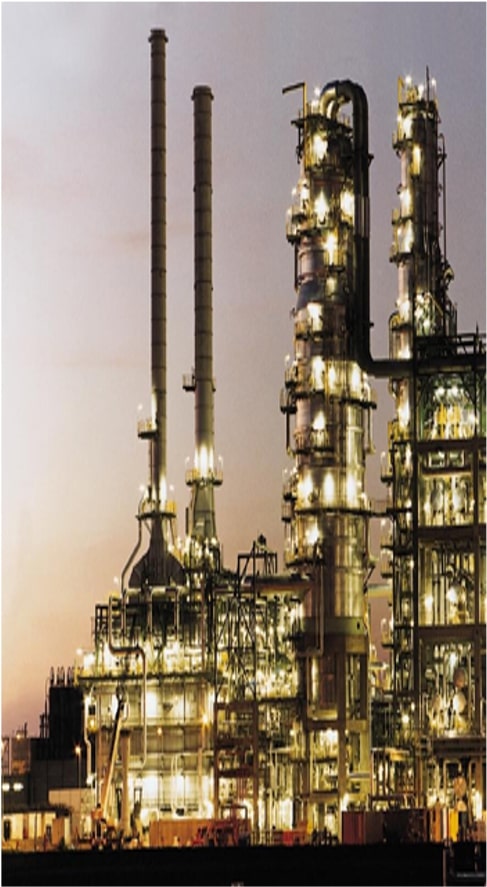
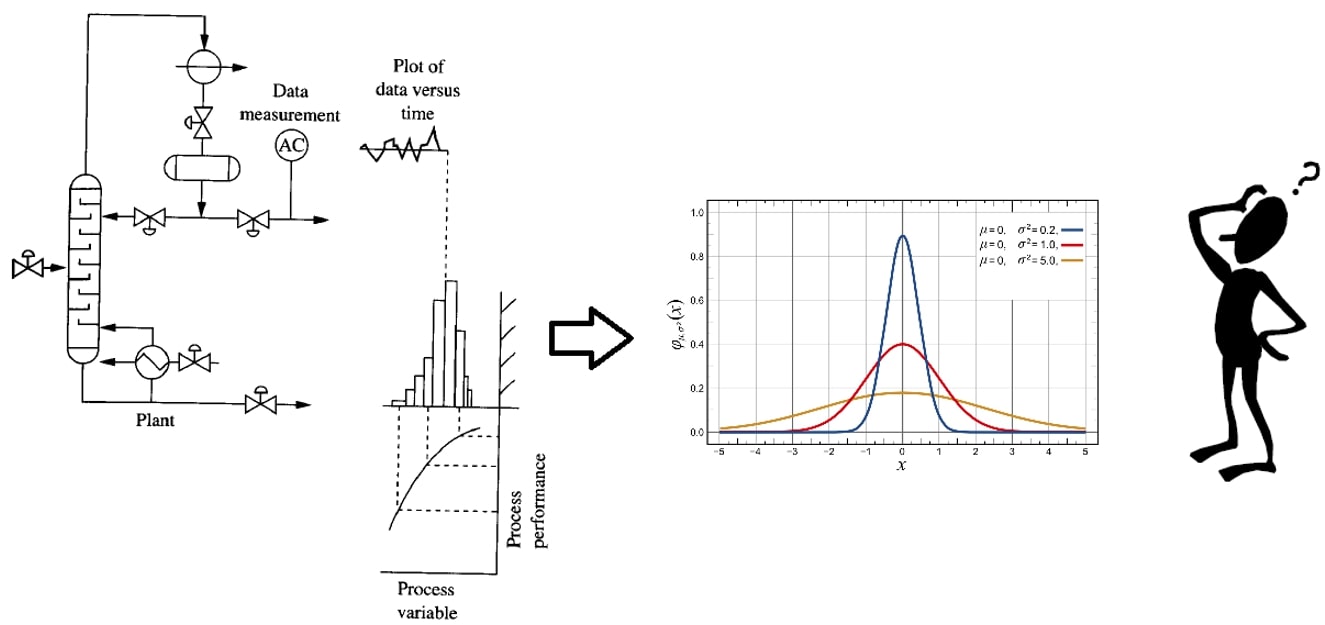
Process control is today a fundamental part of the production process. Through process control we are able to produce our products in line with our quality, cost, environment and safety standards.

This article provides a basic introduction to process control based on the differentiation between an open control loop and a closed control loop. This fundamental idea is part of the pillars of process control.

In the second part of the article we talk about the mythical current loop and the reasons why it is still a valid and current means of communication.

The article ends with a small reference to instrument calibration.

1.Control System

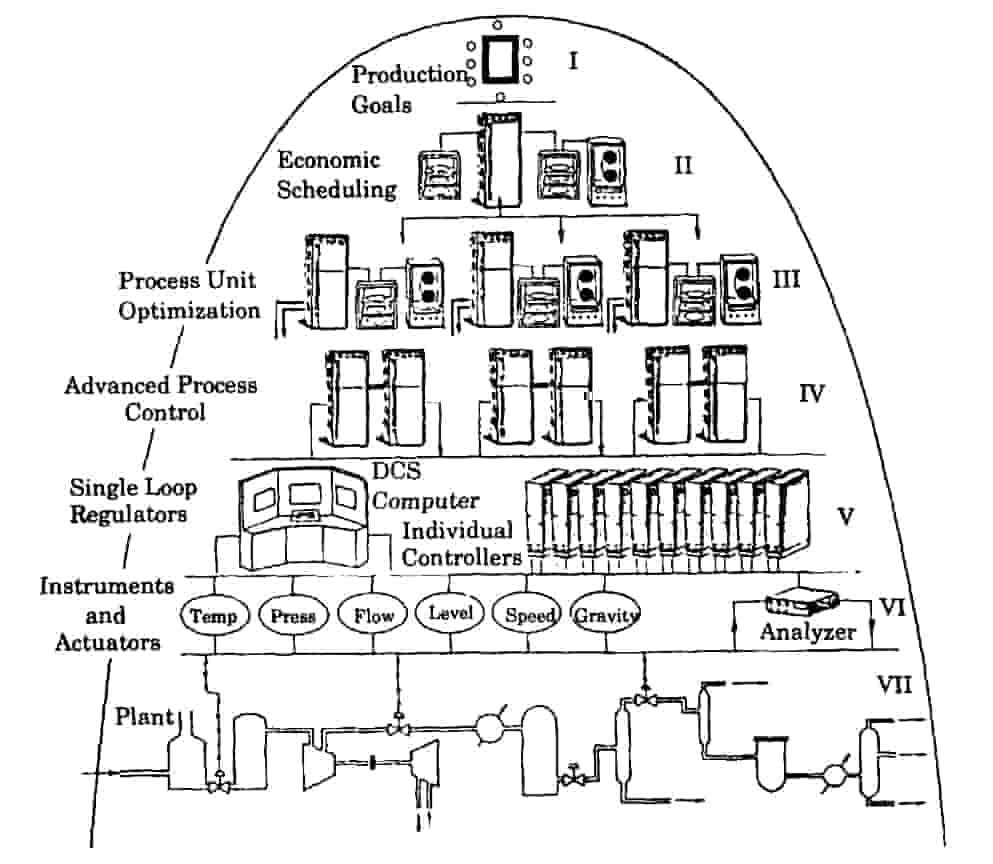
Measurement and control constitute the brain and nervous system of any modern plant.
Control System

Control System

Control systems are a fundamental part of industry and automation. They are a set of mechanical, electrical and electronic equipment used to enhance production, efficiency and safety.Typically, control systems are based on control loops.

The measurement and control system monitors and regulates processes that would otherwise be difficult to operate while maintaining quality, cost and safety requirements.

The control systems must achieve the following objectives:

  1. They must allow to operate the process in a transparent way, implementing functions that improve the management and control of the Plant.

  2. They must display integrated and reliable information, and in case of system or process error they must be stable and robust.

  3. Ideally, they should improve the quality of the product produced by reducing the variability of the measurements under control.

Process control is necessary in modern industry for:

  • Keeping businesses profitable.

  • Improve product quality.

  • Reduce atmospheric emissions.

  • Minimize human error.

  • Reduce operating costs.

Modern Industry

Modern Industry

2.Types of control systems: Open Loop / Closed Loop

2.1 What is an open loop?

An open loop system is a type of control where the output of the system depends only on the input. These systems have no feedback.

Open Loop

Open Loop

In open loop, the system does not compare the measured variable with the desired value (set point). It is a system in which there is no measuring instrument.

The toaster is an example of an open loop. When we put the bread in the toaster and set the time, we do not know if the bread will be toasted to our liking, as we do not have any feedback on the state of the bread during the toasting process.
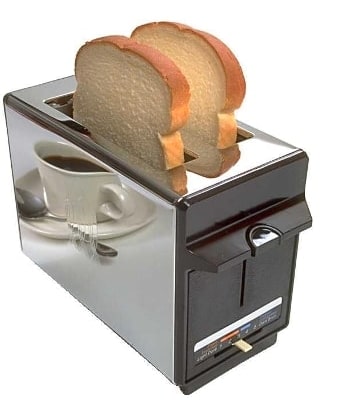
The toaster is an example of an open loop.

The toaster is an example of an open loop.

It is a simple system and is affected by disturbances.

2.2 What is a closed loop / feedback loop?

A closed loop system is a type of control where the output of the system depends on the input and the output. These systems feed back the current output of the system and this information is taken into account when calculating the new output value.

In closed loop, the system does compare the measured variable with the desired value (set point). It is a much more complex system than the open loop and is less affected by disturbances.

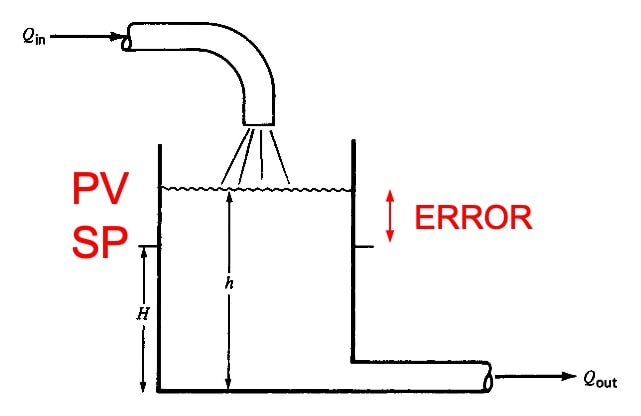
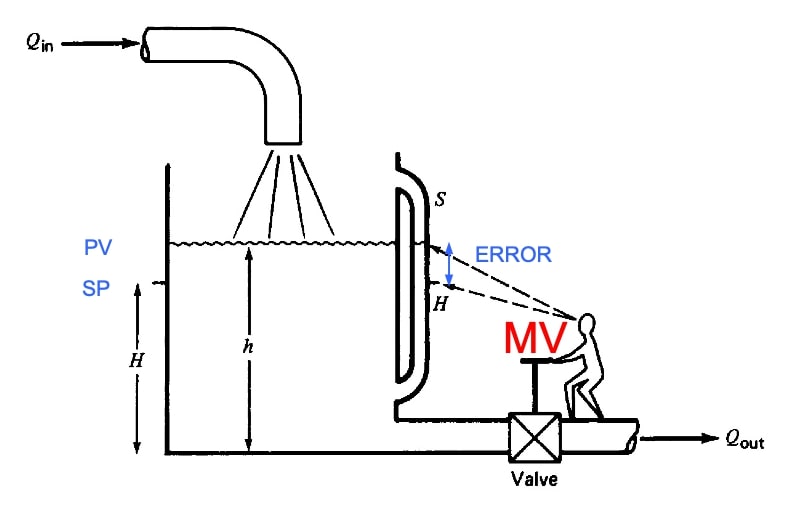
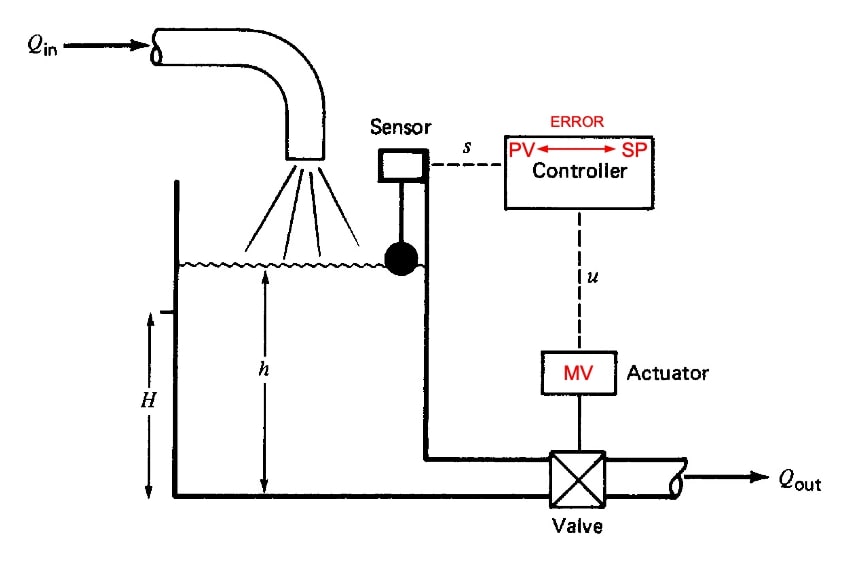
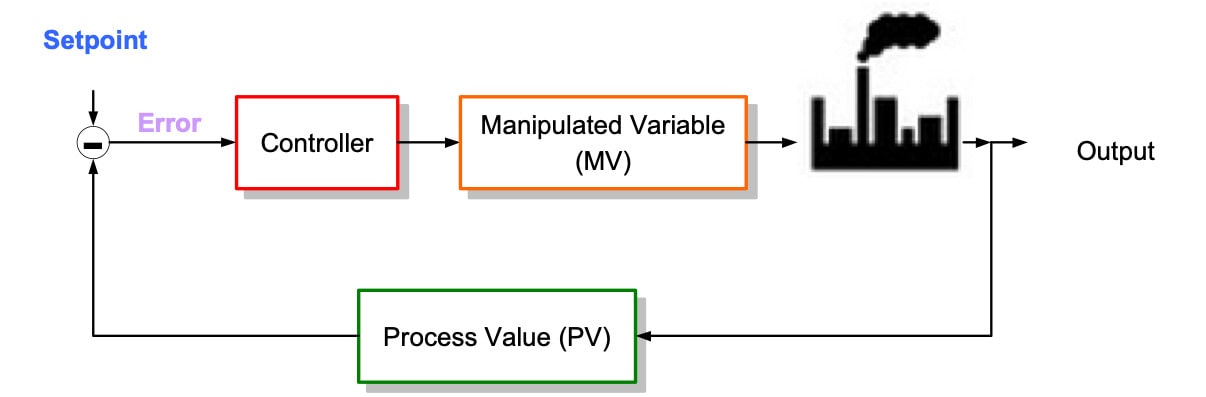
In process control, the basic objective is to regulate the value of a quantity, this desired value is called set point (SP), we also have a way to measure the value of the variable to be controlled continuously (PV) and we also have a way to compare this measured variable with the desired value (ERROR).

Finally, a method of acting or influencing the measured variable (MV) is needed.
Closed Loop

Closed Loop

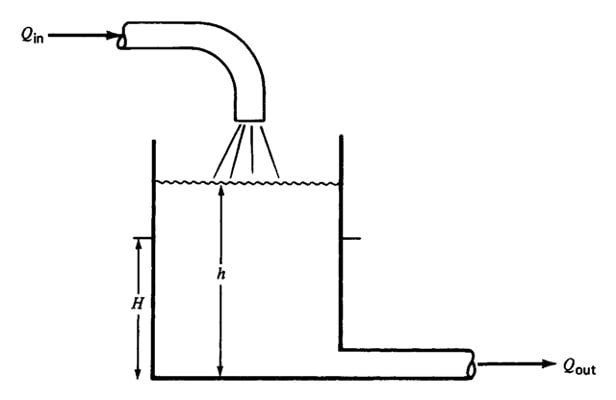
This picture shows a system consisting of a tank with an inlet liquid flow Qin, and an outlet flow Qout.

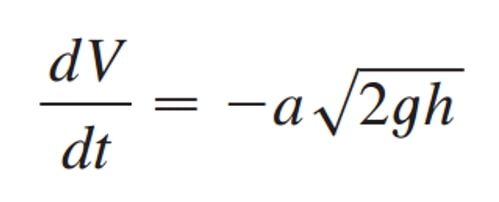
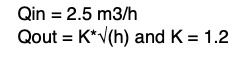
The liquid in the tank has a height or level equal to h. The formula for Qout is Qout = K*√(h), since the flow rate out of the tank depends on the height of the liquid h (Torricelli's Theorem).
Closed Loop

Closed Loop

If h is very small the Qout will be smaller than Qin and then the liquid height will increase. If the liquid height increases it will cause Qout to increase so that we will reach a point where Qout will be greater than Qin and the liquid height will decrease.

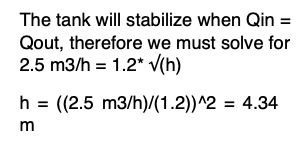
There is a value of h at which Qout is equal to Qin -at this point we say that thelevelisself-regulating.

Looking at the tank in the image above and taking into account the following data:
Closed Loop

Closed Loop

At what liquid height will the tank be self-regulating?
Closed Loop

Closed Loop

Closed Loop

Closed Loop

2.2.1 Manual versus Automatic Closed Loop

We have said that a method of acting or influencing the measured variable (MV) was necessary.

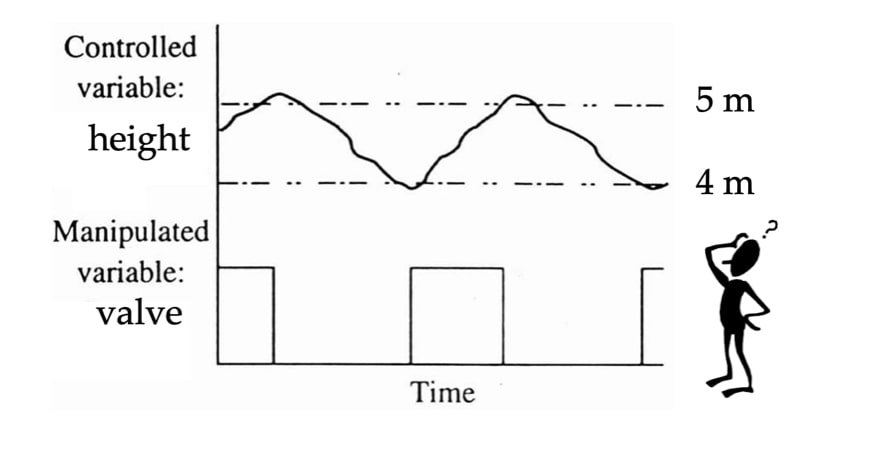
If we assign a person to control the level (height) of the tank, he/she can adjust the height by opening and closing the outlet valve that regulates the flow Qout, so that the level can be regulated.

The controlled variable is still the level (SP), but now the height of the tank depends on an action manipulated by a person (MV) (MANUAL CLOSED LOOP).
Closed Loop

Closed Loop

Why does the tank level fluctuate?

Manual Closed Loop

Manual Closed Loop

Do you consider it stable enough as a variable of a chemical process?
Automatic Closed Loop

Automatic Closed Loop

If we replace the person with an automatic system (AUTOMATIC CLOSED LOOP) we can obtain a more precise control of the level.

The height of the liquid level in the tank is measured by a sensor (mechanical or electronic) and a controller calculates the difference between the measured value (PV) and the set point (SP) and generates a signal to the actuator to open and close the flow controlled outlet valve Qout (MV).
Automatic Closed Loop

Automatic Closed Loop

From what has been explained so far, a feedback control system seems to have at least 3 basic elements:
Feedback Control System

Feedback Control System

How do we select the sensor position?

The position and type of sensor will depend on the loop we want to control, usually the position of the sensor is located near the influence of the output of the control system, so the control action can vary a measure and this measure can be used as feedback information.

What is a typical final element for a chemical process?

Typical end elements are usually valves. These can be control valves or ON/ OFF valves. Frequency inverters or other electrical, pneumatic or hydraulic devices can also be used.

What about the typical sensor?

Pressure is the ultimate measurement. With a pressure measurement it is possible to calculate the level, the flow rate and the pressure itself.

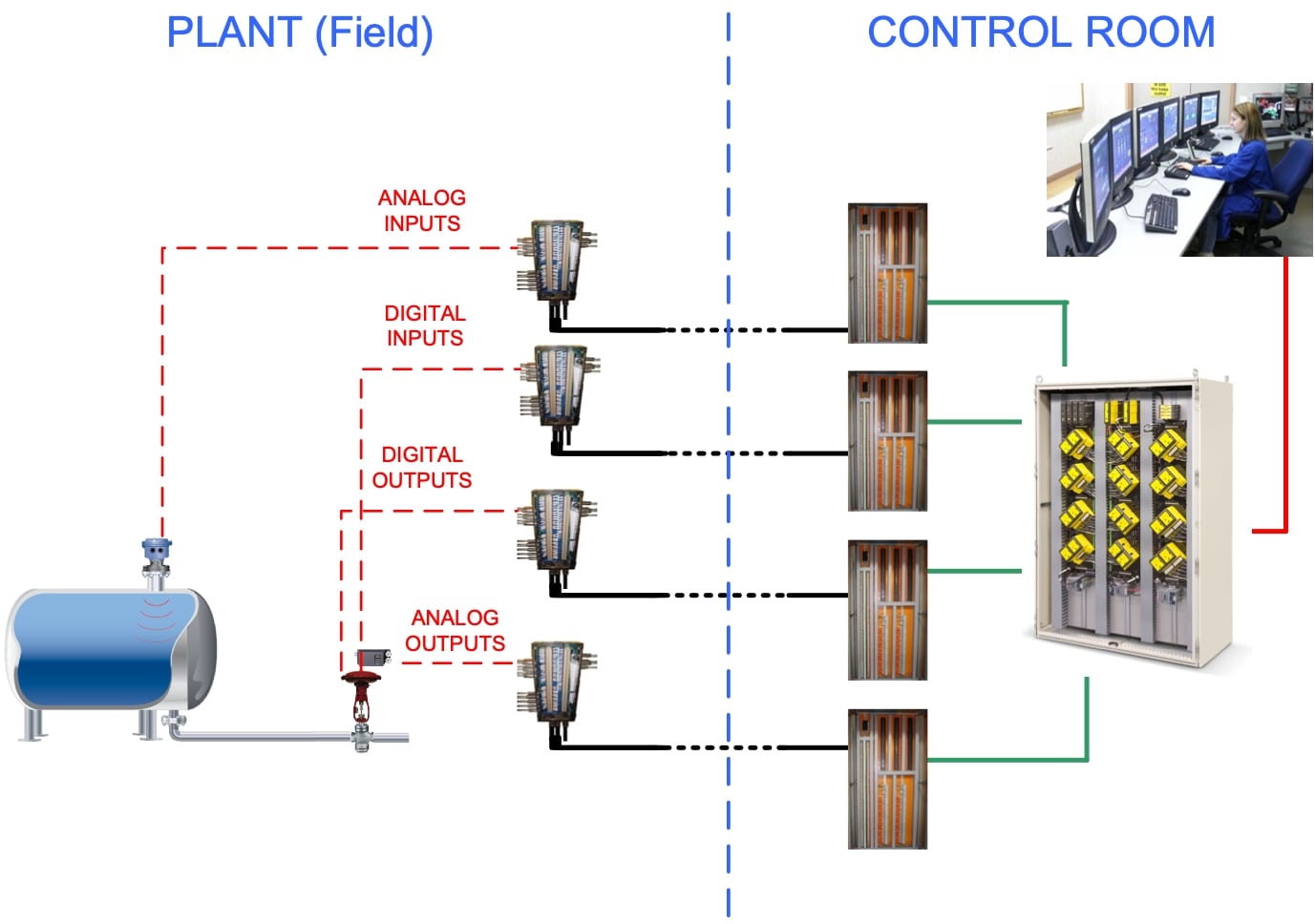
The following diagram shows the elements of a closed loop:
Elements of a Closed Loop

Elements of a Closed Loop

Elements of a closed loop

Elements of a closed loop

Analog and Digital Signals

Analog and Digital Signals

3. Standard instrumentation signal levels

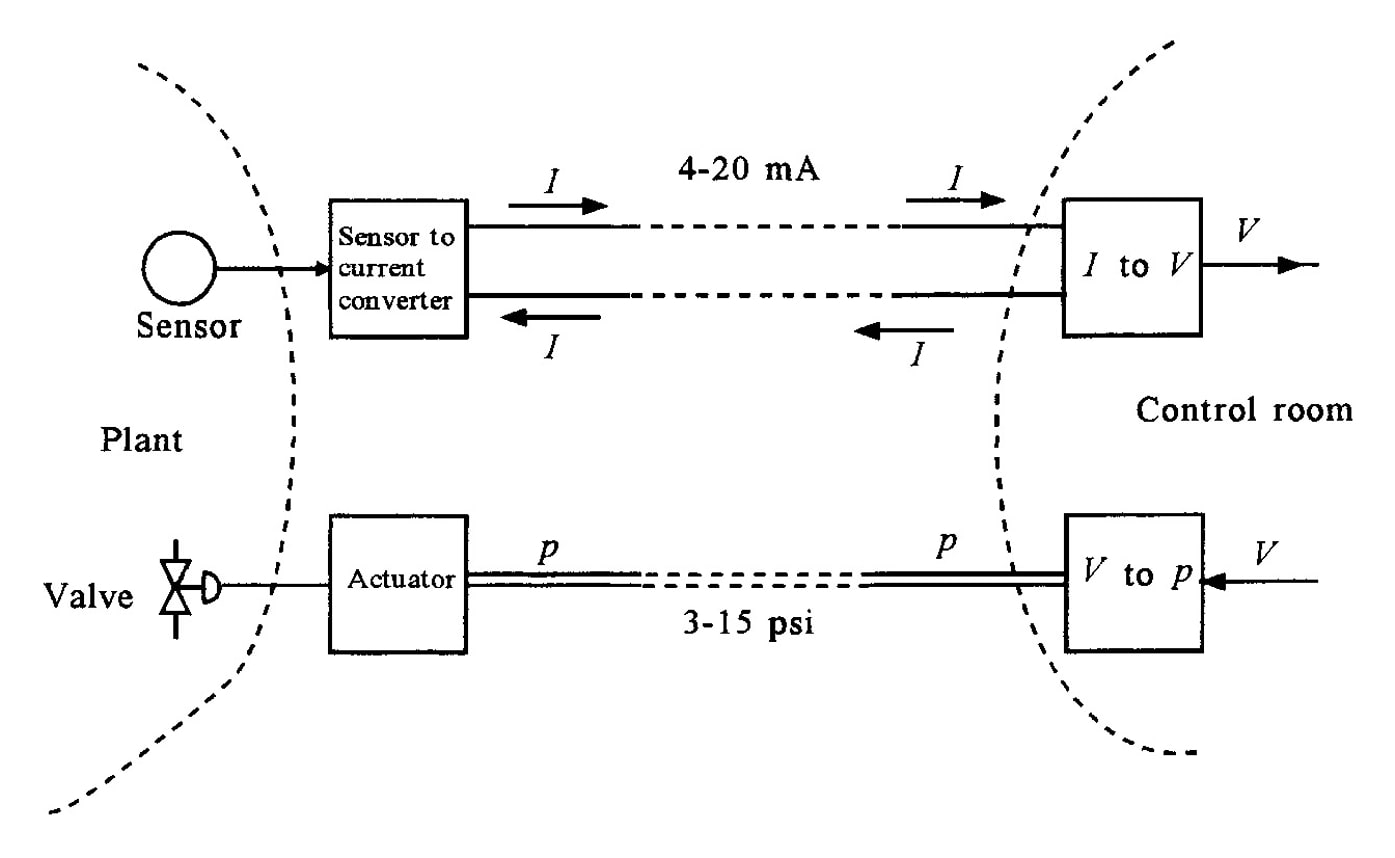
Prior to 1960, instrumentation in the process industries used pneumatic (pressurized air) signals to transmit measurement and control information almost exclusively.

These devices make use of mechanical force balance based elements to generate signals in the range of 3 to 15 p.s.i. as an industrial standard.
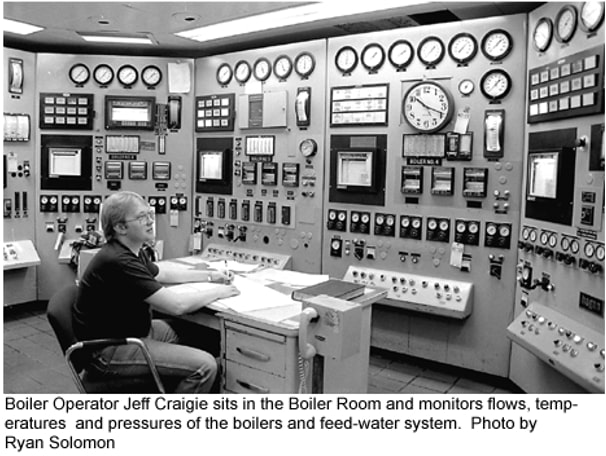
Measurement and Control room

Measurement and Control room

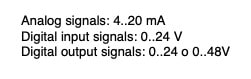
Since 1960, electronic instrumentation has become widespread (4 to 20 mA).

Recently, field bus type signals have become more common.
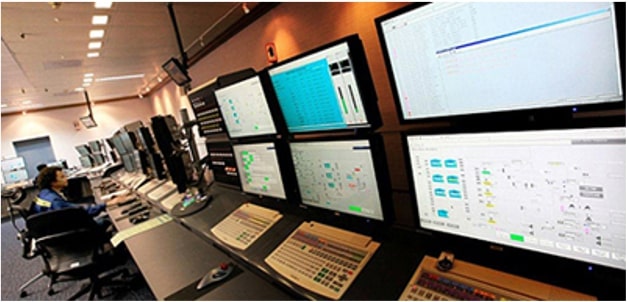
Measurement and Control room

Measurement and Control room

The transmitter converts the sensor output signal to a signal suitable for the controller input (4..20mA).

They are normally designed to act in direct action.

Although, as we have said, electronic instrumentation has spread, analogue instrumentation is still predominant, so we consider it interesting to dedicate a section to describe how it works.
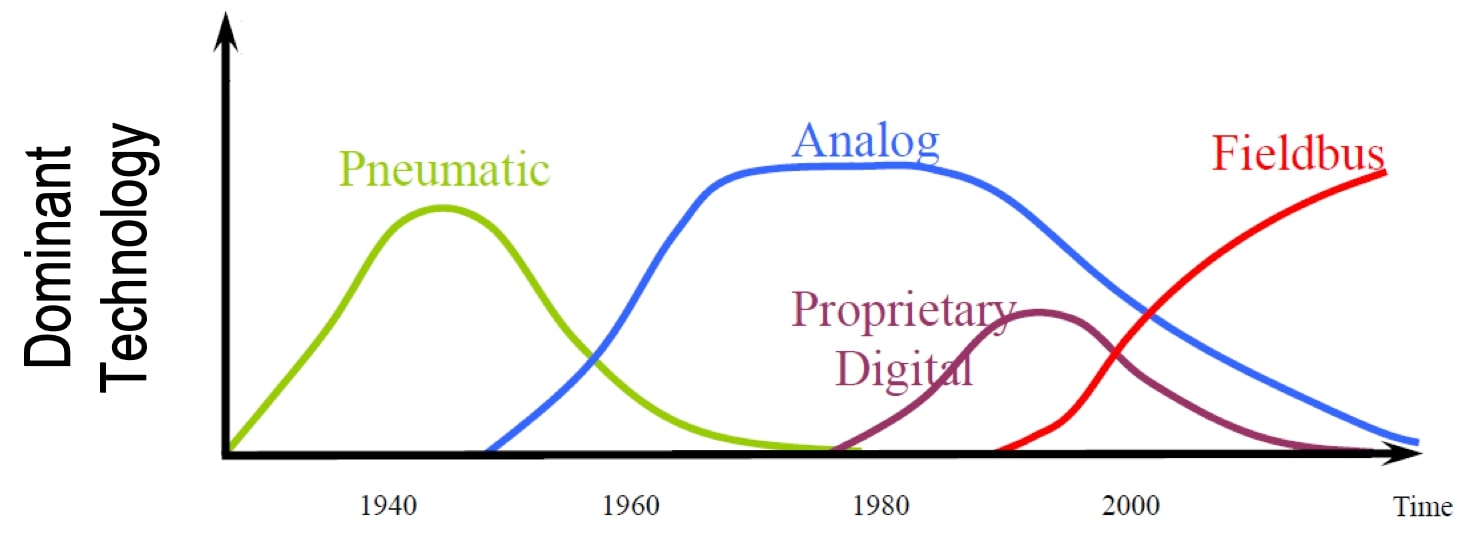
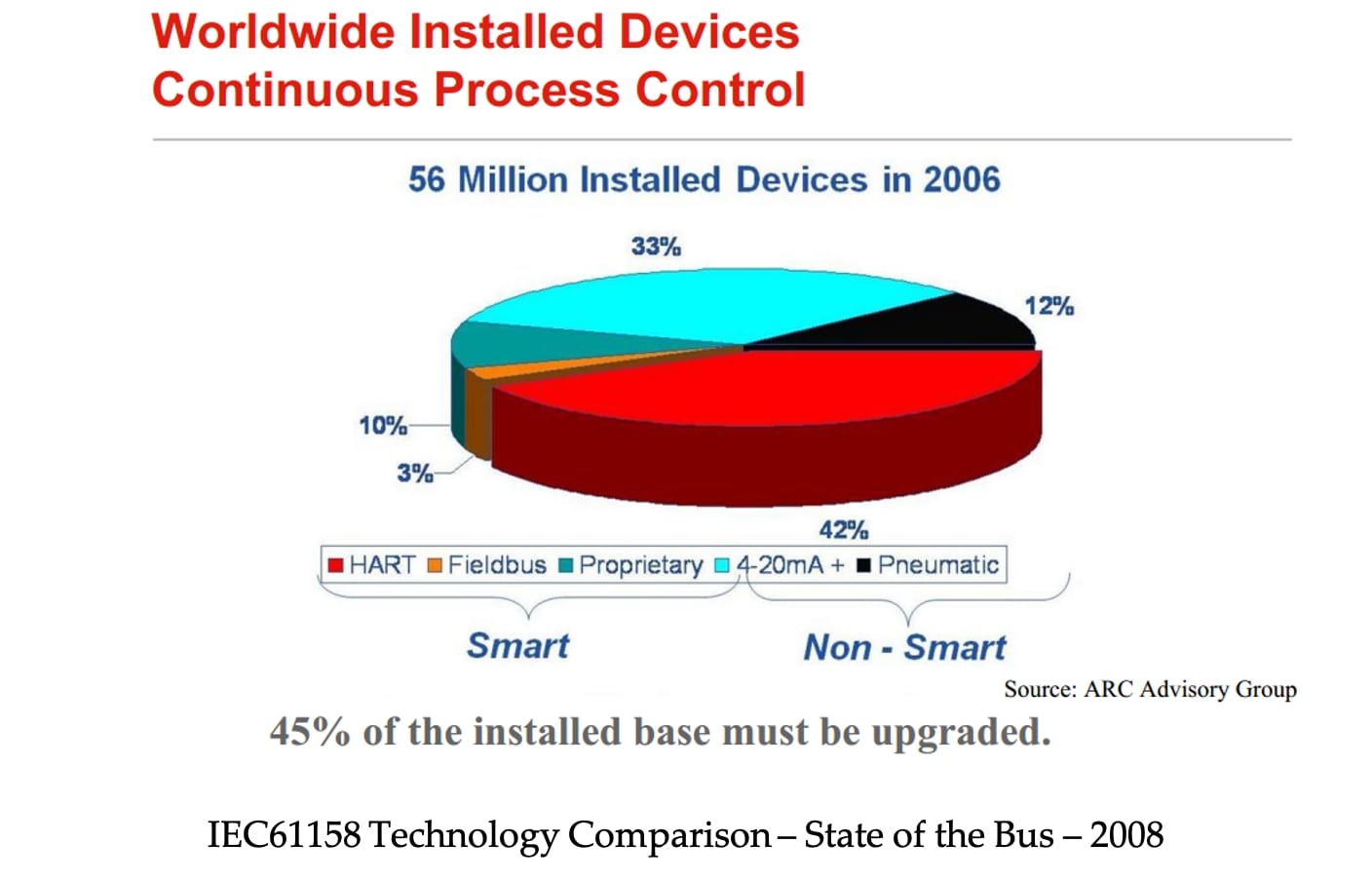
Measurement and Control room

Measurement and Control room

Measurement and Control devices

Measurement and Control devices

3.2 Current Loop / Analogue

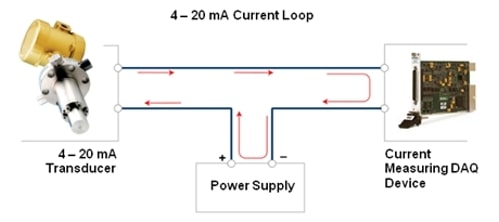
The purpose of a current loop is to transmit the signal from the analogue sensor over a certain distance in the form of a current signal, up to 3 kilometres.
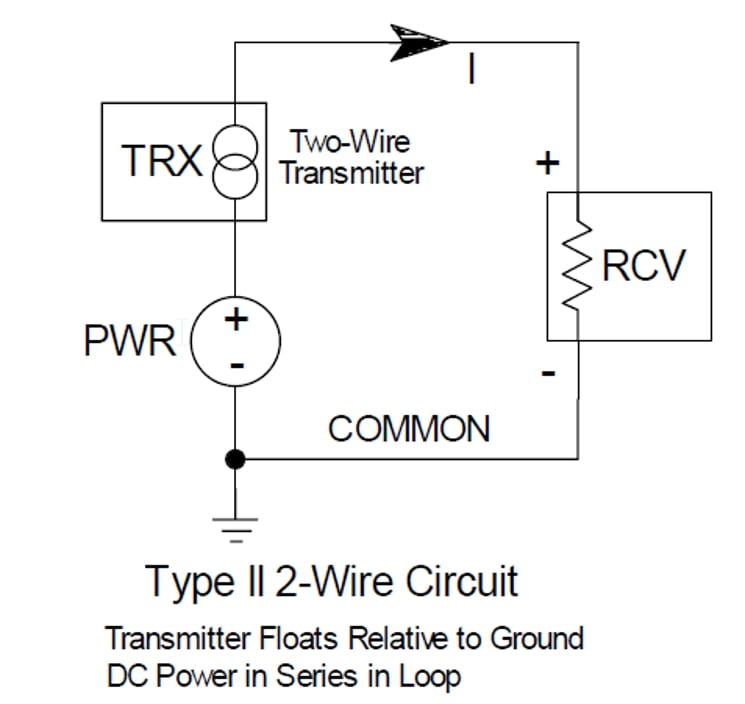
Wire circuit

Wire circuit

The explanation is the following, the sensor varies the sum (intensity) depending on the measurement of the variable it is measuring. As an example, if we measure the temperature through a transmitter with range 0 to 100oC, it will consume 20 mA when the temperature reaches 100oC and 4 mA when the temperature reaches 0oC.

Advantages:

  • Signal accuracy is not affected by voltage drop.

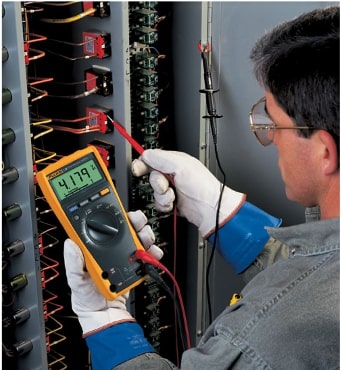
  • Working with a minimum of 4 mA allows to detect problems in the loop.

  • It is not necessary to have specialized training to carry out the installation/maintenance of this type of loop.
Analogue loop advantages

Analogue loop advantages

Disadvantages:

  • Point-to-point communication only.

  • A controller is required to perform the process control.

  • There is no diagnostic information from the devices/sensors.
Analogue loop disadvantages

Analogue loop disadvantages

Download our free PDF file about this article!

  • Instrumentation and Control.net
  • Rating: 4.5980 - 102 reviews
We have prepared this complete PDF so that you have all the information we give in this article and you can share it, discuss it with your colleagues, and use it professionally. Having the content in PDF format allows you to access it offline, print it easily, and keep it well-organized for future reference.
We consider that it is better to have a well-formatted text that includes all the key concepts explained in this publication, ready to share or save for later use. A PDF ensures that the layout remains intact across different devices and makes it easier to annotate or highlight important points.

Introduction to Instrumentation


Core Process Variables Instrumentation measures and controls pressure, temperature, flow, and level. Define ranges, accuracy, and dynamics needed for each variable before selecting devices.

Sensors and Transducers

  • Pressure: gauge/absolute/DP transmitters, elastic elements (Bourdon, diaphragm), remote seals for harsh service.
  • Temperature: thermocouples, RTDs, thermistors; consider range, response, and installation (wells, surface mounts).
  • Flow: differential pressure (orifice, Venturi), vortex, turbine, Coriolis, ultrasonic; match to fluid phase, Reynolds number, and required accuracy.
  • Level: hydrostatic/DP, guided wave radar, ultrasonic, capacitance, floats; choose per fluid properties, vapors, and foam.

Signal and Power Common outputs: 4–20 mA (with HART), fieldbus/Modbus. Decide loop vs. external power and ensure scaling and grounding are correct to avoid noise.

Control Loops Basics A loop combines sensor → controller → final element (e.g., control valve). Key concepts: setpoint, error, PID action, dead time, and tuning for stability vs. responsiveness.

Accuracy, Range, and Turndown Specify required accuracy and total error. Set LRV/URV to cover normal operation with headroom. Turndown affects resolution; avoid oversizing ranges.

Installation Effects Location and mounting affect accuracy: straight runs for flow, immersion length for temperature, correct tapping elevation for level/DP. Minimize vibration, temperature extremes, and condensation in enclosures.

Environmental and Safety Considerations Check ambient limits, ingress protection, and hazardous area certification (Ex d/Ex i). For safety loops, verify SIL capability, proof-test interval, and diagnostics.

Calibration and Maintenance Plan calibration intervals, reference standards, and access (manifolds, valves, test ports). Consider remote seals or purges where plugging or coating is likely.

Human Factors Use local indicators where operators need immediate feedback. Keep tags clear and consistent for troubleshooting and maintenance.

Introduction to Instrumentation References


1 Lipták, B. (2003) Instrument Engineers' Handbook: Process Measurement and Analysis — Foundational overview of industrial instrumentation.

2 Johnson, C. D. (2005) Process Control Instrumentation Technology — Principles, sensors, and transmitters for common variables.

3 Morris, A. S., Langari, R. (2015) Measurement and Instrumentation: Theory and Application — Core measurement concepts and device selection.

4 Anderson, N. A. (1997) Instrumentation for Process Measurement and Control — Practical introduction to industrial instruments.

5 Bentley, J. P. (2005) Principles of Measurement Systems — Fundamentals of sensing and transduction.

6 Doebelin, E., Manik, D. (2007) Measurement Systems: Application and Design — Measurement accuracy, dynamics, and uncertainty.

7 ISA-51.1-1979 (R1993) Process Instrumentation Terminology — Standard definitions for instrumentation performance terms.

8 IEC 61298-1:2008 Process measurement and control devices — General methods and procedures for evaluating performance.

9 Beamex Calibration Handbook (2012) — Practical calibration methods across pressure, temperature, and electrical signals.

10 NIST Technical Note 1297 / ISO/IEC Guide 98-3 (GUM) — Guide to the Expression of Uncertainty in Measurement applied to instrumentation.

Another calculators or articles that may interest you ...


1 P&ID Diagram Basics 2 - International Standards - Learn standard instrumentation symbols worldwide.

2 P&ID Diagram Basics 3 - Functional Identification - Master functional numbering conventions.

3 Introduction to Hazop Analysis - Comprehensive hazard identification and assessment.

4 Pressure Measurement - Pressure sensing techniques and instrumentation types.

5 Molecular Weight of Common Gases - Gas property reference tables.

6 Orifice Plate Calculator - Size - Determine orifice plate dimensions.

7 Flow Rate Calculator - Calculate volumetric and mass flow rates.

8 Temperature Measurement - Temperature sensors and measurement methods.

Frequently Asked Questions


Q1 What is the difference between open loop and closed loop control systems?

A1 An open loop control system operates without feedback - the controller takes an action based on a predetermined setting without measuring the actual result. For example, a timer-based heater that turns on for a fixed duration regardless of actual temperature. A closed loop (feedback) control system continuously measures the process variable and adjusts the controller output to maintain the desired setpoint. For example, a thermostat that measures room temperature and adjusts heating based on the difference from the setpoint. Closed loop systems are self-correcting and can compensate for disturbances, making them far more common in industrial applications. Most process control systems require closed loop control to maintain quality and safety standards.

Q2 Why is the 4-20 mA current loop still widely used in instrumentation?

A2 The 4-20 mA current loop remains the standard for several compelling reasons. Current signals are immune to voltage drops caused by wire resistance, unlike voltage signals that degrade over long distances. The use of 4 mA as the "live zero" provides diagnostic capability - a 0 mA signal indicates a wire break or power failure, distinguishing it from a legitimate low reading. Current loops are simple, reliable, and well-understood by technicians worldwide. They provide intrinsic safety in hazardous areas with proper barriers. Two-wire transmitters can be powered by the same wires carrying the signal, simplifying installation. Despite newer digital protocols (HART, Foundation Fieldbus, Profibus), 4-20 mA continues as the backbone of most control systems due to its proven reliability and simplicity.

Q3 What are the basic components of a typical instrumentation system?

A3 A typical instrumentation system consists of four main components: sensors/detectors that convert physical variables (temperature, pressure, flow, level) into measurable signals; transmitters that condition and amplify sensor signals into standardized outputs (typically 4-20 mA); controllers (DCS, PLC, or standalone) that compare measured values with setpoints and calculate corrective actions; and final control elements (control valves, variable speed drives) that adjust process inputs based on controller outputs. Additionally, systems include power supplies, signal conditioning equipment, barriers for hazardous area protection, indicators and recorders for operator interface, and communication networks. These components work together to form control loops that maintain process variables within desired ranges.

Q4 What is instrument calibration and why is it necessary?

A4 Instrument calibration is the process of comparing an instrument's measurement against a known reference standard and adjusting it to ensure accuracy. Over time, instruments drift due to environmental factors, wear, vibration, and process conditions. Calibration verifies the instrument's accuracy across its entire range and documents performance for quality and regulatory compliance. Regular calibration prevents poor product quality, safety incidents, and regulatory violations. Calibration frequency depends on instrument type, application criticality, manufacturer recommendations, and regulatory requirements. Safety instruments typically require more frequent calibration than general monitoring instruments. A documented calibration program is essential for maintaining measurement integrity and demonstrating due diligence in quality management systems like ISO 9001.

Q5 How do I choose between analog and digital instrumentation?

A5 The choice depends on several factors. Analog (4-20 mA) instrumentation offers simplicity, proven reliability, lower cost per point, ease of troubleshooting with basic multimeters, and no concern about network failures or configuration loss. Digital instrumentation (HART, Foundation Fieldbus, Profibus) provides additional diagnostics, advanced functionality (multiple process variables per device), remote configuration capability, predictive maintenance features, and reduced wiring in large installations. For small systems or critical safety applications, analog remains preferred. For large complex systems with advanced asset management requirements, digital protocols offer significant advantages. Many installations use hybrid approaches: analog signals for control with digital protocols overlaid for asset management. Consider your maintenance capabilities, engineering expertise, and long-term support requirements.

Q6 What is the relationship between measurement, control, and safety systems?

A6 These three systems form a layered protection strategy. The measurement system provides real-time data about process conditions - temperatures, pressures, flows, and levels. The control system uses this data to automatically maintain desired operating conditions, optimizing production while staying within safe operating limits. When control systems cannot maintain safe conditions, the safety instrumented system (SIS) takes protective action - shutting down equipment, closing isolation valves, or activating emergency systems. These layers work independently: basic control prevents normal deviations, alarms alert operators to abnormal situations, and SIS provides automated shutdown if critical limits are exceeded. Modern plants implement this defense-in-depth philosophy where multiple independent protection layers prevent incidents, with each layer backing up the previous one.

Q7 What are the key trends in modern instrumentation and control?

A7 Modern instrumentation is evolving rapidly with several key trends. Wireless instrumentation reduces installation costs and enables measurements in previously inaccessible locations, though concerns about battery life and reliability in critical applications remain. Smart transmitters with digital protocols provide diagnostics, configuration flexibility, and predictive maintenance capabilities. Industrial Internet of Things (IIoT) connects operational technology (OT) with information technology (IT), enabling advanced analytics and cloud-based monitoring. Cybersecurity has become critical as control systems connect to corporate networks. Artificial intelligence and machine learning are being applied to optimize processes and predict equipment failures. Despite these advances, fundamental principles remain unchanged: reliable measurement, robust control strategies, and proper instrument selection and maintenance are still the foundation of effective process control.