Overview
This tutorial walks you through sizing a concentric, square-edged orifice plate using the Orifice Plate – Find Orifice Size calculator at instrumentationandcontrol.net, which implements ISO 5167-2:2003. By following it you will:
- Enter process data correctly for both a liquid and a gas service.
- Understand why the sizing calculation is iterative, what the beta ratio constraint means in practice, and — for gas — what the expansibility factor and pressure ratio check tell you.
- Read and validate the Limits of Use section so you can defend the result to a review or pass it to procurement.
The calculator solves the sizing problem: given a target mass flow rate, a specified differential pressure, and known fluid and pipe properties, find the required orifice bore diameter d. This is the inverse of the more common flow problem and has no closed-form solution, which is why iteration is required.
Before You Begin
Gather the following data before opening the calculator. Having everything ready eliminates back-and-forth mid-session.
For a liquid service
| Data item |
Notes |
| Fluid name |
For the datasheet only; does not affect the result |
| Density ρ |
At operating temperature and pressure, kg/m³ or any supported unit |
| Upstream absolute pressure P₁ |
Used for the pressure ratio check; does not affect C_d for liquids |
| Dynamic viscosity μ |
cP is accepted directly; look up your fluid at operating temperature |
| Pipe internal diameter D |
Schedule and nominal bore, not nominal pipe size |
| Target mass flow rate q_m |
The calculator accepts kg/s only — convert from kg/h before entry |
| Maximum allowable ΔP |
The upper end of the transmitter range; determines the orifice bore |
| Pressure tapping type |
Flange, Corner, or D–½D |
For a gas service
All items above, except density, plus:
| Data item |
Notes |
| Molecular weight MW |
g/mol — no unit conversion needed |
| Operating temperature T |
°C, °F, K, or °R |
| Ratio of specific heats κ |
Default 1.4 for diatomic gases; use your actual value |
Gas density is not entered manually. When Gas is selected, the Density field becomes read-only. The calculator derives density automatically from P₁, T, and MW using the ideal gas law. Verify the computed value looks physically reasonable before clicking Calculate!
Understanding the Calculator Workflow
Three minutes spent here will save you from misreading a result.
The sizing problem
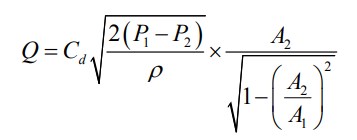
The ISO 5167-2 mass flow equation for an orifice plate is:
$$
q\_m = C\,\varepsilon\,\frac{\pi}{4}\,d^2\,\sqrt{\frac{2\rho\Delta P}{1-\beta^4}}
$$
where C is the discharge coefficient (dimensionless), ε is the expansibility factor (1 for liquids), β = d/D is the beta ratio, and d is the bore you are trying to find. In the flow problem you know d and solve for q_m. In the sizing problem you know q_m and must find d — but C depends on β and the pipe Reynolds number Re_D, which also depends on flow conditions. There is no algebraic closed form: the equation must be solved iteratively.
Why the calculation is iterative
The calculator uses the following strategy on each button press:
- Initial estimate. Compute β₀ using a fixed representative discharge coefficient, ignoring the (1 − β⁴) correction term. This gives a first approximation in a single step.
- Discharge coefficient update. Evaluate the Reader-Harris/Gallagher equation (ISO 5167-2 Annex A) for the current β and Re_D to get a refined C.
- Expansibility update (gas only). Compute ε for the current β, P₁, ΔP, and κ.
- Beta update. Recalculate β from the full sizing formula using the updated C and ε.
- Repeat steps 2–4 up to ten times until successive β values have converged.
In practice, three or four passes are sufficient because C varies slowly with β for fully turbulent flow.
The beta ratio constraint
ISO 5167-2 requires 0.2 ≤ β ≤ 0.75 for the Reader-Harris/Gallagher correlation to be valid. This is an empirical limit: the correlation coefficients were fitted to laboratory data collected across that range. Outside it, the equation extrapolates, and measurement uncertainty increases substantially.
The practical implications are:
- β < 0.2. A very small orifice relative to the pipe creates a high permanent pressure loss and amplifies the effect of bore imperfections or edge damage. The correlation is also extrapolating.
- β > 0.75. The orifice is nearly as large as the pipe. The differential pressure signal is very small, which magnifies transmitter and installation errors, and the correlation extrapolates in the opposite direction.
The calculator's Limits of Use section flags a red warning for β < 0.10 and β > 0.75. Note that the β ≥ 0.10 threshold is the calculator's hard-coded lower limit; for compliance with ISO 5167 and to remain within the validated accuracy of the Cd correlation, you should treat β < 0.20 as a design concern even if the calculator shows green. If your result falls outside the 0.20–0.75 band, the most effective lever is to change the specified ΔP: a higher ΔP increases β, a lower ΔP decreases it.
Gas-specific considerations: expansibility factor and pressure ratio limit
Expansibility factor $\varepsilon$. For a compressible fluid, gas density decreases as the fluid accelerates through the orifice and its static pressure falls. The expansibility factor corrects for this:
$$
\varepsilon = 1 - (0.351 + 0.256\beta^4 + 0.93\beta^8)\left(\frac{\Delta P}{P\_1}\right)^{1/\kappa}
$$
For liquids, ε = 1 exactly. For typical gas metering with ΔP/P₁ in the range 0.01–0.10, ε is approximately 0.97–0.99. Omitting this correction overestimates mass flow by 1–3%, which is comparable to the overall expanded uncertainty of the orifice plate itself.
Pressure ratio limit (Limit 7). The expansibility formula is derived under the assumption that the gas remains subsonic and that the pressure ratio stays above a minimum threshold. The calculator enforces P₂/P₁ ≥ 0.75 (equivalently, ΔP/P₁ ≤ 0.25). If the pressure ratio falls below 0.75, Limit 7 turns red and the calculation should not be used as-is.
Separately, if P₂/P₁ approaches the critical pressure ratio for your gas, the flow is choked (sonic at the vena contracta) and the ISO 5167 equation is fundamentally inapplicable. For air (κ = 1.4):
$$
r\_c = \left(\frac{2}{\kappa+1}\right)^{\kappa/(\kappa-1)} = \left(\frac{2}{2.4}\right)^{3.5} \approx 0.528
$$
In normal industrial metering, the ΔP is kept well below the critical value and Limit 7 will be the binding constraint you encounter first. If you see a red Limit 7, reduce the specified ΔP (or increase β by another means) before treating the result as valid.
The Calculator Interface at a Glance
The form is divided into three input sections followed by two output sections and a Limits of Use checklist.
Input sections
| Section |
Key fields |
| Identification Data |
Tagname, Site, Area, Notes |
| Fluid Data |
Fluid name; State of matter (Liquid/Gas); Density (liquid, direct entry); Molecular Weight (gas); Temperature (gas); P₁; Dynamic Viscosity; Ratio of Sp. Heats κ |
| Pipe Data |
Pipe Diameter D; Mass Flow (kg/s); Pressure Tappings (Flange / Corner / Radius D–½D); Pressure Range ΔP |
Unit conversion. Every numeric field has a unit-selector dropdown. The read-only field to its right shows the SI value that will be passed to the calculation. Always confirm that converted value before proceeding — entry errors in unit selection are among the most common sources of incorrect results.
Output sections
| Section |
Fields |
| Common Results |
Pressure Ratio P₂/P₁; Pressure Drop Ratio ΔP/P₁; Reynolds Number Re_D; Flow Regime (Laminar / Transitional / Turbulent); Beta Ratio β; Discharge Coefficient C |
| Specific Results |
Orifice Diameter d (with a unit selector for mm, cm, m, in, ft) |
| Limits of Use |
Seven ISO 5167 compliance checks, colour-coded green/red, updated after every Calculate! press |
Worked Example 1: Sizing for a Liquid Service (Water)
Scenario. Size a metering orifice plate to measure water at a target mass flow of 5 000 kg/h through a 4-inch schedule 40 pipe. The maximum allowable differential pressure is 100 mbar. Flange tappings are specified.
| Parameter |
Value |
| Fluid |
Water |
| Density |
998 kg/m³ |
| Upstream absolute pressure P₁ |
2 bar |
| Dynamic viscosity |
1 cP |
| Pipe internal diameter D |
101.6 mm (4" Sch 40) |
| Target mass flow |
5 000 kg/h = 1.389 kg/s |
| Maximum ΔP |
100 mbar |
| Pressure tappings |
Flange |
Step 1 — Enter the identification data
Fill in the Identification Data fields at the top of the form:
- Tagname:
FE-101 (or your site convention)
- Site: your plant or facility name
- Area: the process unit (e.g., Utilities, Cooling Water)
- Notes: any relevant context (optional)
These fields do not influence the calculation. They populate the downloadable ISA-style datasheet.
Step 2 — Configure the fluid data
- In the State of matter selector, choose Liquid. The Molecular Weight and Temperature fields disable automatically.
- Enter
998 in the Density field and confirm the unit selector reads kg/m³. The read-only converted field should display 998 Kg/m³.
- Enter
2 in Operating Pressure (P₁) and confirm the unit selector reads bar. The converted field should display 2 bar.
- Enter
1 in Dynamic Viscosity and confirm the unit selector reads cP. The converted field should display 1 cP.
- Leave Ratio of Sp. Heats at the default
1.4. It is not used in the liquid calculation.
Step 3 — Enter the pipe and flow data
-
Enter 101.6 in Pipe Diameter with the unit selector set to mm. Confirm 101.6 mm in the converted field.
-
Enter 1.389 in Mass Flow (kg/s).
Unit conversion required. The Mass Flow field accepts kg/s only. Divide by 3 600: 5 000 ÷ 3 600 = 1.389 kg/s.
-
Set Pressure Tappings to Flange.
-
Enter 100 in the Pressure Range (ΔP) field with the unit selector set to mbar. Confirm the converted field shows 0.1 bar.
Step 4 — Run the calculation
Click the orange Calculate! button. The calculator computes an initial β₀ estimate, then iterates the Reader-Harris/Gallagher equation up to ten times. You will see the result fields populate immediately.
Step 5 — Interpret the results
Your screen should show values close to those in the table below. Minor differences are due to iteration depth and rounding.
| Output |
Expected value |
What it means |
| Pressure Ratio (P₂/P₁) |
0.950 |
(2 − 0.1) / 2 = 1.9 / 2 |
| Pressure Drop Ratio (ΔP/P₁) |
0.050 |
0.1 / 2 |
| Reynolds Number Re_D |
~17 400 |
Turbulent; well above the ISO 5167 minimum |
| Flow Regime |
Turbulent |
Re_D > 4 000 |
| Beta Ratio β |
~0.254 |
d/D; within the ISO 5167 valid range |
| Discharge Coefficient C |
~0.600 |
RHG equation, converged |
| Orifice Diameter d |
~25.8 mm |
The bore you will specify on the datasheet |
The small beta ratio (~0.25) is a direct consequence of specifying a low ΔP of only 100 mbar at a modest flow rate: the orifice must be relatively small to produce any measurable differential signal at that flow. Beta is right at the lower edge of the ISO 5167 accuracy band (0.20).
Practical consideration. A low β means a high permanent pressure loss ratio. If energy cost is a concern, consider raising the specified ΔP (and selecting a higher-range transmitter) to bring β into the 0.40–0.60 range, which is the practical optimum for orifice plates in terms of signal-to-noise ratio and installation robustness. Re-run the calculator with ΔP = 500 mbar to see the effect.
Step 6 — Validate the Limits of Use
Scroll to the Limits of Use section. Each of the seven checks should be green:
| # |
Limit |
Status for this example |
| 1 |
Orifice diameter d ≥ 12.5 mm |
✓ (~25.8 mm) |
| 2 |
Pipe diameter D ≥ 50 mm |
✓ (101.6 mm) |
| 3 |
Pipe diameter D ≤ 5 000 mm |
✓ |
| 4 |
Beta ratio β ≥ 0.10 |
✓ (~0.254) — note: ISO 5167 accuracy requires β ≥ 0.20 |
| 5 |
Beta ratio β ≤ 0.75 |
✓ |
| 6 |
Reynolds number Re_D within range for Flange taps |
✓ (~17 400 ≥ 5 000) |
| 7 |
Pressure ratio (gas only — not evaluated for liquids) |
✓ |
All limits pass. The result is ISO 5167-2 compliant.
Download. Click the Download button below the results table to export the pre-filled ISA-style datasheet as a PDF. This file includes all inputs, results, and the Limits of Use status.
Worked Example 2: Sizing for a Gas Service (Air)
Scenario. Size a metering orifice plate to measure compressed air at a target mass flow of 800 kg/h through a 6-inch schedule 40 pipe. Upstream pressure is 5 bar absolute, maximum ΔP is 100 mbar, and flange tappings are specified.
| Parameter |
Value |
| Fluid |
Air |
| Molecular weight MW |
28.97 g/mol |
| Operating temperature T |
20 °C |
| Upstream absolute pressure P₁ |
5 bar |
| Dynamic viscosity |
0.018 cP |
| Ratio of specific heats κ |
1.4 |
| Pipe internal diameter D |
152.4 mm (6" Sch 40) |
| Target mass flow |
800 kg/h = 0.222 kg/s |
| Maximum ΔP |
100 mbar |
| Pressure tappings |
Flange |
Step 1 — Enter the identification data
Fill in Tagname, Site, Area, and Notes as in Example 1.
Step 2 — Configure the fluid data (gas mode)
-
In the State of matter selector, choose Gas. The Density field becomes read-only; Molecular Weight and Temperature become active.
-
Enter 28.97 in Molecular Weight.
-
Enter 20 in Operating Temperature with the unit selector set to C. Confirm 20 C in the converted field.
-
Enter 5 in Operating Pressure (P₁) with the unit selector set to bar. Confirm 5 bar.
The calculator immediately computes and displays the gas density using the ideal gas law:
$$\rho = \frac{P_1 \times MW}{R \times T} = \frac{5 \times 10^5\,\text{Pa} \times 0.02897\,\text{kg/mol}}{8.314\,\text{J/(mol\,K)} \times 293.15\,\text{K}} \approx 5.94\,\text{kg/m}^3$$
Verify that the read-only Density field shows approximately 5.94 Kg/m³. This is the value that will enter the sizing equation. For reference, air at standard conditions (~1.2 kg/m³) compressed to 5 bar gives ~5.9 kg/m³ — confirming the result is physically reasonable.
- Enter
0.018 in Dynamic Viscosity with the unit selector set to cP. Confirm 0.018 cP.
- Enter
1.4 in Ratio of Sp. Heats. This is correct for dry air and most diatomic gases.
Step 3 — Enter the pipe and flow data
-
Enter 152.4 in Pipe Diameter with the unit selector set to mm. Confirm 152.4 mm.
-
Enter 0.222 in Mass Flow (kg/s).
800 kg/h ÷ 3 600 = 0.222 kg/s.
-
Set Pressure Tappings to Flange.
-
Enter 100 in Pressure Range (ΔP) with the unit selector set to mbar. Confirm 0.1 bar.
Step 4 — Run the calculation
Click Calculate!. The iterative loop now computes the expansibility factor ε at each pass in addition to the discharge coefficient C, because air is a compressible fluid.
Step 5 — Interpret the results
| Output |
Expected value |
What it means |
| Pressure Ratio (P₂/P₁) |
0.980 |
(5 − 0.1) / 5 = 4.9 / 5 |
| Pressure Drop Ratio (ΔP/P₁) |
0.020 |
0.1 / 5 |
| Reynolds Number Re_D |
~103 000 |
Fully turbulent; far above the minimum |
| Flow Regime |
Turbulent |
Re_D ≫ 4 000 |
| Beta Ratio β |
~0.245 |
Within the ISO 5167 valid range |
| Discharge Coefficient C |
~0.598 |
RHG equation, converged |
| Orifice Diameter d |
~37.3 mm |
The bore you will specify on the datasheet |
The beta ratio (~0.245) is again close to the lower boundary of the ISO 5167 range, driven by the relatively modest ΔP of 100 mbar combined with the high line pressure (5 bar) — the gas is dense and the available driving pressure difference is small relative to the line pressure. If β below 0.2 were to occur, raising the specified ΔP would be the straightforward remedy.
Step 6 — Gas-specific outputs: expansibility factor and pressure ratio
Expansibility factor ε
With $\Delta P/P_1 = 0.02$ and $\beta \approx 0.245$, the ISO 5167-2 expansibility formula gives:
$$\varepsilon = 1 - \left(0.351 + 0.256\,\beta^4 + 0.93\,\beta^8\right) \left(\frac{\Delta P}{P_1}\right)^{\!1/\kappa}$$
$$\approx 1 - 0.352 \times (0.02)^{1/1.4} \approx 1 - 0.352 \times 0.0614 \approx 0.978$$
An ε of 0.978 means the effective gas density at the vena contracta is about 2.2% lower than at the upstream tapping due to expansion. If you were to use the liquid formula (ε = 1) for this gas service, you would overestimate mass flow by approximately 2.2% — a systematic error that is comparable to the typical expanded measurement uncertainty of an orifice plate. Always apply the expansibility correction for gas.
The calculator applies ε internally at each iteration; you do not need to enter it. Its effect is visible in the converged C value being slightly lower than you would expect for an equivalent liquid case.
Pressure ratio check (Limit 7)
The calculated P₂/P₁ = 0.980 must be compared against two thresholds:
| Threshold |
Value |
This example |
Status |
| Calculator Limit 7: expansibility formula valid |
P₂/P₁ ≥ 0.75 |
0.980 |
✓ Well above |
| Physical choked flow limit for air (κ = 1.4) |
P₂/P₁ ≥ r_c ≈ 0.528 |
0.980 |
✓ Well above |
The calculator's Limit 7 checks the first threshold (ΔP/P₁ ≤ 0.25), which ensures the expansibility formula itself remains valid and accurate. The choked flow limit (r_c ≈ 0.528 for air) is a harder physical boundary: at or below it the flow is sonic at the vena contracta, the ISO 5167 model breaks down entirely, and no correction factor recovers it. In this example both thresholds are satisfied with substantial margin.
When to watch for choked flow. A high-pressure gas at large ΔP — for example, a control valve bypass where the full upstream pressure appears across the orifice — can approach or exceed the critical pressure ratio. If your process can ever see P₂/P₁ ≤ 0.528 (for air), that operating scenario is outside the scope of the calculator entirely.
Step 7 — Validate the Limits of Use
| # |
Limit |
Status for this example |
| 1 |
Orifice diameter d ≥ 12.5 mm |
✓ (~37.3 mm) |
| 2 |
Pipe diameter D ≥ 50 mm |
✓ (152.4 mm) |
| 3 |
Pipe diameter D ≤ 5 000 mm |
✓ |
| 4 |
Beta ratio β ≥ 0.10 |
✓ (~0.245) — note: ISO 5167 accuracy requires β ≥ 0.20 |
| 5 |
Beta ratio β ≤ 0.75 |
✓ |
| 6 |
Reynolds number Re_D within range for Flange taps |
✓ (~103 000 ≥ 5 000) |
| 7 |
Pressure ratio P₂/P₁ ≥ 0.75 (gas service) |
✓ (0.980) |
All seven limits pass. The result is ISO 5167-2 compliant for a gas service.
Worked Example 3: Sizing for a Steam Service (Saturated Steam)
Scenario. Size a metering orifice plate to measure saturated steam on a 4-inch Sch 40 utility header. The target mass flow is 2 000 kg/h and the maximum allowable differential pressure is 200 mbar. Flange tappings are specified.
| Parameter |
Value |
| Fluid |
Steam (Water Vapor) |
| State of matter |
Steam |
| Steam quality (x) |
1.0 (dry saturated) |
| Operating temperature T |
180 °C |
| Upstream absolute pressure P₁ |
10 bar |
| Steam density ρ (auto-filled) |
~5.16 kg/m³ |
| Dynamic viscosity μ |
0.0145 cP |
| Ratio of specific heats κ |
1.13 |
| Pipe internal diameter D |
101.6 mm (4" Sch 40) |
| Target mass flow |
2 000 kg/h = 0.556 kg/s |
| Maximum ΔP |
200 mbar |
| Pressure tappings |
Flange |
How the calculator obtains steam density. When Steam (Water Vapor) is selected, the Density field becomes read-only. The calculator calls the server-side IAPWS-IF97 steam property lookup using the temperature you enter and the steam quality x, computing the homogeneous mixture density automatically. For dry saturated steam (x = 1) at 180 °C, the returned density is approximately 5.16 kg/m³. Verify the populated density field before pressing Calculate!
Step 1 — Enter identification data
Fill in Tagname, Site, Area, and Notes as in the previous examples (for example, FE-301, Utilities, HP Steam Header).
Step 2 — Configure the fluid data
- In State of matter, choose Steam (Water Vapor). A Steam Quality (x) field appears.
- Enter
1.0 in Steam Quality (x) (dry saturated steam; 0 = saturated liquid, 1 = dry saturated).
- Enter
180 in Operating Temperature and confirm the unit selector reads °C.
- Enter
10 in Operating Pressure (P₁) with the unit selector set to bar. Confirm 10 bar in the converted field. The calculator fetches IAPWS-IF97 properties and populates the read-only Density field with approximately 5.16 Kg/m³.
- Enter
0.0145 in Dynamic Viscosity and set the unit selector to cP.
- Enter
1.13 in Ratio of Sp. Heats. This is the isentropic exponent for saturated steam and governs the expansibility factor and critical pressure ratio.
Step 3 — Enter the pipe and flow data
- Enter
101.6 in Pipe Diameter with the unit selector set to mm.
- Enter
0.556 in Mass Flow (kg/s). (2 000 ÷ 3 600 = 0.556 kg/s.)
- Set Pressure Tappings to Flange.
- Enter
200 in Pressure Range (ΔP) and set the unit selector to mbar. Confirm 0.2 bar in the converted field.
Step 4 — Run the calculation
Click Calculate! The calculator iterates the Reader-Harris/Gallagher equation with the expansibility factor for steam (κ = 1.13) until β converges.
Step 5 — Interpret the results
| Output |
Expected value |
What it means |
| Pressure Ratio (P₂/P₁) |
0.980 |
(10 − 0.2) / 10 |
| Pressure Drop Ratio (ΔP/P₁) |
0.020 |
0.2 / 10 |
| Reynolds Number Re_D |
~480 000 |
Fully turbulent; well above the ISO 5167 minimum |
| Flow Regime |
Turbulent |
Re_D ≫ 4 000 |
| Beta Ratio β |
~0.498 |
d/D; within the ISO 5167 valid range 0.2–0.75 |
| Discharge Coefficient C |
~0.601 |
RHG equation, converged |
| Orifice Diameter d |
~50.6 mm |
Bore to specify on the datasheet |
The β ≈ 0.50 is ideal for orifice plate metering — it provides a strong differential signal while keeping permanent pressure loss moderate, and it sits in the most accurately characterised region of the ISO 5167 correlation.
Expansibility factor. With ΔP/P₁ = 0.020 and κ = 1.13, the ISO 5167-2 expansibility formula gives ε ≈ 0.988. This means the steam expands by about 1.2% as it accelerates through the orifice. If you applied the liquid formula (ε = 1), you would overestimate mass flow by ~1.2%. The calculator applies ε internally at each iteration.
Critical pressure ratio for steam. For steam with $\kappa = 1.13$: $r_c = \left(\frac{2}{\kappa+1}\right)^{\kappa/(\kappa-1)} = \left(\frac{2}{2.13}\right)^{8.69} \approx 0.578$. With $P_2/P_1 = 0.980$, the flow is far from choked. Limit 7 ($P_2/P_1 \geq 0.75$) passes comfortably.
Step 6 — Validate the Limits of Use
| # |
Limit |
Status for this example |
| 1 |
Orifice diameter d ≥ 12.5 mm |
✓ (~50.6 mm) |
| 2 |
Pipe diameter D ≥ 50 mm |
✓ (101.6 mm) |
| 3 |
Pipe diameter D ≤ 5 000 mm |
✓ |
| 4 |
Beta ratio β ≥ 0.10 |
✓ (~0.498) |
| 5 |
Beta ratio β ≤ 0.75 |
✓ |
| 6 |
Reynolds number Re_D within range for Flange taps |
✓ (~480 000 ≥ 5 000) |
| 7 |
Pressure ratio P₂/P₁ ≥ 0.75 (steam service) |
✓ (0.980) |
All limits pass. The result is ISO 5167-2 compliant for a steam service.
Steam quality considerations. If the steam is wet (x < 1.0), the HEM density will be higher than the dry-saturated value, producing a smaller required bore for the same flow and ΔP. For x = 0.95 at 180 °C, the HEM density rises to approximately 15 kg/m³ and the calculated bore would decrease to around 35 mm. Always verify the steam quality value with your process engineer before proceeding to procurement.
Round down to a drillable bore. As with any service, round the calculated bore down to the nearest available drill size (0.5 mm increments is typical). Verify the resulting ΔP at the rounded bore using the companion Orifice Plate – Find Pressure Drop calculator. For steam service, a small increase in ΔP is generally acceptable within the transmitter range.
After You Finish
A valid result from this calculator is a theoretical bore diameter. Before it reaches a purchase order or a fabrication drawing, three further steps are normally required.
Round the bore to a realisable drill size
The calculator delivers the exact bore needed to satisfy the specified flow and ΔP simultaneously. In practice, workshop tolerances mean bores are drilled to the nearest 0.5 mm (or 1/64 in). Always round down to keep the bore smaller than the theoretical value: a slightly undersized bore increases ΔP at the target flow, which keeps the signal within the transmitter range and errs conservatively on measurement sensitivity.
After rounding, verify the resulting flow rate and ΔP at the rounded bore by running the companion Orifice Plate – Find Flow calculator. Confirm that the differential pressure at maximum flow stays within your transmitter's calibrated range.
Check installation straight-run requirements
ISO 5167-2 specifies minimum upstream and downstream straight pipe lengths as a function of β and the fitting immediately upstream (single bend, double bend out-of-plane, reducer, valve, etc.). These requirements can be substantial at higher beta ratios. Refer to the Orifice Plate Installation Guidelines for the applicable straight-length tables before committing to a pipe layout.
Verify at minimum flow
If turndown matters to your application, repeat the calculation at the minimum expected mass flow with the same ΔP. Check that:
- Re_D remains above the ISO 5167 minimum (≥ 5 000 for flange taps).
- The differential pressure at minimum flow is still within the transmitter's calibrated range (and above its minimum readable signal).
An orifice plate sized only at the maximum flow point can fall outside the valid Re_D range at low loads, producing uncorrectable measurement error.