Restriction Orifice Calculator - Find Pressure Drop
Pressure Drop Restriction Orifice Calculation
Common Results | |||||
| Pressure Downstream | Pressure Drop Ratio (DP/P1) | N/A | |||
| Pressure Ratio (P2/P1) | N/A | Critical Pressure Ratio | N/A | ||
| Reynolds (ReD) | N/A | Reynolds Flow Regime | N/A | ||
| Contraction coefficient | N/A | Expansibility Factor | N/A | ||
| Beta Ratio | N/A | Velocity in Pipe | |||
| Mass Flow | Volumetric Flow | ||||
Specific Results | |||||
| Pressure Drop | Noise Level | dB | |||
Limits of Use | |||||
| Choked Flow - The result has not yet been evaluated. | |||||
| Velocity in Pipe - The result has not yet been evaluated. | |||||
| Noise Level - The result has not yet been evaluated. | |||||
Overview
This tutorial walks you through using the Restriction Orifice Calculator — Find Pressure Drop at instrumentationandcontrol.net. By the end, you will have entered fluid and geometry data for both a liquid and a gas service, triggered the calculation, and correctly interpreted every result field — including the discharge coefficient, the expansibility factor, the choked-flow indicator, and the pressure drop itself.
The calculator answers the question: given a bore that already exists (or is being proposed), what pressure drop will it develop at the design flow rate? This is the inverse of the sizing problem (where you specify a desired ΔP and solve for d). You will use it when checking an existing bore, verifying a vendor's selection, or exploring the sensitivity of ΔP to small changes in bore diameter.
Two worked examples are included:
- Example 1 — Liquid: Water, 4-inch (DN 100) pipe, d = 20 mm, 1 000 kg/h.
- Example 2 — Gas: Nitrogen, 4-inch pipe, d = 30 mm, 200 kg/h at 10 bar abs.
Why a Restriction Orifice Is Not a Metering Orifice
Before entering any data it is worth understanding a constraint that does not apply here.
A metering orifice plate (ISO 5167-2) is a precision flow-measurement device. Its discharge coefficient correlation is valid only over a narrow beta ratio range of 0.20 ≤ β ≤ 0.75. Outside that band the correlation uncertainty increases sharply, and the standard does not cover it.
A restriction orifice (RO) is a pressure-letdown or flow-limiting device. Measurement accuracy is not the goal; a defined pressure drop (or a maximum flow ceiling) is. Beta ratios well outside the metering range are normal — values of β = 0.05 to 0.20 are common, and there is no lower bound imposed by this calculator. The discharge coefficient α is derived from a contraction-coefficient correlation (sometimes written C_c) rather than from the ISO 5167 discharge-coefficient correlation. The underlying flow equation is the same orifice equation, but the coefficient is computed differently and is valid across a much wider beta range.
A practical consequence: if you enter a very small bore relative to the pipe, the calculator will still return a result. It is your responsibility to ensure the bore is mechanically realisable (minimum 1–2 mm for most applications) and that the RO plate material and schedule can sustain the resulting forces.
How the Calculator Works
The Governing Equation
The calculator applies the incompressible orifice equation corrected for gas compressibility through an expansibility factor:
where:
| Symbol | Meaning | SI Unit |
|---|---|---|
| qm | Mass flow rate | kg/s |
| alpha | Discharge coefficient (α) | — |
| epsilon | Expansibility factor (ε); 1.000 for liquids | — |
| d | Orifice bore diameter | m |
| rho | Fluid density at upstream conditions | kg/m³ |
| DP | Pressure drop across the orifice | Pa |
Rearranging to solve for $\Delta P$:
For gas, α and ε both depend on ΔP, so the calculator solves iteratively until consecutive estimates of ΔP differ by less than 0.000001 bar.
The Discharge Coefficient α
The discharge coefficient is calculated from a correlation that is a function of the beta ratio $\beta$, the pipe diameter $D$, and the pipe Reynolds number $Re_D$. The correlation used is:
where alpha_0 and a are themselves polynomial functions of β and D. For fully turbulent flow (Re_D > 10 000) the Reynolds-number correction term is negligible and α converges to a value close to 0.60–0.65 for typical restriction-orifice beta ratios. At lower Reynolds numbers — including the transitional zone — the correction increases α somewhat.
You do not need to compute α manually; the calculator derives it from your inputs. The result is shown in the Contraction Coefficient output field.
Density for Gas Service
When you select Gas, the calculator derives the fluid density from the ideal gas law:
where R = 0.083143 bar·L/(mol·K), P1 is the upstream absolute pressure in bar, MW is in g/mol, and T_abs = 273.15 + T(°C) in kelvin. The resulting rho is in kg/m³ (numerically equal to g/L for an ideal gas at these units).
This density is used in all downstream calculations. For real gases at high pressure or low temperature, the ideal-gas assumption introduces error; you should substitute a corrected density value by switching to Liquid mode and entering rho directly.
The Expansibility Factor ε (Gas Only)
When a compressible gas expands through an orifice, its density at the vena contracta is lower than at the upstream tap. The expansibility factor $\varepsilon < 1$ corrects for this density change. The calculator uses a linearised correlation:
where
For small $\Delta P/P_1$ ratios (say, less than 0.05), $\varepsilon$ is very close to 1.000 and its effect is negligible. As the pressure drop increases toward the critical value, $\varepsilon$ falls appreciably and the mass-flow capacity of the bore is reduced relative to the incompressible prediction.
For liquid service the calculator sets ε = 1.000 exactly.
Choked Flow (Gas Only)
Gas velocity through an orifice cannot exceed the local speed of sound. When the pressure ratio $P_2/P_1$ reaches the critical pressure ratio, the velocity at the vena contracta is sonic and the flow is said to be choked. Any further reduction in downstream pressure produces no additional flow. The critical pressure ratio is:
For diatomic gases with $\kappa = 1.4$ (air, nitrogen, oxygen):
This means choked flow occurs when $P_2 < 0.528\,P_1$, or equivalently when $\Delta P > 0.472\,P_1$. For $P_1 = 10$ bar abs, choked flow begins when $\Delta P$ exceeds approximately 4.72 bar.
When the unconstrained solution would imply $\Delta P > (1 - PR_{crit})P_1$, the calculator switches to a separate Newton-Raphson solver that finds the actual pressure ratio at which the given mass flow can be delivered at choked conditions. The choked-flow limit indicator in the results section turns red if this condition is reached.
Input Fields Reference
Identification Data
These fields are optional for the calculation but are exported to the PDF datasheet. They correspond to header fields in an ISA S20 instrument specification sheet.
| Field | Description |
|---|---|
| Tagname | ISA tag number of the restriction orifice (e.g., FE-1023) |
| Site | Plant or facility name |
| Area | Process unit or area (e.g., Utilities, Polymerisation, Storage) |
| Notes | Free-text annotations, design basis notes, or revision history |
Fluid Data
| Field | Applicable to | Default | Notes |
|---|---|---|---|
| Fluid | All | — | Descriptive name only; not used in calculation |
| State of matter | All | Liquid | Switches between Liquid and Gas input modes |
| Density | Liquid | 1 000 kg/m³ | Direct entry; multiple units supported |
| Molecular Weight | Gas | 18 g/mol | Used with T and P1 to compute density via ideal gas law |
| Operating Temperature | Gas | 25 °C | Converted to kelvin internally; multiple units supported |
| Operating Pressure (P1) | All | 14 bar | Upstream absolute pressure; used for gas density, choked flow, and ε |
| Dynamic Viscosity | All | 1 cP | Used to compute Re_D; multiple units supported |
| Ratio of Specific Heats (κ) | Gas | 1.4 | Required for PR_crit and ε; use 1.4 for diatomic gases, 1.3 for CO₂, ~1.13 for steam |
Note on P1 for liquids. The upstream pressure is not used in the liquid pressure-drop calculation itself (choked flow does not occur in liquids and ε = 1). The field remains active because it is exported to the datasheet and is required if you later repurpose the session for a gas calculation.
Pipe Data
| Field | Default | Notes |
|---|---|---|
| Pipe Diameter (D) | 101.6 mm | Internal diameter; enter the actual bore, not the nominal pipe size |
| Orifice Bore (d) | 25 mm | The bore you want to evaluate; no beta-ratio constraint is enforced |
| Mass Flow | 0.5 kg/s | Multiple units supported via the unit selector; enter in whichever unit your datasheet uses |
Results Reference
After clicking Calculate!, the results panel populates in three groups.
Common Results
| Field | Symbol | Unit | Description |
|---|---|---|---|
| Pressure Downstream | P2 | bar abs | Calculated as P1 − ΔP |
| Pressure Drop Ratio | PDR | — | ΔP / P1; dimensionless ratio of pressure drop to upstream pressure |
| Pressure Ratio | PR | — | P2 / P1; compare against Critical P Ratio to assess choked-flow margin |
| Critical P Ratio | pcrit | — | PR_crit as defined above; 0 for liquids |
| Reynolds Number | ReD | — | Pipe Reynolds number: $Re_D = v_pD\rho/\mu$ |
| Flow Regime | ReR | — | Laminar (Re < 2 100), Transitional (2 100–4 000), or Turbulent (Re > 4 000) |
| Contraction Coefficient | alpha (α) | — | The discharge coefficient used in the flow equation |
| Expansibility Factor | eps (ε) | — | Compressibility correction; 1.000 for liquids |
| Beta Ratio | Beta (β) | — | d / D |
| Velocity in Pipe | vp | m/s | Mean bulk velocity in the upstream pipe |
| Mass Flow | qh | kg/h | Confirmation of mass flow rate at operating conditions |
| Volumetric Flow | qv | m³/h | Volume flow at upstream density |
Specific Results
| Field | Symbol | Unit | Description |
|---|---|---|---|
| Pressure Drop | DP | bar | Primary result. Pressure drop across the restriction orifice at the stated flow rate |
Limits of Use
| Indicator | Green condition | Red condition |
|---|---|---|
| Choked Flow | P2/P1 ≥ PR_crit (flow is sub-critical) | P2/P1 < PR_crit (flow is choked; stated ΔP is the maximum achievable at this bore) |
| Velocity in Pipe | vp ≤ 3 m/s (liquid) or vp ≤ 25 m/s (gas) | Pipe velocity exceeds the general guideline; review pipe sizing |
Worked Example 1: Water (Liquid Service)
A restriction orifice is installed in a DN 100 cooling-water line. The bore has been drilled at 20 mm. You need to confirm the pressure drop across the plate at the design flow rate of 1 000 kg/h.
Given data:
| Parameter | Value |
|---|---|
| Pipe internal diameter D | 101.6 mm (4-inch schedule 40) |
| Orifice bore d | 20 mm |
| Fluid | Water |
| Density ρ | 998 kg/m³ |
| Dynamic viscosity μ | 1 cP |
| Mass flow | 1 000 kg/h |
Step 1 — Open the Calculator
Navigate to https://instrumentationandcontrol.net/restriction-orifice-calculator-pressure-drop.php.
The page opens with State of matter set to Liquid by default. No change is needed.
Step 2 — Enter Identification Data
Fill in the identification fields as appropriate for your project. For this example:
| Field | Value |
|---|---|
| Tagname | FE-2201 |
| Site | Utilities |
| Area | Cooling Water Circuit |
| Notes | Design flow verification, nominal 1 000 kg/h |
These fields are not used in the calculation but will appear on the exported PDF.
Step 3 — Enter Fluid Data
- Fluid: type
Water. - State of matter: confirm Liquid is selected (the Density field is active; Molecular Weight and Temperature are greyed out).
- Density: enter
998and confirm the unit selector shows kg/m³. - Operating Pressure (P1): leave at the default
14bar. For a liquid, this value does not affect ΔP but is exported to the datasheet. - Dynamic Viscosity: enter
1and confirm the unit selector shows cP. - Ratio of Specific Heats: leave at
1.4(not used for liquids).
Step 4 — Enter Pipe Data
- Pipe Diameter (D): enter
101.6and confirm the unit shows mm. - Orifice Bore (d): enter
20and confirm the unit shows mm. - Mass Flow: change the unit selector to kg/h, then enter
1000.
Step 5 — Run the Calculation
Click Calculate!.
Step 6 — Read and Interpret the Results
The results panel should show values consistent with the following:
| Result | Value | Interpretation |
|---|---|---|
| Beta Ratio β | 0.197 | Well below the 0.20 lower limit of metering plates; acceptable for an RO |
| Velocity in Pipe vp | 0.034 m/s | Very low; the 4-inch pipe is generously sized for this flow rate |
| Reynolds Number Re_D | ~3 480 | Transitional flow (2 100–4 000) |
| Flow Regime | Transitional | See note below |
| Contraction Coefficient α | ~0.610 | Close to the classic sharp-edged orifice value of 0.61 |
| Expansibility Factor ε | 1.000 | Liquid; not applicable |
| Pressure Drop ΔP | ~0.011 bar (1.05 kPa) | Primary result |
| Pressure Ratio PR | ~0.999 | P2 ≈ P1; negligible pressure drop relative to line pressure |
| Choked Flow | Green | Not applicable to liquids |
| Velocity in Pipe (limit) | Green | 0.034 m/s is well within the 3 m/s guideline |
Understanding the Transitional Reynolds Number
Re_D ≈ 3 480 places this case in the transitional zone between laminar (< 2 100) and fully turbulent (> 4 000) flow. In this regime the discharge coefficient is less stable and more sensitive to upstream disturbances than in turbulent flow. The Reynolds-number correction in the α correlation accounts for the lower Re_D, but if the actual operating conditions fluctuate significantly around this design point, the coefficient — and therefore the ΔP — will vary accordingly. For a restriction orifice where precise pressure drop is critical, consider increasing the flow rate or reducing the pipe bore to achieve turbulent flow at the design point.
Why the Pressure Drop Is Small
At 1 000 kg/h (0.278 kg/s), the velocity through the 20 mm bore is approximately 0.89 m/s — modest for a sharp-edged orifice. The resulting ΔP of ~0.011 bar (11 mbar, ~110 mmH₂O) is real but small. If the duty requires a higher pressure drop — for example, to consume spare head in a gravity-fed system — a smaller bore (d ≈ 8–12 mm) would be more appropriate. Use the companion Restriction Orifice Calculator — Find Bore Size page to iterate on d for a target ΔP.
Worked Example 2: Nitrogen (Gas Service)
A restriction orifice with a 30 mm bore is installed in a DN 100 nitrogen supply line at 10 bar abs. The design throughput is 200 kg/h at 20 °C. You need to verify the pressure drop and confirm the flow is not choked.
Given data:
| Parameter | Value |
|---|---|
| Pipe internal diameter D | 101.6 mm |
| Orifice bore d | 30 mm |
| Fluid | Nitrogen (N₂) |
| Molecular weight MW | 28.01 g/mol |
| Operating temperature T | 20 °C |
| Operating pressure P1 | 10 bar abs |
| Dynamic viscosity μ | 0.018 cP |
| Ratio of specific heats κ | 1.4 (diatomic) |
| Mass flow | 200 kg/h |
Step 1 — Open the Calculator and Select Gas Mode
Navigate to the calculator page. In the State of matter drop-down, select Gas. The Density field greys out and the Molecular Weight and Operating Temperature fields become active.
Step 2 — Enter Identification Data
| Field | Value |
|---|---|
| Tagname | FE-3105 |
| Site | Nitrogen Distribution |
| Area | Blanketing Header |
| Notes | 10 bar supply, 200 kg/h design, bore verification |
Step 3 — Enter Fluid Data
- Fluid: type
Nitrogen. - Molecular Weight: enter
28.01. - Operating Temperature: enter
20and confirm the unit is C (°C). The calculator converts this to 293.15 K internally. - Operating Pressure (P1): enter
10and confirm the unit is bar (absolute). - Dynamic Viscosity: enter
0.018, confirm cP. - Ratio of Specific Heats: enter
1.4(the default is already correct for nitrogen).
The calculator will now compute the gas density automatically using the ideal gas law. You can verify the derived density in the greyed-out Density display field: it should read approximately 11.49 kg/m³, consistent with rho = 28.01 × 10 / (0.0831433 × 293.15) ≈ 11.49 kg/m³.
Step 4 — Enter Pipe Data
- Pipe Diameter (D):
101.6mm. - Orifice Bore (d):
30mm. - Mass Flow: select kg/h and enter
200.
Step 5 — Run the Calculation
Click Calculate!.
Step 6 — Read and Interpret the Results
| Result | Value | Interpretation |
|---|---|---|
| Beta Ratio β | 0.295 | Within the restriction-orifice operating range |
| Velocity in Pipe vp | ~0.60 m/s | Well within the 25 m/s guideline for gas |
| Reynolds Number Re_D | ~38 800 | Fully turbulent |
| Flow Regime | Turbulent | Coefficient is stable; reliable ΔP result |
| Contraction Coefficient α | ~0.634 | Slightly higher than the liquid case at similar β, as expected for turbulent gas flow |
| Expansibility Factor ε | ~1.000 | ΔP/P1 ≈ 0.00067; expansion correction is negligible |
| Critical P Ratio | 0.528 | Choked flow begins below P2/P1 = 0.528 (i.e., ΔP > 4.72 bar) |
| Pressure Drop ΔP | ~0.0067 bar (0.67 kPa) | Primary result |
| Pressure Ratio PR | ~0.9993 | P2/P1 far above the critical ratio of 0.528 |
| Pressure Drop Ratio PDR | ~0.00067 | ΔP is 0.067 % of P1; no choked-flow risk at this bore and flow |
| Choked Flow | Green | Sub-critical; safe margin of ~4.71 bar before choke |
| Velocity in Pipe (limit) | Green | 0.60 m/s is far below 25 m/s |
Interpreting the Expansibility Factor
ε = 1.000 (to three decimal places) confirms that gas compressibility has a negligible influence on this result. The ΔP of 0.0067 bar is only 0.067 % of P1. In this regime the restriction orifice behaves essentially as an incompressible device. The expansibility correction becomes important when ΔP/P1 exceeds roughly 0.05 (5 %). For the nitrogen line at P1 = 10 bar, that would require ΔP > 0.5 bar — a significantly larger bore restriction than the 30 mm bore produces at 200 kg/h.
Interpreting the Choked-Flow Result
The critical pressure ratio of 0.528 means choked flow sets in when P2 falls below 5.28 bar abs (at P1 = 10 bar). The current operating point gives P2 ≈ 9.993 bar abs — a margin of approximately 4.71 bar before choke. The choked-flow indicator is green and the Limits of Use section confirms: "There is no choked flow."
If you now reduce the bore — for example to d = 10 mm — or greatly increase the flow rate in the calculator, you may see the indicator turn red. At that point the calculator switches to the choked-flow branch internally: it solves for the actual pressure ratio at which the given mass flow is delivered at sonic conditions, and the ΔP displayed represents the maximum pressure drop achievable through that bore. No increase in downstream pressure drop can force more flow through a choked orifice; any additional pressure energy is dissipated as heat and noise downstream.
Exporting Results
Downloading a PDF Datasheet
After a successful calculation, click Download → SEND (or the equivalent download button on the page). The calculator assembles a PDF report that includes:
- Identification data (Tagname, Site, Area, Notes) as a header block.
- A full table of inputs in the user-selected units.
- All common and specific results, also in user-selected units.
- The Limits of Use indicators.
- A disclaimer footer.
The file is named automatically using the date, time, and tagname (for example, 2025-06-15 14-32-01-FE-3105.pdf).
Adapting Results for an ISA S20 Datasheet
The identification fields map directly to the standard ISA S20 header: Tagname → Tag Number; Site → Plant; Area → Area/Unit. Copy the PDF values into the corresponding rows of your specification sheet. The Pressure Drop (ΔP) and Operating Pressure (P1) values populate the Differential Pressure and Inlet Pressure rows of the RO datasheet. Beta ratio, discharge coefficient, and Reynolds number support the Sizing Basis section.
Troubleshooting Common Issues
Unexpected Zero or Blank Results
If all result fields remain empty after clicking Calculate!, check that:
- All required numeric fields contain valid positive numbers (no blank or zero values in D, d, qm, rho, or mu).
- For gas mode, MW, T, and P1 are all filled and non-zero. A zero molecular weight or temperature causes a divide-by-zero in the density calculation.
- The mass flow unit selector matches the value you entered. Entering 1 000 into a field whose unit is kg/s would cause an unrealistically high flow that may exceed the orifice capacity.
Orifice Too Small Warning
If the calculator returns no ΔP result for a very small bore, the bore may be physically too small to pass the specified flow — that is, even with DP equal to the entire upstream pressure P1, the orifice cannot deliver qm. Increase d or reduce the flow rate. The calculator flags this condition internally (the ots flag); the result fields will remain empty.
Choked Flow with an Unexpectedly High ΔP
If the choked-flow indicator turns red, the ΔP displayed is not the pressure drop you would measure at the design flow — it is the maximum pressure drop the bore can sustain while delivering that mass flow. To bring the system out of choke, increase the bore diameter d (which reduces the required ΔP), raise P1, or reduce the design mass flow. For critical-service restriction orifices — for example, on flare or blowdown headers — choked flow may be the intended design condition, providing a firm maximum flow ceiling regardless of downstream pressure fluctuations.
Transitional Reynolds Number
A Reynolds number in the range 2 100–4 000 (Transitional) indicates unstable flow in the pipe. The discharge coefficient correlation is less accurate in this regime. If your operating point falls in this band, consider:
- Checking whether the actual operating flow is likely to be higher (fully turbulent) or lower (laminar) than the design value.
- Using a smaller pipe if the process permits, to move the operating Re above 4 000 at the design flow.
- Applying a conservative uncertainty margin to the ΔP result.
Worked Example 3 — Steam Service (Saturated Steam, 3" Pipe)
Scenario. Confirm the pressure drop across an existing 14.7 mm restriction orifice in a 3-inch (77.9 mm ID) steam line passing 500 kg/h of dry saturated steam at 10 bar abs.
| Parameter | Value |
|---|---|
| Fluid | Steam (Water Vapor), x = 1.0 (dry saturated) |
| Operating temperature | 180 °C |
| Upstream pressure P₁ | 10 bar abs |
| Density (auto-filled) | ~5.16 kg/m³ |
| Dynamic viscosity | 0.0145 cP |
| Ratio of specific heats κ | 1.13 |
| Pipe ID D | 77.9 mm |
| Orifice bore d | 14.7 mm |
| Mass flow | 500 kg/h = 0.139 kg/s |
Configuration Steps
- Set State of matter to Steam (Water Vapor), enter x = 1.0, T = 180 °C, P₁ = 10 bar. The density auto-fills (~5.16 kg/m³).
- Enter μ = 0.0145 cP, κ = 1.13.
- Enter D = 77.9 mm, d = 14.7 mm, mass flow = 0.5 kg/s (or 1 800 kg/h unit with appropriate conversion).
- Click Calculate!
Expected Results
| Output | Expected value | Notes |
|---|---|---|
| Beta Ratio β | 0.189 | 14.7 / 77.9 |
| Reynolds Number Re_D | ~150 000 | Turbulent |
| Discharge Coefficient Cd | ~0.62 | Standard Cd for sharp-edged orifice |
| Expansibility Factor Y | ~0.927 | κ = 1.13, ΔP/P₁ ≈ 0.20 |
| Pressure Drop ΔP | ~2.0 bar | Confirmed consistent with companion examples |
| P₂ (derived) | ~8.0 bar abs | P₁ − ΔP |
| P₂/P₁ | 0.80 | Above r_c ≈ 0.578 — sub-critical |
| Choked Flow | No | P₂/P₁ > r_c |
Consistency check with companion calculators. This result should be the inverse of Examples 3 in the Restriction Orifice — Find Flow Rate and Restriction Orifice — Find Orifice Size calculators. Entering the same geometry and flow conditions returns ΔP ≈ 2.0 bar; entering ΔP = 2.0 bar and flow = 500 kg/h in the sizing calculator returns d ≈ 14.7 mm. Cross-checking across these three calculators is good practice for verifying data entry and unit selection.
Steam at κ = 1.13 vs. air at κ = 1.4. Steam has a lower isentropic exponent than diatomic gases. This produces a lower critical pressure ratio (r_c ≈ 0.578 vs. 0.528 for air) and a larger expansibility correction at the same ΔP/P₁ ratio. If you mistakenly use κ = 1.4 for steam, the calculator will underestimate Y and slightly overestimate ΔP. Always use κ = 1.13 for saturated steam.
What happens near the choked limit. If the downstream system pressure drops to 5.78 bar (r_c × P₁), the flow becomes choked. In the pressure-drop direction, the calculator will report a ΔP at the choked condition and flag the result. At choked conditions, no further increase in mass flow can be achieved by reducing P₂ — the restriction orifice acts as a flow-limiting device.
Information and Definitions
| Term | Definition |
|---|---|
| Used Equation | 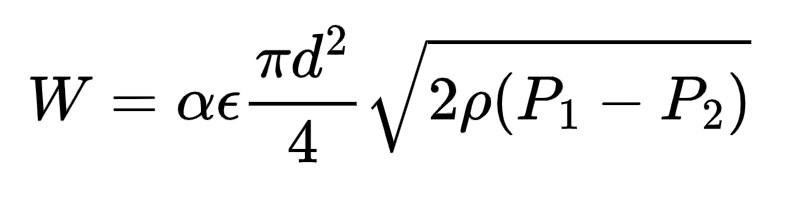 |
| Dimensional Analysis |  |
| Beta Ratio | The ratio of the orifice diameter to the pipe diameter, affecting flow restriction and pressure drop. It is essential in flow measurement, with specific ratios optimizing accuracy for different flow ranges. |
| Choked Flow | Choked flow occurs when a gas flow reaches maximum velocity due to critical pressure conditions, limiting further flow increase. It's vital in gas transport systems to avoid system inefficiencies and ensure safe operation. |
| Common Results | Refers to standard calculations and outputs in fluid mechanics, such as flow rate, pressure drop, and velocity, essential for analyzing system performance and determining if the design meets operational requirements. |
| Contraction Coefficient | A factor representing the reduction in cross-sectional area in a flow contraction, influencing flow speed and pressure. It is used in flow calculations involving orifices and sudden changes in pipe diameter. |
| Critical P Ratio | The critical pressure ratio is the ratio of downstream to upstream pressure at which gas flow becomes choked, meaning maximum flow rate is reached. It is essential in designing nozzles and controlling flow in compressible fluid systems. |
| Density | Density is the mass per unit volume of a fluid, typically measured in kg/m3. It impacts fluid behavior, such as buoyancy and pressure. High-density fluids exert greater pressure in systems, influencing design parameters in piping and fluid transport applications. |
| Dynamic Viscosity | Dynamic viscosity is a measure of a fluid's resistance to shear or flow, measured in Pascal-seconds (Pa s) or centipoise (cP). It affects how easily a fluid flows through pipes and around objects, influencing energy requirements in pumping systems. |
| Expansibility Factor | A correction factor for compressible fluids, accounting for gas expansion in flow through orifices or nozzles. It affects accurate flow measurements and is particularly important in high-pressure systems. |
| Fluid Data | Refers to essential information about a fluid, including properties like density, viscosity, and specific heat. This data is crucial for calculating flow rates, pressure drops, and heat transfer in systems. Fluid data helps engineers understand fluid behavior under different conditions, which aids in designing efficient systems in industries like oil, gas, and water treatment. |
| Limits of Use | Defines the operational boundaries, like maximum pressure or temperature, for a system. Staying within these limits ensures safe, efficient operation and protects equipment from damage or failure. |
| Mass Flow (Kg/h) | The amount of fluid mass passing through a point per hour. It is critical for measuring fluid transport, affecting system sizing, energy requirements, and overall efficiency in industrial processes. |
| Mass Flow (Kg/s) | Mass flow in kg/s indicates fluid mass per second, important for real-time flow control and energy calculations in fast-moving fluid systems, especially in high-demand applications like power generation. |
| Molecular Weight | Molecular weight is the mass of a molecule of a substance, measured in atomic mass units (amu). In fluid mechanics, it helps calculate the density of gases and affects the fluid's compressibility and flow characteristics, particularly for gases in dynamic systems. |
| Operating Pressure | The pressure at which a system operates, influencing fluid density and flow rate. Higher pressures increase fluid density in gases, affecting flow calculations and system integrity. Operating pressure is crucial for safety, efficiency, and equipment durability in fluid systems. |
| Operating Temperature | The temperature at which a fluid operates within a system, influencing its viscosity, density, and flow behavior. Higher temperatures generally decrease fluid viscosity, affecting the resistance to flow, and can also impact material compatibility and safety limits. |
| Orifice Diameter | The diameter of an orifice or opening in a pipe, often used in flow measurement. It restricts flow, creating a pressure difference used to calculate flow rate, with smaller diameters increasing pressure drop and reducing flow. |
| Pipe Data | Refers to the dimensions, materials, and specifications of piping systems, affecting fluid dynamics, resistance, and capacity. Pipe data is essential for designing efficient fluid transport systems and calculating parameters like flow rate and pressure drop. |
| Pipe Diameter | Pipe diameter is the internal width of a pipe, influencing flow rate, velocity, and pressure drop. Larger diameters reduce friction and resistance, improving flow efficiency but requiring more space and higher installation costs. |
| Pressure Downstream | Pressure downstream is the fluid pressure after passing through a restriction, like a valve or orifice. It impacts flow rate and is essential for calculating pressure drops, energy losses, and flow efficiency within pipes and fluid control systems. |
| Pressure Drop | Pressure drop is the reduction in fluid pressure as it flows through a system, caused by friction, restrictions, or changes in elevation. It is a key factor in energy loss and pump selection in fluid systems. |
| Pressure Drop Ratio | The ratio of pressure drop across an element to the inlet pressure. It helps assess energy losses and efficiency in a system, with high ratios indicating significant pressure loss and potential flow restrictions. |
| Pressure Ratio | The ratio of outlet pressure to inlet pressure, used to describe pressure changes across systems. It is crucial in analyzing compressible flows, particularly in gas systems, to determine flow characteristics and efficiency. |
| Ratio of Sp.Heats | The ratio of specific heats, or heat capacity ratio (gamma or kappa), is the ratio of a fluid's specific heat at constant pressure to its specific heat at constant volume. It affects compressible flow and is critical in calculations involving gases and thermodynamics. |
| Reynolds Flow Regime | The classification of flow as laminar, transitional, or turbulent based on the Reynolds number. It affects flow behavior, pressure drop, and efficiency, guiding the design and operation of fluid systems. |
| Reynolds Number | A dimensionless number indicating whether a fluid flow is laminar or turbulent, calculated from fluid velocity, density, viscosity, and characteristic length. It helps predict flow patterns and friction losses in pipes and channels. |
| Specific Results | Refers to calculated values unique to a system's conditions, such as specific flow rates or pressure conditions, essential for verifying that the system operates within desired parameters for performance and safety. |
| State of Matter | Defines the physical state of a substance: solid, liquid, or gas, determined by temperature and pressure. In fluid mechanics, the state of matter affects fluid flow, density, and viscosity. Gases are compressible, liquids nearly incompressible, and each state behaves uniquely under dynamic conditions. |
| Steam Quality (x) | Steam quality (also called dryness fraction) defines the proportion of vapor in a liquid-vapor mixture, on a mass basis. $x = 0$ represents fully saturated liquid; $x = 1$ represents dry saturated steam. For wet steam ($0 < x < 1$), the calculator uses the Homogeneous Equilibrium Model (HEM) to determine the effective mixture density: $\rho_{mix} = \frac{1}{x/\rho_g + (1-x)/\rho_f}$, where $\rho_g$ and $\rho_f$ are the saturated vapor and liquid densities at the operating temperature (from IAPWS-IF97 steam tables). Example: at 150 °C, $\rho_g \approx 2.55\,\text{kg/m}^3$ and $\rho_f \approx 917\,\text{kg/m}^3$ — for $x = 0.9$ (10 % moisture), $\rho_{mix} \approx 2.83\,\text{kg/m}^3$, noticeably denser than dry steam, which directly affects the calculated pressure drop. Steam leaving a boiler or passing through a throttling valve is rarely perfectly dry; typical quality values in industrial practice range from 0.90 to 0.98. |
| Velocity in Pipe | The speed of fluid movement through a pipe, influenced by pipe diameter and flow rate. It affects pressure drop, energy losses, and is crucial for sizing pipes to avoid excessive turbulence or friction. |
| Volumetric Flow | The volume of fluid passing through a point per unit time, often in m3/h. It is used in pump sizing, system efficiency calculations, and to ensure fluid supply meets demand in various processes. |
| Noise Level (Acoustic Power Level) | The calculator estimates the acoustic power level ($L_W$) generated by the restriction orifice, expressed in decibels (dB). It follows a simplified engineering model: (1) Mechanical power: $W_{mech} = (q_m\,\Delta P\,100000)/\rho$ [W], where $q_m$ is mass flow rate [kg/s], $\Delta P$ is pressure drop [bar], and $\rho$ is fluid density [kg/m3]. (2) Acoustic efficiency: $\eta_a = 0.0001\,(\Delta P/P_1)^2$ for subsonic gas; $\eta_a = 0.01$ for choked gas; $\eta_a = 0.00001$ for liquid. (3) Acoustic power radiated: $W_a = \eta_a\,W_{mech}$ [W]. (4) Acoustic power level: $L_W = 10\log_{10}(W_a/10^{-12})$ [dB re $10^{-12}$ W]. A warning is displayed when $L_W \geq 85$ dB, indicating a high acoustic power level that may require engineering review (noise insulation, silencer, or multi-stage pressure reduction). Note: This is a simplified estimate for early-stage evaluation; refer to IEC 60534-8-3 (control valve noise) or project-specific acoustic studies. |
Restriction Orifice Find Pressure Drop Calculator References
| # | Reference |
|---|---|
| 1 | International Organization of Standards (ISO 5167-1). 2003. Measurement of fluid flow by means of pressure differential devices inserted in circular cross-section conduits running full - Part 1: General principles and requirements. |
| 2 | International Organization of Standards (ISO 5167-2) 2003. Measurement of fluid flow by means of pressure differential devices inserted in circular cross-section conduits running full -- Part 2: Orifice plates. |
| 3 | American Society of Mechanical Engineers (ASME). 2001. Measurement of fluid flow using small bore precision orifice meters. ASME MFC-14M-2001. |
| 4 | U.S. Dept. of the Interior, Bureau of Reclamation, 2001 revised, 1997 third edition, Water Measurement Manual. |
| 5 | Michael Reader-Harris (2015) Orifice Plates and Venturi Tubes. |
| 6 | Miller, R. W., Flow Measurement Handbook, 3rd ed., McGraw-Hill, New York, 1996. |
| 7 | American Gas Association, AGA Gas Measurement Manual, American Gas Association, New York. |
| 8 | Wikipedia |
| 9 | Corrosionpedia |
| 10 | Orifice Plates and Venturi Tubes (2015) - Michael Reader-Harris |
| 11 | EMERSON Fundamentals of Orifice Meter Measurement |
| 12 | Search Data Center |
Another calculators or articles that may interest you
-
Restriction Orifice Calculator — Find Flow Rate — calculate the flow rate through an existing restriction orifice given its bore and operating conditions.
-
Restriction Orifice Calculator — Find Size — determine the bore diameter required to achieve a desired pressure drop at a given flow rate.
-
Orifice Plate Calculator — Find Pressure Drop — calculate the differential pressure across a metering orifice plate per ISO 5167-2.
-
Flow Rate Calculator — calculate the volumetric flow rate of any liquid or gas through a specific pipe diameter.
-
Pressure Measurement — learn about pressure measurement principles, units, and instrumentation.
-
Density of Common Liquids Table — reference table for liquid density data used as calculator input.
-
Absolute Viscosity of Common Gases — reference table for dynamic viscosity values needed as calculator input for gas flows.
-
What's the difference between Absolute, Gauge and Differential Pressure? — explanation of pressure reference types used in calculator inputs.
Frequently Asked Questions
Q1 Can restriction orifice installation in vertical line?
A1 Yes, a restriction orifice can be installed in a vertical line, but it's important to consider the flow direction and ensure it's installed correctly for accurate functionality. The orientation of the orifice plate itself (regardless of vertical or horizontal lines) should be matched to the flow requirements to achieve the desired pressure drop and flow rate control.
Q2 Why restriction orifice plate is used?
A2 A restriction orifice plate is used to deliberately create a pressure drop within a piping system. This controlled pressure drop is crucial in applications where there is a need to limit flow, regulate process conditions, or protect downstream equipment from excessive pressure. It's commonly used in various industries, including oil, gas, and chemical processing.
Q3 Why restriction orifice is used?
A3 Restriction orifices are used to control flow rates, reduce pressure, and provide a means for reliable process regulation. By restricting the passage area, they create a pressure differential that serves to manage fluid or gas movement through the system. They're essential in preventing flow surges and ensuring stability in sensitive equipment or processes.
Q4 Where to buy restriction orifice?
A4 Restriction orifice plates can be purchased from suppliers specializing in industrial flow control equipment, such as Emerson, ABB, and Flowserve. There are also many online suppliers and distributors, like Grainger and McMaster-Carr, which offer various types and sizes of orifice plates to fit different application needs and industry standards.
Q5 What is a restriction orifice used for?
A5 A restriction orifice is commonly used to reduce pressure, control flow rate, or manage process conditions in a fluid system. It finds applications across a wide range of industries, particularly in sectors like petrochemical, oil and gas, and water treatment, where precise flow and pressure management are essential for system safety and efficiency.
Q6 What does a restriction orifice do?
A6 A restriction orifice functions by creating a reduced cross-sectional flow area within the pipe, which induces a pressure drop across the orifice. This reduction in pressure allows engineers to control the flow rate and pressure in the downstream section of the pipe, ensuring the fluid system operates within safe and efficient parameters.
Q7 What is restriction orifice plate?
A7 A restriction orifice plate is a circular metal plate, often with a centrally drilled hole, installed in piping systems to create a controlled pressure drop. It serves as a simple, effective method for reducing flow rates, protecting downstream equipment, or achieving specific process conditions by partially restricting the flow path of fluids or gases.