Orifice Plate - Find Flow Rate
ISO 5167-2:2003 Orifice Flow Calculator - Metric Units
Common Results | |||||
| Pressure Ratio (P2/P1) | N/A | Pressure Drop Ratio (DP/P1) | N/A | ||
| Reynolds (ReD) | N/A | Reynolds Flow Regime | N/A | ||
| Beta Ratio | N/A | Discharge Coefficient | N/A | ||
Specific Results | |||||
| Mass Flow | Mass Flow | ||||
| Volumetric Flow | Normal Flow | ||||
Limits of Use | |||||
| 1. Orifice Diameter (d) - The result has not yet been evaluated. | |||||
| 2. Pipe Diameter (D) minimum size - The result has not yet been evaluated. | |||||
| 3. Pipe Diameter (D) maximum size - The result has not yet been evaluated. | |||||
| 4. Beta Ratio (Beta) minimum size - The result has not yet been evaluated. | |||||
| 5. Beta Ratio (Beta) maximum size - The result has not yet been evaluated. | |||||
| 6. Reynolds Number (ReD) - The result has not yet been evaluated. | |||||
| 7. Pressure Ratio - The result has not yet been evaluated. | |||||
Overview
This tutorial walks you through the Orifice Plate — Find Flow Rate calculator at instrumentationandcontrol.net. By the end you will know how to enter process data for a liquid or gas service, interpret every output field, verify that your geometry satisfies the ISO 5167-2 limits of use, and check whether a gas application is approaching choked flow.
The calculator implements the ISO 5167-2:2003 orifice plate model in metric units. It accepts pipe diameter, orifice bore, fluid properties, and differential pressure as inputs and returns mass flow rate together with the discharge coefficient, beta ratio, Reynolds number, and (for gas service) the expansibility factor and pressure ratio.
Two fully worked examples are included: a water service on a 4-inch line and a compressed-air service on a 6-inch line.
Background: The ISO 5167-2 Calculation Model
The mass-flow equation
ISO 5167-2 expresses volumetric (and hence mass) flow through an orifice plate as:
where:
| Symbol | Meaning | Units |
|---|---|---|
qm |
Mass flow rate | kg/s |
C |
Discharge coefficient (dimensionless) | — |
eps |
Expansibility factor — 1.0 for liquids (dimensionless) | — |
d |
Orifice bore diameter | m |
rho |
Fluid density at upstream conditions | kg/m³ |
dP |
Differential pressure across the orifice | Pa |
beta |
Diameter ratio d/D (dimensionless) | — |
The factor $1/\sqrt{1-\beta^4}$ is the velocity-of-approach correction. It accounts for the fact that the fluid is already accelerating in the pipe before it reaches the orifice.
Discharge coefficient: Reader-Harris/Gallagher equation
The calculator solves for C iteratively using the Reader-Harris/Gallagher equation from ISO 5167-2:2003, Annex A:
The constants L1 and L2 are the normalised distances of the upstream and downstream pressure tappings from the orifice plate face. Their values depend on the tapping configuration:
| Tapping Type | L1 | L2 |
|---|---|---|
| Flange | 1 inch / D | 1 inch / D |
| Corner | 0 | 0 |
| Radius (D–½D) | D | D/2 |
Because C depends on Re_D and Re_D depends on flow velocity — which in turn depends on C — the equation is solved through 100 successive iterations starting from an initial velocity guess of 1 ft/s. Convergence is rapid; results are stable after fewer than 20 iterations for typical process conditions.
Expansibility factor (gas only)
For compressible fluids the expansibility factor eps corrects for the density change as gas accelerates through the orifice. The ISO 5167-2 correlation is:
where $P_1$ is absolute upstream pressure, $P_2 = P_1 - \Delta P$ is absolute downstream pressure, and $\kappa$ is the isentropic exponent (ratio of specific heats). For liquids $\varepsilon = 1.0$ exactly.
Choked flow
Choked flow occurs when the gas velocity at the orifice reaches the local speed of sound. At that point, further reducing downstream pressure cannot increase the flow rate. The critical pressure ratio at which choking begins is:
For air (kappa = 1.4) this evaluates to approximately 0.528, meaning choking starts when P2/P1 falls below 0.528, i.e. when differential pressure exceeds about 47.2 % of absolute inlet pressure.
ISO 5167-2 additionally limits the pressure ratio to P2/P1 >= 0.75 for the standard method to remain valid. The calculator flags both conditions in its Limits of Use panel.
Gas density
For gas service the calculator derives upstream density from the ideal gas law:
where $P_1$ is in Pa, $MW$ is molar mass in kg/mol, $R = 8{,}314\,\text{J/(kmol·K)}$, and $T$ is absolute temperature in K. You do not need to supply density directly — it is computed from the molecular weight and operating conditions you enter.
Understanding the Input Fields
Identification data
These fields populate the ISA-style datasheet that can be downloaded after calculation. They have no effect on the computed result.
| Field | Description |
|---|---|
| Tagname | Instrument tag (e.g. FE-1001) |
| Site | Plant or facility name |
| Area | Process area or unit (e.g. Utilities, Polymerization) |
| Notes | Free-text remarks; include revision history or assumptions here |
Fluid data
| Field | Applicable to | Notes |
|---|---|---|
| Fluid | Both | Free-text label for the datasheet |
| State of matter | Both | Select Liquid or Gas — this switch enables/disables the gas-only fields below |
| Density | Liquid only | Upstream operating density. For liquids, enter directly. Unit conversion is built in. |
| Molecular Weight | Gas only | Molar mass in g/mol. Used to calculate gas density from ideal gas law. |
| Operating Temperature | Gas only | Upstream temperature. Used with MW and P1 to derive gas density. |
| P1 (upstream pressure) | Both | Absolute upstream pressure. For liquids, this populates the datasheet but does not affect the flow calculation. For gas, it determines operating density and the pressure ratio. |
| P2 (downstream pressure) | Both | Absolute downstream pressure. The calculator derives differential pressure as dP = P1 - P2. |
| Dynamic Viscosity | Both | Required to compute Reynolds number and the Re-dependent term in the Cd equation. Use 1 cP for water at 20 °C; consult the Absolute Viscosity of Common Gases table for gas values. |
| Ratio of Specific Heats (kappa) | Gas only | Isentropic exponent. Defaults to 1.4 (diatomic gases). Required for eps and the critical pressure ratio. Consult the Heat Capacity Ratio table for non-air gases. |
Pipe and orifice data
| Field | Description |
|---|---|
| Pipe Diameter (D) | Internal pipe diameter. For standard schedule pipe use the actual bore, not nominal size. |
| Orifice Diameter (d) | Bore of the orifice plate at flowing temperature. |
| Pressure Tappings | Tapping configuration: Flange, Corner, or Radius (D–½D). This changes the L1 and L2 constants in the Cd equation and the minimum Reynolds number limit. |
Understanding the Output Fields
Common results (liquid and gas)
| Output | Description |
|---|---|
| Beta Ratio | beta = d / D. Must be in the range 0.2–0.75 for the standard to apply with full accuracy. |
| Discharge Coefficient (Cd) | Converged value from the Reader-Harris/Gallagher equation. Typically 0.595–0.62 for flange-tapped orifices in fully turbulent flow. |
| Reynolds Number (Re_D) | Pipe Reynolds number at the computed flow velocity. Used to verify turbulent flow and to satisfy the minimum Re limit. |
| Reynolds Flow Regime | Laminar (Re < 2 100), Transitional (2 100–4 000), or Turbulent (Re > 4 000). |
| Mass Flow Rate (kg/s and kg/h) | Primary output. The calculator also displays volumetric flow in m³/h. |
| Volumetric Flow (m³/h) | Derived from mass flow and density. |
| Pressure Ratio (PR) | PR = P2/P1. ISO 5167-2 requires PR >= 0.75 for gas service. |
| Pressure Drop Ratio (PDR) | PDR = dP/P1. Complementary to PR; PDR <= 0.25 is the equivalent gas limit. |
Gas-only results
| Output | Description |
|---|---|
| Gas Density (rho) | Upstream density computed from the ideal gas law. Displayed so you can verify the value before accepting results. |
| Expansibility Factor (eps) | Compressibility correction. Values close to 1.0 indicate nearly incompressible conditions. Values below ~0.95 should prompt a review of whether the ISO 5167-2 method remains appropriate. |
| Normal Flow (Nm³/h) | Volumetric flow referred to standard conditions (0 °C, 1 atm), using Nm3/h = (qm / MW) * 22.414. |
Limits of Use panel
After each calculation the panel reports seven checks against the ISO 5167-2 validity range:
| # | Check | ISO 5167-2 limit |
|---|---|---|
| 1 | Orifice diameter d | d >= 12.5 mm |
| 2 | Pipe diameter D (minimum) | D >= 50 mm |
| 3 | Pipe diameter D (maximum) | D <= 5 000 mm |
| 4 | Beta ratio (minimum) | beta >= 0.10 |
| 5 | Beta ratio (maximum) | beta <= 0.75 |
| 6 | Reynolds number | Re_D >= 5 000 (flange taps); higher limits apply for corner and radius taps at beta > 0.56 |
| 7 | Pressure ratio (gas only) | PR >= 0.75 |
All items shown in green indicate the calculation is within the validated range of the standard. Any red item means the result is an extrapolation and the quoted uncertainty figures of ISO 5167-2 no longer apply.
Note on beta limits in practice. Although the calculator accepts beta values as low as 0.10, the ISO 5167-2 uncertainty statements are only fully supported for 0.2 <= beta <= 0.75. Designs outside this range require additional calibration or the use of alternative primary elements.
Worked Example 1: Liquid Service — Water in a 4-Inch Line
Scenario
A concentric, square-edged orifice plate on flange taps is installed in a 4-inch schedule-40 water line. You need to verify the mass flow rate under the following conditions.
| Parameter | Value |
|---|---|
| Pipe bore D | 101.6 mm |
| Orifice bore d | 50.0 mm |
| Fluid | Water |
| Density | 998 kg/m³ |
| Dynamic viscosity | 1.0 cP |
| Upstream pressure P1 | 3.0 bar abs |
| Downstream pressure P2 | 2.9 bar abs |
| Differential pressure dP | 100 mbar |
| Pressure tappings | Flange |
Pre-calculation check: beta ratio
Before opening the calculator, verify the beta ratio is within range:
beta = d / D = 50.0 / 101.6 = 0.49210.4921 is between 0.20 and 0.75, so the geometry is compliant with ISO 5167-2.
Step 1 — Open the calculator and enter identification data
Navigate to Orifice Plate — Find Flow Rate. In the Identification Data section enter a tagname (e.g. FT-2201), site, area, and any relevant notes for your datasheet.
Step 2 — Configure fluid data
- Enter Fluid:
Water - Set State of matter:
LiquidThe Molecular Weight, Operating Temperature, and Ratio of Specific Heats fields will disable — they are not used for incompressible fluids. - Enter Density:
998kg/m³ - Enter P1:
3.0bar (select bar from the unit dropdown) - Enter P2:
2.9bar — the calculator derives dP = 100 mbar internally - Enter Dynamic Viscosity:
1.0cP
For liquids, P1 appears on the datasheet but does not change the calculated mass flow. Only dP drives the incompressible Bernoulli equation.
Step 3 — Enter pipe and orifice geometry
- Pipe Diameter (D):
101.6mm - Orifice Diameter (d):
50.0mm - Pressure Tappings:
Flange
Step 4 — Calculate and read results
Click Calculate. The expected outputs are:
| Output | Expected value |
|---|---|
| Beta Ratio | 0.49213 |
| Discharge Coefficient Cd | ≈ 0.6040 |
| Reynolds Number Re_D | ≈ 285 000 |
| Flow Regime | Turbulent |
| Mass Flow (kg/s) | ≈ 5.46 kg/s |
| Mass Flow (kg/h) | ≈ 19 660 kg/h |
| Volumetric Flow | ≈ 19.7 m³/h |
Step 5 — Verify the Limits of Use panel
All seven indicators should be green. Key checks for this example:
- Limit 1 (d >= 12.5 mm): 50 mm ✓
- Limit 2 (D >= 50 mm): 101.6 mm ✓
- Limit 4/5 (beta 0.10–0.75): 0.49 ✓
- Limit 6 (Re_D >= 5 000): 285 000 ✓ — well into the fully turbulent regime where the Re-dependent correction in the Cd equation is negligible
Interpreting the discharge coefficient
A Cd of 0.604 is typical for a flange-tapped orifice with beta ≈ 0.49 at high Reynolds numbers. As Re increases the term 0.0029 * beta^2.5 * (10^6/Re_D)^0.75 approaches zero and Cd converges to its high-Re asymptote of approximately 0.603. At this flow condition the convergence contribution is under 0.002, confirming stable operation in the ISO 5167-2 fully turbulent regime.
Worked Example 2: Gas Service — Air in a 6-Inch Line
Scenario
Compressed air flows through a 6-inch line. A flange-tapped orifice plate is being sized for flow measurement. You need to calculate the mass flow rate and confirm the flow is not choked.
| Parameter | Value |
|---|---|
| Pipe bore D | 152.4 mm |
| Orifice bore d | 80.0 mm |
| Fluid | Air |
| Molecular weight MW | 28.97 g/mol |
| Ratio of specific heats kappa | 1.4 |
| Operating temperature T | 20 °C |
| Upstream pressure P1 | 5.0 bar abs |
| Downstream pressure P2 | 4.9 bar abs |
| Differential pressure dP | 100 mbar |
| Dynamic viscosity | 0.018 cP |
| Pressure tappings | Flange |
Pre-calculation checks
Beta ratio check
beta = 80.0 / 152.4 = 0.5249Within the 0.20–0.75 range. ✓
Manual choked-flow pre-screen
Before entering any data, check whether the operating conditions are near the choked-flow boundary:
Critical pressure ratio for air ($\kappa = 1.4$):
$PR = 0.98$ is far above $r_{crit} = 0.528$, so flow is well clear of choking. The ISO 5167-2 gas limit ($PR \geq 0.75$) is also satisfied.
Step 1 — Identification data
Enter tag, site, area, and notes as appropriate.
Step 2 — Configure fluid data
- Fluid:
Air - State of matter:
GasThe Molecular Weight, Operating Temperature, and Ratio of Specific Heats fields are now active. The Density field disables because the calculator derives gas density from the ideal gas law. - Molecular Weight:
28.97g/mol - Ratio of Specific Heats (kappa):
1.4 - Operating Temperature:
20°C - P1:
5.0bar abs - P2:
4.9bar abs - Dynamic Viscosity:
0.018cP
The calculator displays the computed upstream density after pressing Calculate. For this example it will show approximately 5.94 kg/m³, derived as
rho = 500 000 Pa * 0.02897 kg/mol / (8 314 J/(kmol·K) * 293.15 K). Verify this figure before accepting results; an incorrect molecular weight or temperature is a common source of error.
Step 3 — Enter pipe and orifice geometry
- Pipe Diameter (D):
152.4mm - Orifice Diameter (d):
80.0mm - Pressure Tappings:
Flange
Step 4 — Calculate and read results
Click Calculate. The expected outputs are:
| Output | Expected value |
|---|---|
| Gas Density rho (computed) | ≈ 5.94 kg/m³ |
| Beta Ratio | 0.52493 |
| Discharge Coefficient Cd | ≈ 0.604 |
| Expansibility Factor eps | ≈ 0.9946 |
| Reynolds Number Re_D | ≈ 1 860 000 |
| Flow Regime | Turbulent |
| Pressure Ratio PR | 0.980 |
| Pressure Drop Ratio PDR | 0.020 |
| Mass Flow (kg/s) | ≈ 1.08 kg/s |
| Mass Flow (kg/h) | ≈ 3 890 kg/h |
| Normal Flow Nm³/h | ≈ 3 010 Nm³/h |
Step 5 — Verify the Limits of Use panel
All seven indicators should be green:
- Limit 6 (Re_D): Re_D ≈ 1 860 000 >> 5 000 ✓
- Limit 7 (PR >= 0.75): PR = 0.98 ✓
Interpreting the expansibility factor
Eps ≈ 0.9946 is very close to 1.0, which is expected: the pressure drop of 100 mbar across a 5 bar line gives a differential-to-inlet ratio of only 2 %. The gas barely changes density as it passes through the orifice. Had dP been much larger relative to P1 — for example, 1.5 bar across a 2 bar line — eps would fall to around 0.85 and the correction would become significant.
Interpreting the choked-flow result
The calculator's Limit 7 check reports green because PR = 0.98 >= 0.75. The critical pressure ratio for air at kappa = 1.4 is approximately 0.528. Choking would occur if you reduced P2 below about 2.64 bar abs while holding P1 = 5 bar abs (dP > 2.36 bar). In that regime the ISO 5167-2 standard no longer applies and the mass flow would plateau at its choked value — continuing to reduce downstream pressure would not increase throughput.
Worked Example 3: Steam Service — Saturated Steam in a 4-Inch Line
Scenario. An existing metering orifice plate with a 50 mm bore is installed in a 4-inch Sch 40 steam header (D = 101.6 mm) with flange tappings. The transmitter reads 180 mbar. Calculate the steam mass flow.
| Parameter | Value |
|---|---|
| Fluid | Steam (Water Vapor), dry saturated (x = 1.0) |
| Operating temperature T | 180 °C |
| Upstream absolute pressure P₁ | 10 bar |
| Steam density ρ (auto-filled) | ~5.16 kg/m³ |
| Dynamic viscosity μ | 0.0145 cP |
| Ratio of specific heats κ | 1.13 |
| Pipe internal diameter D | 101.6 mm (4" Sch 40) |
| Orifice bore d | 50 mm |
| Differential pressure ΔP | 180 mbar |
| Pressure tappings | Flange |
Configuring Steam Mode
- Set State of matter to Steam (Water Vapor). The Steam Quality (x) field appears.
- Enter
1.0for dry saturated steam. - Enter
180°C for Operating Temperature and10bar for P₁. - The read-only Density field auto-populates with ~5.16 kg/m³ from the IAPWS-IF97 lookup. Verify this value before proceeding.
- Enter
0.0145cP for Dynamic Viscosity and1.13for Ratio of Sp. Heats. - Enter
101.6mm for Pipe Diameter D,50mm for Orifice Diameter d,180mbar for ΔP, and select Flange tappings.
Results
Click Calculate! and confirm the following outputs:
| Output | Expected value | What it means |
|---|---|---|
| Pressure Ratio (P₂/P₁) | 0.982 | (10 − 0.18) / 10 |
| Pressure Drop Ratio (ΔP/P₁) | 0.018 | 0.18 / 10 |
| Reynolds Number Re_D | ~450 000 | Fully turbulent |
| Flow Regime | Turbulent | Re_D ≫ 4 000 |
| Beta Ratio β | 0.492 | 50 / 101.6 |
| Discharge Coefficient C | ~0.601 | RHG equation, converged |
| Expansibility Factor ε | ~0.989 | Compressibility correction for steam at κ = 1.13 |
| Mass Flow | ~1 870 kg/h | Steam mass flow at these conditions |
Why ε ≠ 1 for steam. Steam is a compressible fluid. As it accelerates through the orifice, static pressure drops and the steam expands, reducing its density below the upstream value. The expansibility factor ε ≈ 0.989 corrects for this effect. Using ε = 1 (the liquid assumption) would overestimate mass flow by approximately 1.1%. The calculator applies ε automatically.
Critical pressure ratio for steam (κ = 1.13). r_c ≈ 0.578. At P₂/P₁ = 0.982, the flow is entirely subsonic and Limit 7 passes comfortably. If you were to test a very high ΔP (for example, raising ΔP to 4 bar so that P₂/P₁ = 0.60), Limit 7 would turn red — not yet choked (still above r_c), but the expansibility formula begins to extrapolate and the result should be treated with caution.
Validating the Limits of Use
| # | Limit | Status |
|---|---|---|
| 1 | d ≥ 12.5 mm | ✓ (50 mm) |
| 2 | D ≥ 50 mm | ✓ (101.6 mm) |
| 3 | D ≤ 5 000 mm | ✓ |
| 4 | β ≥ 0.10 | ✓ (0.492) |
| 5 | β ≤ 0.75 | ✓ |
| 6 | Re_D within range for Flange taps | ✓ (~450 000 ≥ 5 000) |
| 7 | P₂/P₁ ≥ 0.75 (steam service) | ✓ (0.982) |
All seven limits pass. The result is ISO 5167-2 compliant for a steam service.
Wet steam (x < 1). If the steam quality is below 1 — for example, x = 0.95 due to condensation upstream — the HEM density rises significantly (to ~15 kg/m³ at 180 °C and x = 0.95). The same bore and ΔP would then indicate a substantially higher mass flow. Always verify the quality value with process data before accepting a steam flow result.
Tips, Constraints, and Common Mistakes
Always use internal pipe bore, not nominal size
Nominal pipe sizes (NPS 4, NPS 6, etc.) differ from actual internal bore. Schedule-40 NPS 4 has an internal diameter of 102.26 mm, not 101.6 mm. For custody-transfer or high-accuracy applications obtain the certified bore from the pipe mill certificate and enter that value. A 1 mm error in D on a 4-inch line changes beta by about 0.005 and shifts the calculated flow by roughly 0.5 %.
Enter the orifice bore at operating temperature
Thermal expansion of the orifice plate material shifts the bore diameter. For stainless steel, thermal expansion is approximately 17 × 10⁻⁶ per °C. At 200 °C above ambient, a 50 mm bore grows by roughly 0.17 mm — a 0.3 % change in d that produces about 0.7 % change in mass flow (since flow scales with d²).
Viscosity has a larger effect at low Reynolds numbers
The Re-dependent term in the Cd equation is 0.0029 * beta^2.5 * (10^6/Re_D)^0.75. At Re_D = 5 000 this term can add 0.05 to 0.08 to Cd; at Re_D = 1 000 000 it is essentially zero. For viscous liquid services (mu > 10 cP) the Reynolds number may drop into the range where this correction becomes large and the minimum Re limit is at risk.
Differential pressure units
The calculator accepts differential pressure in multiple units (bar, mbar, Pa, kPa, psi, inH₂O, mmHg, and others). Confirm the unit selector matches your transmitter calibration range. A common mistake is entering a differential pressure in mbar when the selector is set to bar, producing a 1 000-fold error in dP and a 31.6-fold error in the calculated flow (since flow scales with sqrt(dP)).
Gas service: always check the computed density
After clicking Calculate, verify the displayed upstream gas density against an independent estimate before recording results. If the density appears unreasonable (e.g. negative or many times larger than expected), check that the molecular weight and temperature have the correct values and units.
Pressure tapping selection affects Cd and the minimum Re limit
Flange taps are the most common in industrial practice and are the default. Corner taps give a slightly lower L1 and L2, shifting the Cd value by a few tenths of a percent. The minimum Reynolds number constraint for corner taps at beta > 0.56 is Re_D >= 16 000 * beta^2, which at beta = 0.7 becomes Re_D >= 7 840 — slightly above the 5 000 floor for flange taps.
Download the datasheet
Once calculation is complete, use the Download button to export a pre-filled ISA-style datasheet in spreadsheet format. This is useful for design documentation, procurement specifications, and pre-commissioning record-keeping.
Additional Considerations
Rangeability and strategies when the flow range exceeds 3:1
The orifice plate is a differential-pressure (head-type) flowmeter: the differential pressure it develops varies as the square of the flow rate. This square-root relationship means that halving the flow reduces the differential pressure to one quarter of its maximum value, and reducing flow to 30 % of maximum leaves only 9 % of full-scale dP available to drive the transmitter. At the low end of the range, small absolute errors in dP measurement translate into relatively large errors in the inferred flow, and measurement uncertainty rises sharply.
As a practical consequence, the industry guideline — stated in reference texts such as the Instrument Engineers' Handbook (Lipták, 2003) — is that the maximum-to-minimum flow ratio should not exceed 3:1, or at the most 3.5:1, for any single head-type meter where accuracy is important. A 10:1 flow variation produces a 100:1 variation in differential pressure; a 20:1 variation produces a 400:1 variation.
When a process genuinely requires a wider measurement range, the following strategies are available:
| Strategy | How it works |
|---|---|
| Two primary elements of different capacities | A smaller-bore orifice handles the low-flow range; a larger-bore orifice handles the high-flow range. The active element is selected by a flow-switching valve arrangement. |
| Two DP transmitters with different calibrated spans | A single orifice is connected to a high-range and a low-range transmitter; the active transmitter is selected based on which is within its linear region. |
| Multirange smart transmitter | A single transmitter with selectable span automatically switches range when the measured dP crosses a configurable threshold, effectively extending rangeability to 10:1 or beyond. |
Practical advice for calculator users: if the ratio of your maximum expected flow to your minimum measurable flow exceeds 3.5:1, review the design before finalising the orifice bore. Consider splitting the measurement duty across two instruments, or replacing the orifice plate with a primary element that offers inherently better rangeability (such as a Coriolis or magnetic flowmeter) for that service.
Special orifice plate types for challenging services
The standard concentric, square-edged orifice plate — the type implemented in this calculator per ISO 5167-2 — performs well for clean, single-phase fluids at moderate-to-high Reynolds numbers. Several variants exist for services where this configuration is unsuitable.
Eccentric and segmental orifice plates are used when the fluid carries entrained solids, a second liquid phase (e.g. oil with water), or wet gas. In an eccentric plate the circular bore is offset so that its edge is flush with the bottom of the pipe bore, allowing settled solids or liquid droplets to pass without accumulating upstream of the plate. A segmental plate achieves a similar effect with a half-circle opening. Both designs are less accurate than the concentric type and require separate calibration data.
Quadrant-edge and conical-entrance orifice plates are designed for viscous fluids and other services where the pipe Reynolds number falls below approximately 20,000 — the threshold below which a standard square-edged orifice produces an unstable, Reynolds-number-dependent discharge coefficient. The upstream edge is radiused (quadrant-edge) or formed as a conical inlet (conical-entrance) to control the flow separation point and maintain a stable Cd down to Reynolds numbers as low as 300–500. These plates are the preferred choice for heavy fuel oils, polymer solutions, and other high-viscosity fluids.
Integral orifice meters combine the primary element and the differential-pressure detector into a single compact assembly. They are used on small bore lines (down to approximately 6 mm internal diameter) and very low flow rates where installing a separate orifice plate and impulse lines would be impractical. The trade-off is reduced accessibility: field inspection, cleaning, and element replacement are more difficult than with a conventional installation.
Note: This calculator implements only the standard concentric square-edged orifice plate per ISO 5167-2:2003. Eccentric, segmental, quadrant-edge, conical-entrance, and integral orifice types each have their own discharge coefficient correlations that are not covered by ISO 5167-2 and are not reproduced here. If your service requires one of these variants, use the appropriate manufacturer data or recognised reference correlations rather than the outputs of this calculator.
Information and Definitions
| Term | Description |
|---|---|
| Used Equation | 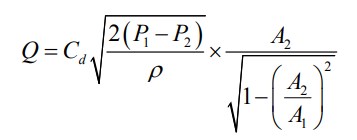 |
| Dimensional Analysis | 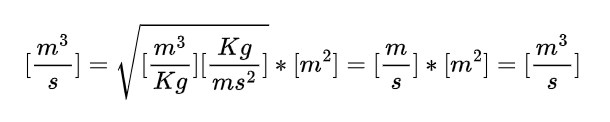 |
| Beta Ratio | The ratio of the orifice diameter to the pipe diameter, affecting flow restriction and pressure drop. It is essential in flow measurement, with specific ratios optimizing accuracy for different flow ranges. |
| Common Results | Refers to standard calculations and outputs in fluid mechanics, such as flow rate, pressure drop, and velocity, essential for analyzing system performance and determining if the design meets operational requirements. |
| Contraction Coefficient | A factor representing the reduction in cross-sectional area in a flow contraction, influencing flow speed and pressure. It is used in flow calculations involving orifices and sudden changes in pipe diameter. |
| Critical P Ratio | The critical pressure ratio is the ratio of downstream to upstream pressure at which gas flow becomes choked, meaning maximum flow rate is reached. It is essential in designing nozzles and controlling flow in compressible fluid systems. |
| Density | Density is the mass per unit volume of a fluid, typically measured in kg/m3. It impacts fluid behavior, such as buoyancy and pressure. High-density fluids exert greater pressure in systems, influencing design parameters in piping and fluid transport applications. |
| Dynamic Viscosity | Dynamic viscosity is a measure of a fluid's resistance to shear or flow, measured in Pascal-seconds (Pa s) or centipoise (cP). It affects how easily a fluid flows through pipes and around objects, influencing energy requirements in pumping systems. |
| Fluid Data | Refers to essential information about a fluid, including properties like density, viscosity, and specific heat. This data is crucial for calculating flow rates, pressure drops, and heat transfer in systems. Fluid data helps engineers understand fluid behavior under different conditions, which aids in designing efficient systems in industries like oil, gas, and water treatment. |
| Limits of Use | Defines the operational boundaries, like maximum pressure or temperature, for a system. Staying within these limits ensures safe, efficient operation and protects equipment from damage or failure. |
| Mass Flow (Kg/h) | The amount of fluid mass passing through a point per hour. It is critical for measuring fluid transport, affecting system sizing, energy requirements, and overall efficiency in industrial processes. |
| Mass Flow (Kg/s) | Mass flow in kg/s indicates fluid mass per second, important for real-time flow control and energy calculations in fast-moving fluid systems, especially in high-demand applications like power generation. |
| Molecular Weight | Molecular weight is the mass of a molecule of a substance, measured in atomic mass units (amu). In fluid mechanics, it helps calculate the density of gases and affects the fluid's compressibility and flow characteristics, particularly for gases in dynamic systems. |
| Operating Pressure | The pressure at which a system operates, influencing fluid density and flow rate. Higher pressures increase fluid density in gases, affecting flow calculations and system integrity. Operating pressure is crucial for safety, efficiency, and equipment durability in fluid systems. |
| Operating Temperature | The temperature at which a fluid operates within a system, influencing its viscosity, density, and flow behavior. Higher temperatures generally decrease fluid viscosity, affecting the resistance to flow, and can also impact material compatibility and safety limits. |
| Orifice Diameter | The diameter of an orifice or opening in a pipe, often used in flow measurement. It restricts flow, creating a pressure difference used to calculate flow rate, with smaller diameters increasing pressure drop and reducing flow. |
| Pipe Data | Refers to the dimensions, materials, and specifications of piping systems, affecting fluid dynamics, resistance, and capacity. Pipe data is essential for designing efficient fluid transport systems and calculating parameters like flow rate and pressure drop. |
| Pipe Diameter | Pipe diameter is the internal width of a pipe, influencing flow rate, velocity, and pressure drop. Larger diameters reduce friction and resistance, improving flow efficiency but requiring more space and higher installation costs. |
| Pressure Drop | Pressure drop is the reduction in fluid pressure as it flows through a system, caused by friction, restrictions, or changes in elevation. It is a key factor in energy loss and pump selection in fluid systems. |
| Pressure Drop Ratio | The ratio of pressure drop across an element to the inlet pressure. It helps assess energy losses and efficiency in a system, with high ratios indicating significant pressure loss and potential flow restrictions. |
| Pressure Ratio | The ratio of outlet pressure to inlet pressure, used to describe pressure changes across systems. It is crucial in analyzing compressible flows, particularly in gas systems, to determine flow characteristics and efficiency. |
| Ratio of Sp.Heats | The ratio of specific heats, or heat capacity ratio (kappa), is the ratio of a fluid's specific heat at constant pressure to its specific heat at constant volume. It affects compressible flow and is critical in calculations involving gases and thermodynamics. |
| Reynolds Flow Regime | The classification of flow as laminar, transitional, or turbulent based on the Reynolds number. It affects flow behavior, pressure drop, and efficiency, guiding the design and operation of fluid systems. |
| Reynolds Number | A dimensionless number indicating whether a fluid flow is laminar or turbulent, calculated from fluid velocity, density, viscosity, and characteristic length. It helps predict flow patterns and friction losses in pipes and channels. |
| Specific Results | Refers to calculated values unique to a system's conditions, such as specific flow rates or pressure conditions, essential for verifying that the system operates within desired parameters for performance and safety. |
| State of Matter | Defines the physical state of a substance: solid, liquid, or gas, determined by temperature and pressure. In fluid mechanics, the state of matter affects fluid flow, density, and viscosity. Gases are compressible, liquids nearly incompressible, and each state behaves uniquely under dynamic conditions. |
| Steam Quality (x) | Steam quality (also called dryness fraction) defines the proportion of vapor in a liquid-vapor mixture, on a mass basis. $x = 0$ represents fully saturated liquid; $x = 1$ represents dry saturated steam. For wet steam ($0 < x < 1$), the calculator uses the Homogeneous Equilibrium Model (HEM) to determine the effective mixture density: $\rho_{mix} = \frac{1}{x/\rho_g + (1-x)/\rho_f}$, where $\rho_g$ and $\rho_f$ are the saturated vapor and liquid densities at the operating temperature (from IAPWS-IF97 steam tables). Example: at 150 °C, $\rho_g \approx 2.55\,\text{kg/m}^3$ and $\rho_f \approx 917\,\text{kg/m}^3$ — for $x = 0.9$ (10 % moisture), $\rho_{mix} \approx 2.83\,\text{kg/m}^3$, noticeably denser than dry steam, which directly affects the calculated flow rate. Steam leaving a boiler or passing through a throttling valve is rarely perfectly dry; typical quality values in industrial practice range from 0.90 to 0.98. |
| Velocity in Pipe | The speed of fluid movement through a pipe, influenced by pipe diameter and flow rate. It affects pressure drop, energy losses, and is crucial for sizing pipes to avoid excessive turbulence or friction. |
| Volumetric Flow | The volume of fluid passing through a point per unit time, often in m3/h. It is used in pump sizing, system efficiency calculations, and to ensure fluid supply meets demand in various processes. |
Orifice Plate Find Flow Calculator References
| # | Reference |
|---|---|
| 1 | International Organization of Standards (ISO 5167-1). 2003. Measurement of fluid flow by means of pressure differential devices inserted in circular cross-section conduits running full - Part 1: General principles and requirements. |
| 2 | International Organization of Standards (ISO 5167-2) 2003. Measurement of fluid flow by means of pressure differential devices inserted in circular cross-section conduits running full -- Part 2: Orifice plates. |
| 3 | American Society of Mechanical Engineers (ASME). 2001. Measurement of fluid flow using small bore precision orifice meters. ASME MFC-14M-2001. |
| 4 | U.S. Dept. of the Interior, Bureau of Reclamation, 2001 revised, 1997 third edition, Water Measurement Manual. |
| 5 | Michael Reader-Harris (2015) Orifice Plates and Venturi Tubes. |
| 6 | Miller, R. W., Flow Measurement Handbook, 3rd ed., McGraw-Hill, New York, 1996. |
| 7 | American Gas Association, AGA Gas Measurement Manual, American Gas Association, New York. |
| 8 | Wikipedia |
| 9 | Corrosionpedia |
| 10 | Orifice Plates and Venturi Tubes (2015) - Michael Reader-Harris |
| 11 | EMERSON Fundamentals of Orifice Meter Measurement |
| 12 | Search Data Center |
| 13 | Lipták, Béla G. (Editor-in-Chief). Instrument Engineers' Handbook, Volume 1: Process Measurement and Analysis, 4th Edition. CRC Press / ISA Press, 2003. ISBN 0-8493-1083-0. Chapter 2.15: Orifices, pp. 259–276. |
Another calculators or articles that may interest you ...
| # | Link |
|---|---|
| 1 | In Flow Rate Calculator you can calculate the volumetric flow rate of any liquid or gas through a specific pipe diameter and download results. |
| 2 | Pressure Measurement, a comprehensive guide to pressure measurement principles and techniques. |
| 3 | Orifice Plate Calculator - Find Orifice Size is an useful tool to calculate the size of an orifice plate. |
| 4 | Density of Common Liquids Table, an easy reference table for liquid density data. |
| 5 | Absolute Viscosity of Common Gases, is a table that represents the absolute viscosity of some common fluids and his evolution against the temperature. |
| 6 | This is a table of specific heats' ratio for common gases: Heat Capacity Ratio of Common Fluids |
| 7 | Molecular Weight Common Fluids Table, an easy reference table for molecular weight data. |
Frequently Asked Questions
Q1 What are the advantages of using an orifice plate for flow measurement?
A1 Orifice plates are widely used due to their simplicity, low cost, and ease of installation. They do not have any moving parts, which minimizes maintenance requirements. They can be used for a wide range of fluids, including gases, liquids, and steam. Orifice plates also provide reasonably accurate measurements when properly installed and maintained. Additionally, they are compatible with differential pressure transmitters, allowing for easy integration into existing systems. Their standardization and availability in different materials make them suitable for various industrial applications, including oil and gas, water treatment, and chemical processing.
Q2 What are the limitations of an orifice plate in flow measurement?
A2 Orifice plates cause a permanent pressure drop, which can reduce system efficiency. Their accuracy is affected by wear, corrosion, and incorrect installation. They require a straight pipe section upstream and downstream for reliable readings. Orifice plates are also sensitive to flow disturbances, and errors can arise from improper beta ratio selection. Their performance in low-flow conditions is not ideal, as small variations in flow may not be accurately captured. Compared to other flow measurement devices, they may have lower accuracy and require frequent calibration in demanding applications.
Q3 What factors affect the accuracy of an orifice plate?
A3 Several factors influence the accuracy of an orifice plate. Proper installation, including alignment and positioning within the pipeline, is crucial. The condition of the orifice plate, including surface roughness and edge sharpness, impacts measurements. The beta ratio, which is the ratio of orifice diameter to pipe diameter, must be appropriately selected. Flow disturbances, caused by bends, valves, or fittings, can introduce errors. Adequate straight pipe lengths upstream and downstream help ensure accuracy. Temperature, pressure fluctuations, and fluid properties, such as viscosity and density, also play a role in measurement precision.
Q4 What is an orifice plate and how does it measure flow?
A4 An orifice plate is a thin, flat plate with a precisely machined hole, installed within a pipe to create a flow restriction. As fluid passes through the orifice, its velocity increases while pressure decreases, creating a differential pressure across the plate. This pressure difference is measured using a differential pressure transmitter, which correlates with the flow rate. The flow rate is then determined using established equations based on fluid properties and orifice geometry. Orifice plates operate on the principle of Bernoulli's equation and are commonly used in industries to measure gas, liquid, and steam flow.
Q5 What is the beta ratio in an orifice plate?
A5 The beta ratio is the ratio of the orifice diameter to the internal pipe diameter. It is a critical parameter in orifice plate flow calculations. A typical beta ratio ranges from 0.2 to 0.75, with values outside this range leading to reduced accuracy. A low beta ratio results in higher pressure loss and increased sensitivity to flow disturbances, while a high beta ratio may cause excessive velocity and turbulence. The beta ratio influences discharge coefficient and flow measurement uncertainty. Proper selection ensures accurate measurement and minimizes pressure drop while maintaining reliable flow calculations.
Q6 What is the purpose of the vena contracta in orifice plate flow measurement?
A6 The vena contracta is the point downstream of the orifice where the fluid stream has its smallest cross-sectional area and highest velocity. It forms due to the fluid inertia and pressure drop created by the orifice restriction. The pressure difference between the upstream section and the vena contracta is measured to determine the flow rate. Understanding the vena contracta location is important for accurate pressure tapping placement. Incorrect tap positioning can introduce errors in differential pressure measurement, affecting flow rate calculations. The vena contracta effect also influences discharge coefficient values.
Q7 What types of orifice plates are commonly used?
A7 Several types of orifice plates exist, each designed for specific applications. The most common is the concentric orifice plate, which features a centrally located hole and is widely used in industrial flow measurement. Eccentric orifice plates have an off-center hole, making them suitable for measuring slurries or fluids with particulates. Segmental orifice plates have a semi-circular opening, used for similar applications. Quadrant edge orifice plates are designed for measuring viscous fluids and provide improved accuracy at low Reynolds numbers. The choice of orifice plate depends on fluid type, flow conditions, and system requirements.
Q8 Where should pressure taps be placed for an orifice plate?
A8 Pressure taps must be correctly positioned to ensure accurate differential pressure measurement. The most common configurations include flange taps, which are located one pipe diameter upstream and downstream of the orifice. Corner taps are placed directly at the orifice plate, commonly used in small pipes. D-D/2 taps are positioned one diameter upstream and half a diameter downstream, providing a reliable measurement in larger pipelines. Pipe taps, placed farther from the orifice, are used in older systems but are less accurate. Correct tap placement minimizes errors and ensures consistent flow measurement performance.
Q9 Why is a straight pipe section required before and after an orifice plate?
A9 A straight pipe section is necessary to ensure stable, uniform flow before it reaches the orifice plate. Flow disturbances from elbows, valves, pumps, and fittings create turbulence, which affects pressure distribution and measurement accuracy. Adequate straight lengths allow flow to stabilize, ensuring that the differential pressure reading correctly represents the flow rate. The recommended upstream and downstream pipe lengths depend on beta ratio and pipe configuration. Typically, ten to twenty pipe diameters upstream and five to ten diameters downstream are required for optimal performance, reducing measurement uncertainty and improving accuracy.
Q10 Why is an orifice plate flow meter considered a differential pressure device?
A10 An orifice plate flow meter measures flow by creating a pressure drop across a restriction. It operates on the principle of differential pressure measurement, where the difference between upstream and downstream pressures is proportional to the flow rate. This pressure difference is detected using a differential pressure transmitter, which converts it into an electrical signal for flow rate calculation. Because it relies on pressure changes rather than direct velocity or volume measurements, it falls under the category of differential pressure flow meters. This method is widely used due to its simplicity, reliability, and compatibility with various fluids.
Q11 How does pulsating flow affect orifice plate accuracy, and what can be done about it?
A11 Pulsating flow originates from upstream or downstream equipment such as reciprocating pumps and compressors, and it is one of the most damaging conditions for differential pressure flow measurement. When flow pulsations are present, the differential pressure signal fluctuates rapidly, causing the indicated flow rate to read higher than the actual value — an error that is inherent to the square-root relationship between differential pressure and flow. Severe pulsations can even cause mechanical failure of the orifice plate itself. A pulsating flow is generally defined as one whose frequency exceeds 0.1 Hz. Pulsation dampeners installed in the connecting lines between the orifice and the differential pressure transmitter can reduce the effect, but they do not eliminate it entirely. The most effective solution is to relocate the primary element as far as practical from the source of pulsation, or to select a different meter technology better suited to pulsating conditions. Even in steady flow, small differential pressure variations called flow noise exist due to turbulent eddies at the orifice and vena contracta; this noise is typically about 1% of the full-scale differential pressure range, but can reach 10% in poorly designed or installed installations.
Q12 How should the differential pressure range be selected for an orifice plate installation?
A12 The standard and most widely recommended full-scale differential pressure range for orifice plates, venturi tubes, and flow nozzles is 0 to 100 inches of water column (0 to 25 kPa), corresponding to the maximum design flow rate. This range is high enough to minimise errors caused by differences in liquid density within the impulse lines, seal chambers, or condensing pots that result from temperature variations in the field. Most differential pressure transmitters also achieve their best accuracy near this range. If the differential pressure range is set too low, small absolute measurement errors become proportionally large once the square root is extracted to obtain flow, significantly amplifying uncertainty at all flow rates. Conversely, if the range is set too high, the permanent pressure loss across the orifice becomes excessive, increasing energy costs and potentially affecting process conditions. Selecting a range close to the 0–100 inH₂O standard therefore balances measurement accuracy, acceptable pressure loss, and transmitter performance.
Q13 What is the overall accuracy of a complete orifice plate measurement loop, and why does it degrade at low flow rates?
A13 A well-manufactured orifice plate is inherently a percent-of-actual-reading device with an error limit of approximately ±0.5% of actual flow rate. However, the total loop error must also include the differential pressure transmitter, which contributes approximately ±0.5% of its full-scale range, as well as any error introduced by the square root extraction step required to convert differential pressure into flow rate. Because the differential pressure varies as the square of the flow rate, a transmitter error that is a fixed percentage of full scale becomes a much larger percentage of the actual flow reading at reduced flow. For example, operating at 20% of full-scale flow, the combined loop error — assuming all component errors are additive — can reach approximately ±12% of the actual reading, even though no individual component exceeds ±0.5% of full scale. At 80% of full-scale flow, the same additive assumption yields a total error of approximately ±2% of the actual reading. This behaviour means that orifice plate installations are best suited to applications where the flow rate stays above roughly 30–40% of the design maximum. For processes with a wide flow turndown requirement, a different meter technology or a transmitter with a suppressed zero should be considered.