Orifice Calculation - Find Pressure Drop
ISO 5167-2:2003 Orifice Pressure Drop Calculator
Common Results | |||||
| Pressure Ratio (P2/P1) | N/A | Pressure Drop Ratio (DP/P1) | N/A | ||
| Reynolds (ReD) | N/A | Reynolds Flow Regime | N/A | ||
| Beta Ratio | N/A | Discharge Coefficient | N/A | ||
Specific Results | |||||
| Pressure Range | |||||
Limits of Use | |||||
| 1. Orifice Diameter (d) - The result has not yet been evaluated. | |||||
| 2. Pipe Diameter (D) minimum size - The result has not yet been evaluated. | |||||
| 3. Pipe Diameter (D) maximum size - The result has not yet been evaluated. | |||||
| 4. Beta Ratio (Beta) minimum size - The result has not yet been evaluated. | |||||
| 5. Beta Ratio (Beta) maximum size - The result has not yet been evaluated. | |||||
| 6. Reynolds Number (ReD) - The result has not yet been evaluated. | |||||
| 7. Pressure Ratio - The result has not yet been evaluated. | |||||
Overview
This tutorial walks you through two complete calculations using the Orifice Plate – Find Pressure Drop calculator at instrumentationandcontrol.net. By the end you will be able to determine the differential pressure (ΔP) across a standard concentric orifice plate for both liquid and gas service, using the ISO 5167-2:2003 Reader-Harris/Gallagher method.
The calculator requires you to know the orifice bore diameter (d) and pipe internal diameter (D) up front — it then solves for ΔP given the target mass flow rate. This is the inverse of the "Find Flow Rate" problem and is the typical verification step after an orifice plate has already been sized.
What You Will Accomplish
- Enter identification, fluid, and geometry data for a liquid and a gas case.
- Understand the ISO 5167 beta ratio constraint and why it matters.
- Read and interpret the full result set: ΔP, Cd, Reynolds number, and — for gas — expansibility factor Y and choked flow status.
Before You Begin
Required Inputs
Gather the following before starting a calculation:
| Input | Liquid | Gas |
|---|---|---|
| Pipe internal diameter D (mm) | ✔ | ✔ |
| Orifice bore diameter d (mm) | ✔ | ✔ |
| Mass flow rate (kg/h) | ✔ | ✔ |
| Fluid density (kg/m³) | ✔ | — |
| Upstream pressure P1 (bar abs) | ✔ | ✔ |
| Dynamic viscosity (cP) | ✔ | ✔ |
| Molecular weight (kg/kmol) | — | ✔ |
| Operating temperature T (°C) | — | ✔ |
The Beta Ratio Constraint (ISO 5167)
ISO 5167-2 defines the beta ratio as:
The standard restricts valid beta ratios to 0.2 ≤ β ≤ 0.75. Outside this range the discharge coefficient correlation is not valid, and the calculator will flag the result. Always verify your d and D combination is within this range before running the calculation.
Worked Example 1 — Liquid Service (Water, 4" Pipe)
Scenario
Verify the differential pressure produced by a 50 mm orifice plate installed in a 4" (101.6 mm ID) water line running at 5 000 kg/h.
| Parameter | Value |
|---|---|
| Fluid | Water |
| Density | 998 kg/m³ |
| Upstream pressure P1 | 6 bar abs |
| Dynamic viscosity | 1.0 cP |
| Pipe diameter D | 101.6 mm |
| Orifice diameter d | 50 mm |
| Mass flow rate | 5 000 kg/h |
Step 1 — Identification Data
Fill in the optional identification fields at the top of the form. These fields (Tagname, Plant, Area, Notes) populate the ISA instrument datasheet generated by the Download button and do not affect the calculation.
Step 2 — Fluid State and Properties
Select Liquid from the fluid state selector. Enter:
- Fluid name:
Water - Density:
998kg/m³ - P1:
6bar abs - Dynamic viscosity:
1.0cP
Step 3 — Pipe and Orifice Dimensions
Enter $D = 101.6\,\text{mm}$ and $d = 50\,\text{mm}$.
Beta ratio check: $\beta = 50/101.6 = 0.492$ — within the $0.2$ to $0.75$ ISO 5167 range. ✔
Step 4 — Mass Flow Rate
Enter 5000 kg/h.
Step 5 — Results
Click Calculate!. The expected results are:
| Output | Value |
|---|---|
| Beta ratio (β) | 0.492 |
| Reynolds number (Re) | ~174 000 |
| Flow regime | Turbulent |
| Discharge coefficient (Cd) | ~0.605 |
| Differential pressure (ΔP) | ~35 kPa |
Discharge Coefficient Cd
Cd is calculated iteratively using the ISO 5167-2 Reader-Harris/Gallagher equation. It accounts for the geometry (β), Reynolds number, and upstream tap configuration. Typical values for corner-tap orifice plates at turbulent Reynolds numbers lie between 0.595 and 0.620. The value converges after a few iterations; the calculator performs this automatically.
Worked Example 2 — Gas Service (Air, 6" Pipe)
Scenario
Determine the differential pressure and check for choked flow for an 80 mm orifice installed in a 6" (152.4 mm ID) air line at 5 bar abs and 20 °C, with a target mass flow of 800 kg/h.
| Parameter | Value |
|---|---|
| Fluid | Air |
| Molecular weight | 28.97 kg/kmol |
| Temperature | 20 °C |
| Upstream pressure P1 | 5 bar abs |
| Dynamic viscosity | 0.018 cP |
| Pipe diameter D | 152.4 mm |
| Orifice diameter d | 80 mm |
| Mass flow rate | 800 kg/h |
Step 1 — Identification Data
Enter identification fields as required for your instrument datasheet.
Step 2 — Fluid State and Properties
Select Gas from the fluid state selector. Enter:
- Fluid name:
Air - Molecular weight:
28.97kg/kmol - Temperature:
20°C - P1:
5bar abs - Dynamic viscosity:
0.018cP
The calculator derives gas density at operating conditions from the ideal gas law using the molecular weight, temperature, and pressure you supply.
Step 3 — Pipe and Orifice Dimensions
Enter $D = 152.4\,\text{mm}$ and $d = 80\,\text{mm}$.
Beta ratio check: $\beta = 80/152.4 = 0.525$ — within the $0.2$ to $0.75$ ISO 5167 range. ✔
Step 4 — Mass Flow Rate
Enter 800 kg/h.
Step 5 — Results
Click Calculate!. The expected results include:
| Output | Value |
|---|---|
| Beta ratio (β) | 0.525 |
| Reynolds number (Re) | ~195 000 |
| Flow regime | Turbulent |
| Discharge coefficient (Cd) | ~0.607 |
| Expansibility factor (Y) | ~0.993 |
| Critical pressure ratio | ~0.528 |
| Choked flow | No |
| Differential pressure (ΔP) | ~2.5 kPa |
Expansibility Factor Y
For compressible fluids, ISO 5167-2 applies an expansibility correction factor Y (also called the gas expansion factor) to account for the reduction in gas density as it accelerates through the orifice. Y is always ≤ 1.0 and approaches 1.0 for low pressure drops relative to P1. The calculator evaluates Y using the ISO 5167 formula based on β, the pressure drop ratio (ΔP/P1), and the isentropic exponent (heat capacity ratio κ).
Choked Flow Check
For gas flows, the calculator computes the critical pressure ratio:
For air ($\kappa \approx 1.4$): $r_c \approx 0.528$. If the actual downstream-to-upstream pressure ratio $P_2/P_1$ falls below $r_c$, the flow chokes — the mass flow cannot increase further regardless of downstream pressure. The calculator displays a Choked Flow indicator when this condition is detected. In this example $P_2/P_1 > 0.528$, so flow is not choked.
Understanding the Key Outputs
Differential Pressure (ΔP)
ΔP is the pressure difference measured between the upstream (D) and downstream (D/2) tapping points. The ISO 5167 mass flow equation rearranged for ΔP is:
where qm is mass flow rate (kg/s), ρ1 is upstream fluid density, Cd is the discharge coefficient, and Y is the expansibility factor (= 1.0 for liquids).
Reynolds Number and Flow Regime
where μ is dynamic viscosity in Pa·s. The ISO 5167 discharge coefficient correlation is valid for Re ≥ 5 000 (fully turbulent). For lower Reynolds numbers the calculator will flag a warning.
Discharge Coefficient (Cd)
Cd captures the real-world deviation from ideal Bernoulli flow due to boundary layer effects, vena contracta geometry, and viscous losses. The Reader-Harris/Gallagher equation used in ISO 5167-2 expresses Cd as a function of β and Re. Because Cd depends on Re, which in turn depends on the result, the solution is obtained by iterating until convergence — typically in 4–6 iterations.
Expansibility Factor (Y) — Gas Only
Y corrects Cd for the compressibility of the gas. It is evaluated from:
A value of $Y = 1.0$ means no correction is needed (incompressible assumption). For typical industrial gas metering applications $\Delta P/P_1$ is small and $Y$ stays above 0.98.
Critical Pressure Ratio and Choked Flow — Gas Only
When ΔP approaches the critical value (P1 · (1 - rc)), further increases in mass flow are not possible. Operating near or beyond the choked condition invalidates the ISO 5167 model. If the calculator indicates choked flow, reduce the mass flow rate or increase the pipe/orifice size before accepting the result.
Worked Example 3 — Steam Service (Saturated Steam, 4" Pipe)
Scenario. Verify the differential pressure produced by an installed 50 mm bore orifice plate in a 4-inch Sch 40 steam header (D = 101.6 mm, flange tappings) when carrying saturated steam at 1 800 kg/h.
| Parameter | Value |
|---|---|
| Fluid | Steam (Water Vapor), x = 1.0 (dry saturated) |
| Operating temperature | 180 °C |
| Upstream pressure P₁ | 10 bar abs |
| Density (auto-filled) | ~5.16 kg/m³ |
| Dynamic viscosity | 0.0145 cP |
| Ratio of specific heats κ | 1.13 |
| Pipe ID D | 101.6 mm |
| Orifice bore d | 50 mm |
| Mass flow | 1 800 kg/h = 0.5 kg/s |
| Pressure tappings | Flange |
Configuration Steps
- Set State of matter to Steam (Water Vapor) and enter Steam Quality x = 1.0.
- Enter T = 180 °C and P₁ = 10 bar. The density field auto-fills (~5.16 kg/m³).
- Enter μ = 0.0145 cP and κ = 1.13.
- Enter D = 101.6 mm, d = 50 mm, mass flow = 0.5 kg/s, and select Flange tappings.
- Click Calculate!
Expected Results
| Output | Expected value |
|---|---|
| Beta Ratio β | 0.492 (50 / 101.6) |
| Reynolds Number Re_D | ~440 000 (Turbulent) |
| Discharge Coefficient C | ~0.601 |
| Expansibility Factor Y | ~0.990 |
| Differential Pressure ΔP | ~167 mbar |
| P₂/P₁ | 0.983 — well above critical ratio 0.578 |
How $\Delta P$ is calculated for steam. The calculation solves the ISO 5167-2 mass-flow equation in reverse: given $q_m$, $d$, $D$, $\rho$, and $\mu$, it iterates simultaneously for $C$ (via RHG) and $Y$ (via the expansibility formula) to find the $\Delta P$ that satisfies:
$$q_m = C\,Y\,\frac{\pi}{4}\,d^2\,\sqrt{\frac{2\rho\Delta P}{1-\beta^4}}$$
Because both $C$ and $Y$ depend on $\Delta P$ through the pressure ratio, iteration is necessary even in the pressure-drop direction.
Comparison with gas service. At the same bore, flow rate, and pipe, an equivalent gas service (for example, nitrogen at 5 kg/m³ and κ = 1.4) would yield a similar ΔP — steam's lower κ = 1.13 produces a slightly larger Y correction (more expansion) but its density is close to that of a light gas at elevated pressure. For precise steam metering, the IAPWS-IF97 density is critical; using an approximate density shifts ΔP proportionally.
Limits of Use Check
| # | Limit | Status |
|---|---|---|
| 1–3 | d, D within size range | ✓ |
| 4–5 | 0.10 ≤ β ≤ 0.75 | ✓ (β = 0.492) |
| 6 | Re_D ≥ 5 000 for Flange taps | ✓ (~440 000) |
| 7 | P₂/P₁ ≥ 0.75 | ✓ (0.983) |
All limits pass. Use the companion Orifice Plate – Find Flow Rate calculator with this ΔP as input to verify the inverse: you should recover ~1 800 kg/h.
What to Do Next
- Export to ISA Datasheet: Use the Download button to generate a PDF instrument datasheet populated with your identification data and results. This is ready for inclusion in a project data package.
- Cross-check with Find Flow Rate: Use the Orifice Plate – Find Flow Rate calculator with the computed ΔP as input to verify the inverse calculation returns your original mass flow rate.
- Iterate on beta ratio: If ΔP is too high for your differential pressure transmitter range, increase d (higher β) to lower ΔP. If precision is critical at low flow rates, consider a lower β to increase the signal. Re-run the calculator after each change to confirm ISO 5167 validity.
- Size a new orifice plate: If you need to find d given a target ΔP and flow rate, use the Orifice Plate – Find Size calculator.
Additional Considerations
Rangeability and beta ratio selection for pressure drop control
The orifice plate is inherently a square-law device: differential pressure is proportional to the square of the flow rate (ΔP ∝ Q²). This has a direct consequence for rangeability. A 3:1 flow range produces a 9:1 DP range, and a 10:1 flow range produces a 100:1 DP range. Standard differential pressure transmitters perform best over approximately a 3:1 to 4:1 DP span — wider ranges degrade measurement accuracy at the low end because the signal-to-noise ratio falls as the square root is extracted from an increasingly small DP value.
When using the pressure-drop calculator to verify an installation over a wide operating envelope, run the calculation at both minimum and maximum expected flow rates and confirm that both results fall within the transmitter's accurate measurement range. If the minimum-flow DP is too small (for example below 2–3% of full scale), the installation will have poor accuracy at low loads even if it performs well at design flow.
Beta ratio has a powerful influence on differential pressure. Increasing beta — using a larger bore relative to the pipe — reduces ΔP dramatically because more flow area is available; conversely, decreasing beta raises ΔP and increases the signal level. The effect is not linear: small changes in beta produce large changes in ΔP. Use the calculator to explore this sensitivity by comparing results for different beta values at the same flow rate — for example, comparing β = 0.5 against β = 0.6 at design flow will illustrate how strongly the calculated ΔP responds to bore selection. As a practical recommendation, aim for a beta ratio in the 0.4 to 0.6 range for general metering applications. This window balances an adequate DP signal against acceptable permanent pressure loss, and keeps both the discharge coefficient and the expansibility factor within their most stable and well-characterised regions of the ISO 5167 correlation.
Permanent pressure loss versus differential pressure
The differential pressure measured at the orifice taps is not the same as the permanent pressure loss that the pump or compressor must overcome. After the orifice plate, the flow re-expands and pressure partially recovers. The permanent (unrecovered) pressure loss is consistently lower than the measured ΔP — typically 60 to 80% of it, depending on the beta ratio.
An approximate formula for a concentric sharp-edged orifice plate gives the permanent loss as:
ΔP_perm ≈ ΔP × (1 - beta²)
Applying this to two representative beta values:
- For β = 0.5: ΔP_perm ≈ 0.75 × ΔP — approximately 75% of the measured differential pressure is unrecovered.
- For β = 0.7: ΔP_perm ≈ 0.51 × ΔP — approximately 51% of the measured differential pressure is unrecovered.
This distinction is important for pump and compressor sizing. The rotating equipment must be sized to overcome the permanent pressure loss, not the full measured differential pressure. Sizing against the full ΔP will result in over-specified equipment and unnecessarily high energy consumption.
For energy-sensitive applications where minimising permanent pressure loss is a priority, venturi tubes are worth considering as an alternative primary element. A venturi's smooth converging and diverging geometry allows substantially better pressure recovery, with permanent losses typically in the range of 10 to 15% of the measured differential pressure — far lower than a sharp-edged orifice at the same beta ratio and flow conditions.
Information and Definitions
| Term | Definition |
|---|---|
| Used Equation | 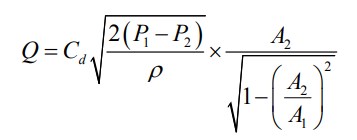 |
| Dimensional Analysis | 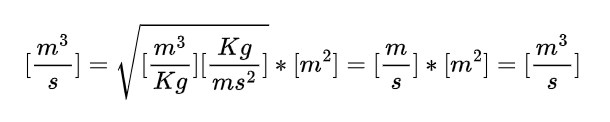 |
| Beta Ratio | The ratio of the orifice diameter to the pipe diameter, affecting flow restriction and pressure drop. It is essential in flow measurement, with specific ratios optimizing accuracy for different flow ranges. |
| Common Results | Refers to standard calculations and outputs in fluid mechanics, such as flow rate, pressure drop, and velocity, essential for analyzing system performance and determining if the design meets operational requirements. |
| Contraction Coefficient | A factor representing the reduction in cross-sectional area in a flow contraction, influencing flow speed and pressure. It is used in flow calculations involving orifices and sudden changes in pipe diameter. |
| Critical P Ratio | The critical pressure ratio is the ratio of downstream to upstream pressure at which gas flow becomes choked, meaning maximum flow rate is reached. It is essential in designing nozzles and controlling flow in compressible fluid systems. |
| Density | Density is the mass per unit volume of a fluid, typically measured in kg/m3. It impacts fluid behavior, such as buoyancy and pressure. High-density fluids exert greater pressure in systems, influencing design parameters in piping and fluid transport applications. |
| Dynamic Viscosity | Dynamic viscosity is a measure of a fluid's resistance to shear or flow, measured in Pascal-seconds (Pa s) or centipoise (cP). It affects how easily a fluid flows through pipes and around objects, influencing energy requirements in pumping systems. |
| Fluid Data | Refers to essential information about a fluid, including properties like density, viscosity, and specific heat. This data is crucial for calculating flow rates, pressure drops, and heat transfer in systems. Fluid data helps engineers understand fluid behavior under different conditions, which aids in designing efficient systems in industries like oil, gas, and water treatment. |
| Limits of Use | Defines the operational boundaries, like maximum pressure or temperature, for a system. Staying within these limits ensures safe, efficient operation and protects equipment from damage or failure. |
| Mass Flow (Kg/h) | The amount of fluid mass passing through a point per hour. It is critical for measuring fluid transport, affecting system sizing, energy requirements, and overall efficiency in industrial processes. |
| Mass Flow (Kg/s) | Mass flow in kg/s indicates fluid mass per second, important for real-time flow control and energy calculations in fast-moving fluid systems, especially in high-demand applications like power generation. |
| Molecular Weight | Molecular weight is the mass of a molecule of a substance, measured in atomic mass units (amu). In fluid mechanics, it helps calculate the density of gases and affects the fluid's compressibility and flow characteristics, particularly for gases in dynamic systems. |
| Operating Pressure | The pressure at which a system operates, influencing fluid density and flow rate. Higher pressures increase fluid density in gases, affecting flow calculations and system integrity. Operating pressure is crucial for safety, efficiency, and equipment durability in fluid systems. |
| Operating Temperature | The temperature at which a fluid operates within a system, influencing its viscosity, density, and flow behavior. Higher temperatures generally decrease fluid viscosity, affecting the resistance to flow, and can also impact material compatibility and safety limits. |
| Orifice Diameter | The diameter of an orifice or opening in a pipe, often used in flow measurement. It restricts flow, creating a pressure difference used to calculate flow rate, with smaller diameters increasing pressure drop and reducing flow. |
| Pipe Data | Refers to the dimensions, materials, and specifications of piping systems, affecting fluid dynamics, resistance, and capacity. Pipe data is essential for designing efficient fluid transport systems and calculating parameters like flow rate and pressure drop. |
| Pipe Diameter | Pipe diameter is the internal width of a pipe, influencing flow rate, velocity, and pressure drop. Larger diameters reduce friction and resistance, improving flow efficiency but requiring more space and higher installation costs. |
| Pressure Drop | Pressure drop is the reduction in fluid pressure as it flows through a system, caused by friction, restrictions, or changes in elevation. It is a key factor in energy loss and pump selection in fluid systems. |
| Pressure Drop Ratio | The ratio of pressure drop across an element to the inlet pressure. It helps assess energy losses and efficiency in a system, with high ratios indicating significant pressure loss and potential flow restrictions. |
| Pressure Ratio | The ratio of outlet pressure to inlet pressure, used to describe pressure changes across systems. It is crucial in analyzing compressible flows, particularly in gas systems, to determine flow characteristics and efficiency. |
| Ratio of Sp.Heats | The ratio of specific heats, or heat capacity ratio (kappa), is the ratio of a fluid's specific heat at constant pressure to its specific heat at constant volume. It affects compressible flow and is critical in calculations involving gases and thermodynamics. |
| Reynolds Flow Regime | The classification of flow as laminar, transitional, or turbulent based on the Reynolds number. It affects flow behavior, pressure drop, and efficiency, guiding the design and operation of fluid systems. |
| Reynolds Number | A dimensionless number indicating whether a fluid flow is laminar or turbulent, calculated from fluid velocity, density, viscosity, and characteristic length. It helps predict flow patterns and friction losses in pipes and channels. |
| Specific Results | Refers to calculated values unique to a system's conditions, such as specific flow rates or pressure conditions, essential for verifying that the system operates within desired parameters for performance and safety. |
| State of Matter | Defines the physical state of a substance: solid, liquid, or gas, determined by temperature and pressure. In fluid mechanics, the state of matter affects fluid flow, density, and viscosity. Gases are compressible, liquids nearly incompressible, and each state behaves uniquely under dynamic conditions. |
| Steam Quality (x) | Steam quality (also called dryness fraction) defines the proportion of vapor in a liquid-vapor mixture, on a mass basis. $x = 0$ represents fully saturated liquid; $x = 1$ represents dry saturated steam. For wet steam ($0 < x < 1$), the calculator uses the Homogeneous Equilibrium Model (HEM) to determine the effective mixture density: $\rho_{mix} = \frac{1}{x/\rho_g + (1-x)/\rho_f}$, where $\rho_g$ and $\rho_f$ are the saturated vapor and liquid densities at the operating temperature (from IAPWS-IF97 steam tables). Example: at 150 °C, $\rho_g \approx 2.55\,\text{kg/m}^3$ and $\rho_f \approx 917\,\text{kg/m}^3$ — for $x = 0.9$ (10 % moisture), $\rho_{mix} \approx 2.83\,\text{kg/m}^3$, noticeably denser than dry steam, which directly affects the calculated pressure drop. Steam leaving a boiler or passing through a throttling valve is rarely perfectly dry; typical quality values in industrial practice range from 0.90 to 0.98. |
| Velocity in Pipe | The speed of fluid movement through a pipe, influenced by pipe diameter and flow rate. It affects pressure drop, energy losses, and is crucial for sizing pipes to avoid excessive turbulence or friction. |
| Volumetric Flow | The volume of fluid passing through a point per unit time, often in m3/h. It is used in pump sizing, system efficiency calculations, and to ensure fluid supply meets demand in various processes. |
Orifice Plate Find Pressure Drop Calculator References
| # | Reference |
|---|---|
| 1 | International Organization of Standards (ISO 5167-1). 2003. Measurement of fluid flow by means of pressure differential devices inserted in circular cross-section conduits running full - Part 1: General principles and requirements. |
| 2 | International Organization of Standards (ISO 5167-2) 2003. Measurement of fluid flow by means of pressure differential devices inserted in circular cross-section conduits running full -- Part 2: Orifice plates. |
| 3 | American Society of Mechanical Engineers (ASME). 2001. Measurement of fluid flow using small bore precision orifice meters. ASME MFC-14M-2001. |
| 4 | U.S. Dept. of the Interior, Bureau of Reclamation, 2001 revised, 1997 third edition, Water Measurement Manual. |
| 5 | Michael Reader-Harris (2015) Orifice Plates and Venturi Tubes. |
| 6 | Miller, R. W., Flow Measurement Handbook, 3rd ed., McGraw-Hill, New York, 1996. |
| 7 | American Gas Association, AGA Gas Measurement Manual, American Gas Association, New York. |
| 8 | Wikipedia |
| 9 | Corrosionpedia |
| 10 | Orifice Plates and Venturi Tubes (2015) - Michael Reader-Harris |
| 11 | EMERSON Fundamentals of Orifice Meter Measurement |
| 12 | Search Data Center |
Another calculators or articles that may interest you ...
| # | Link |
|---|---|
| 1 | In Flow Rate Calculator you can calculate the volumetric flow rate of any liquid or gas through a specific pipe diameter and download results. |
| 2 | Pressure Measurement, a comprehensive guide to pressure measurement principles and techniques. |
| 3 | Orifice Plate Calculator - Find Orifice Size is a useful tool to calculate the size of an orifice plate. |
| 4 | Density of Common Liquids Table, an easy reference table for liquid density data. |
| 5 | Absolute Viscosity of Common Gases, is a table that represents the absolute viscosity of some common fluids and its evolution against the temperature. |
| 6 | This is a table of specific heats' ratio for common gases: Heat Capacity Ratio of Common Fluids |
| 7 | Molecular Weight Common Fluids Table, an easy reference table for molecular weight data. |
Frequently Asked Questions
Q1 What causes pressure drop across an orifice plate?
A1 Pressure drop across an orifice plate occurs due to the restriction in flow area, which accelerates the fluid and decreases its pressure. When fluid passes through the narrow opening, velocity increases, and pressure decreases per the Bernoulli principle. Some energy is lost as heat and turbulence. The pressure partially recovers downstream, but due to irreversible losses, the total pressure remains lower than before the orifice plate. The extent of the pressure drop depends on factors like orifice diameter, fluid properties, and flow velocity.
Q2 How does differential pressure relate to flow rate in an orifice plate?
A2 The differential pressure across an orifice plate is proportional to the square of the flow rate. This relationship is described by the orifice flow equation, which is derived from the Bernoulli equation and the continuity principle. As flow rate increases, differential pressure rises exponentially. By measuring this pressure drop, the volumetric or mass flow rate can be determined using empirical discharge coefficients that account for fluid dynamics. However, flow conditions such as turbulence, viscosity, and Reynolds number influence the accuracy of this measurement.
Q3 How does fluid density affect pressure drop in an orifice plate?
A3 Fluid density plays a significant role in determining the pressure drop across an orifice plate. Since pressure drop is influenced by the velocity of the fluid, a denser fluid results in a different velocity profile compared to a less dense one. The orifice flow equation incorporates density as a factor, meaning that changes in density directly impact the differential pressure reading. For compressible fluids, density varies with pressure and temperature, requiring corrections in flow calculations to ensure accurate measurement. In contrast, incompressible fluids maintain a more consistent density.
Q4 How does pipe roughness influence pressure drop across an orifice plate?
A4 Pipe roughness affects pressure drop across an orifice plate by influencing flow turbulence and boundary layer behavior. A rougher pipe surface increases frictional losses, leading to additional pressure drop beyond what is caused by the orifice itself. If the upstream conditions are not well-controlled, excessive roughness can disrupt the expected velocity profile, causing inaccuracies in differential pressure measurements. Standard flow measurement installations recommend using smooth, straight pipe sections before and after the orifice plate to minimize these effects and maintain accurate flow readings.
Q5 How does pressure recovery occur after an orifice plate?
A5 Pressure recovery after an orifice plate happens as the fluid expands and slows down downstream of the restriction. When fluid passes through the orifice, it accelerates and experiences a pressure drop. As it moves beyond the orifice into a wider pipe section, velocity decreases, and some of the lost pressure is regained. However, due to energy dissipation in turbulence and friction, full pressure recovery does not occur. The degree of recovery depends on factors such as orifice design, flow velocity, and fluid properties, with sharper-edged plates causing greater permanent losses.
Q6 How does temperature affect pressure drop across an orifice plate?
A6 Temperature changes influence pressure drop across an orifice plate by altering fluid properties such as density and viscosity. For gases, higher temperatures reduce density, leading to lower pressure drops for the same volumetric flow rate. Conversely, lower temperatures increase density and result in higher pressure drops. For liquids, viscosity changes with temperature, affecting flow characteristics and frictional losses. Accurate flow measurement requires compensation for temperature variations, particularly in gas applications where density changes significantly with temperature and pressure fluctuations.
Q7 How is cavitation related to pressure drop in an orifice plate?
A7 Cavitation occurs when the local pressure of a fluid drops below its vapor pressure, causing vapor bubbles to form and collapse. In an orifice plate, significant pressure drop at the vena contracta can lead to cavitation if the downstream pressure is insufficient to prevent vaporization. When cavitation occurs, it generates noise, vibration, and potential damage to the orifice plate and piping. To avoid cavitation, the system pressure should be maintained above the fluid vapor pressure, and appropriate orifice plate selection should consider cavitation-prone conditions.
Q8 How is energy lost due to pressure drop in an orifice plate?
A8 Energy loss in an orifice plate results from conversion of pressure energy into kinetic energy and dissipation through turbulence and friction. When fluid accelerates through the orifice, some energy is irreversibly lost as heat and eddies. While pressure partially recovers downstream, the overall system pressure remains lower due to these energy losses. The extent of energy dissipation depends on factors like orifice plate geometry, fluid properties, and flow rate. Managing energy losses is important in high-efficiency flow systems where minimizing pressure drop can reduce pumping or compression costs.
Q9 What is the effect of fluid compressibility on pressure drop in an orifice plate?
A9 Fluid compressibility significantly influences pressure drop across an orifice plate, especially in gases and high-velocity flow conditions. Unlike incompressible fluids, gases undergo density changes as pressure drops. At higher velocities, compressibility effects become pronounced, requiring flow equations that account for variations in density. Correction factors, such as the expansion factor, adjust for these effects to ensure accurate flow measurements. For highly compressible fluids, additional considerations like choked flow conditions must be evaluated to prevent measurement errors and operational issues.
Q10 What is the significance of pressure drop in orifice plate applications?
A10 Pressure drop across an orifice plate is a crucial factor in flow measurement, pump selection, and energy efficiency. While it provides the basis for calculating flow rate using differential pressure, excessive pressure drop can lead to energy losses and increased operational costs. In some applications, managing pressure drop is critical to maintaining system performance and preventing issues such as cavitation or inadequate downstream pressure. Engineers must balance accurate flow measurement with minimal pressure losses by selecting appropriate orifice plate designs and optimizing piping configurations.
Q11 How does pulsating flow affect the accuracy of differential pressure measurement?
A11 Pulsations caused by reciprocating pumps, compressors, or flow disturbances upstream or downstream of the orifice plate cause the differential pressure signal to fluctuate continuously. Because differential pressure is proportional to the square of flow rate, averaging a fluctuating DP signal and then taking the square root over-reads the true flow compared to taking the instantaneous square root before averaging. This produces a systematic positive error — the calculated ΔP value does not correspond correctly to the actual steady-state flow. In severe cases, large pressure oscillations can also physically damage the orifice plate or the differential pressure transmitter. Pulsating flow is generally defined as having a frequency above 0.1 Hz. Common mitigations include installing pulsation dampeners on the impulse lines, relocating the measurement point further from the source of pulsation to allow natural attenuation, or switching to a flow technology that is less sensitive to pulsation — such as Coriolis or vortex meters.
Q12 What differential pressure range should be selected for an orifice plate installation?
A12 The standard recommended full-scale differential pressure range for orifice plates, venturi tubes, and flow nozzles is 0 to 100 inches of water column (approximately 0 to 25 kPa) at the design maximum flow rate. This range represents a practical optimum: it is high enough that small errors in impulse-line fluid density and transmitter zero shift are negligible fractions of the total span, yet low enough that the permanent pressure loss across the element remains commercially acceptable. If the DP range is selected too low — for example, below 25 inH₂O at full flow — even a small absolute transmitter error produces a large percentage error in the calculated flow rate when the square root is extracted. If the DP range is selected too high — above roughly 250 inH₂O — the permanent pressure loss becomes significant and increases long-term operating costs. When using the pressure-drop calculator, if the calculated ΔP at design flow falls well outside this recommended window, consider adjusting the beta ratio: increasing beta lowers ΔP, while decreasing beta raises it.
Q13 How accurate is an orifice plate pressure drop measurement in practice?
A13 Measurement accuracy for an orifice plate installation depends on contributions from both the primary element and the differential pressure transmitter. A properly manufactured and installed orifice plate conforming to ISO 5167 carries an uncertainty of approximately ±0.5% of actual flow rate, which translates to roughly ±1% uncertainty in the differential pressure reading because DP varies as the square of flow. A conventional DP transmitter adds its own uncertainty — typically ±0.5% of full scale — on top of this. The combination of these errors becomes increasingly significant at low flow rates: at 20% of full-scale flow the accumulated loop error can reach approximately ±12% of the actual reading, making measurements at very low turndown unreliable. At 80% of full-scale flow the total loop error is approximately ±2% of the actual reading, which is acceptable for most process control applications. For custody transfer or other high-accuracy requirements, smart multivariable transmitters with real-time temperature and pressure compensation can reduce overall uncertainty significantly. As a practical guideline, maintaining operation above 30% of design flow rate is the minimum threshold for acceptable measurement accuracy with a conventional orifice plate installation.